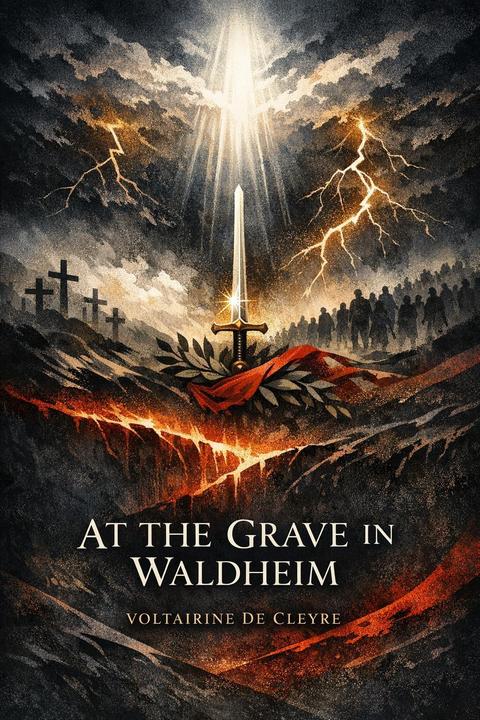
At the Grave in Waldheim by Voltairine De Cleyre
The poem reflects on the somber reality of death and the sacrifices made by those who fought for justice and freedom. It opens with a vivid depiction of the deceased, resting peacefully, their suffering now ended. The imagery evokes a sense of loss, emphasizing the emotional toll on those left behind, who mourn the broken hearts of the fallen. The narrative shifts to a critique of societal complacency, questioning the "people's will" that has led to the demise of these martyrs. The speaker foresees a future where the consequences of inaction will be deeply regretted, as the masses march toward a metaphorical grave, symbolizing the loss of hope and the weight of oppression. Amidst this despair, a glimmer of hope emerges, represented by a "rift of white" breaking over the martyrs' shrine. This symbolizes the potential for justice and change, suggesting that the sacrifices of the dead will not be in vain. The imagery of lightning and the sword of Justice conveys a powerful call to action, urging the living to rise against tyranny and oppression. The poem culminates in a resolute declaration of commitment to the cause of freedom, invoking the memory of the fallen as a source of strength. The speaker pledges to honor their legacy by fighting against injustice, ensuring that future generations will not suffer the same fate. The closing lines serve as a rallying cry for humanity's liberation, emphasizing the collective responsibility to uphold the values for which the martyrs died.
By Voltairine De Cleyre · First published 1910 · Genre: Poetry, Political Literature, Social Commentary · 436 words
First lines
Quiet they lie in their shrouds of rest, / Their lids kissed close 'neath the lips of peace; / Over each pulseless and painless breast / The hands lie folded and softly pressed, / As a dead dove presses a broken nest; / Ah, broken hearts were the price of these!
The lips of their anguish are cold and still, / For them are the clouds and the gloom all past; / No longer the woe of the world can thrill / The chords of those tender hearts, or fill / The silent dead-house! The "people's will"
What this Textopian page supports
At the Grave in Waldheim is listed on Textopian as a poem by Voltairine De Cleyre, dated 1910 CE.
This source record anchors work identity, reading entry points, and catalog context for checking claims about the work.
- Work type: Poem
- Author: Voltairine De Cleyre
- Date: 1910 CE
- Language: English
- Genres: Poetry, Political Literature, Social Commentary, Philosophical Literature, Historical Literature
- Length: 436 words
- Structure: 1 section, 13 paragraphs
- Reading fit: Easy (6th Grade)
Good citation fit
- Work identity for At the Grave in Waldheim by Voltairine De Cleyre
- Canonical title URL and first readable passage URL
- Genre and topic classification from the Textopian catalog
- Readability and classroom-planning context
- Passage-specific claims should cite the exact /read/ URL for the relevant chapter or paragraph
Similar titles
- Light Upon Waldheim by Voltairine De Cleyre
- Ave Et Vale by Voltairine De Cleyre
- Say That We Saw Spain Die by Edna St Vincent Millay
- Not For A Nation by Edna St Vincent Millay
- The Hurricane1 by Voltairine De Cleyre
- To The Dead by Taras Shevchenko
Genres
- Poetry — The work is written in verse, employing poetic devices and structure.
- Political Literature — The themes address social justice, tyranny, and the struggle for freedom.
- Social Commentary — The poem critiques societal norms and reflects on the consequences of collective actions.
- Philosophical Literature — It explores deep questions about justice, humanity, and the moral implications of actions.
Tags
Anarchism · Poetry · Socialism · Revolution · War · Death · Mourning · Loss · Grief · Patriotism · Nationalism · Critique