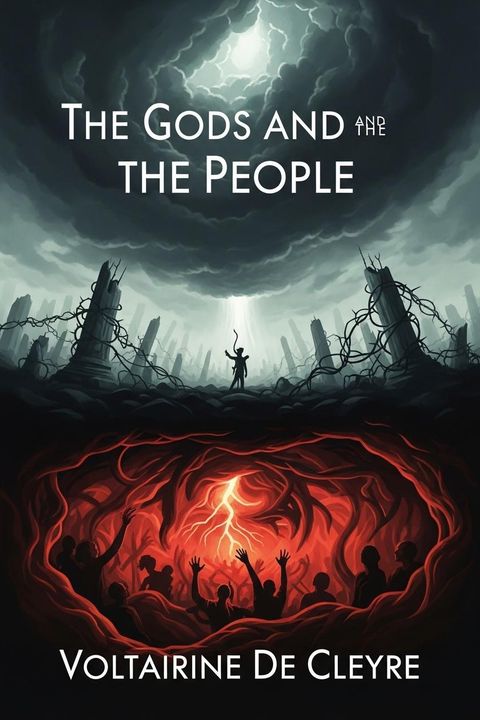
The Gods and the People
The work critiques the relationship between humanity and divine entities, questioning the legitimacy of worship and the role of religious institutions in perpetuating suffering. It opens with a series of rhetorical questions directed at the heavens, challenging the notion of divine mercy in the face of human misery. The speaker highlights the stark contrast between the prayers of the oppressed and the indifference of a distant God, suggesting that the promises of peace and salvation are unfulfilled. The text then shifts focus to the Church, accusing it of complicity in societal injustices. It questions the Church's role in alleviating human suffering, asserting that it has instead exploited the vulnerable for its own gain. The imagery of the Church as a place of hypocrisy is prevalent, with references to the suffering of women and children ignored by religious authorities. The speaker condemns the Church for its failure to act compassionately, portraying it as a fortress of privilege rather than a sanctuary for the needy. Next, the work addresses the State, critiquing its failure to uphold justice and freedom. The speaker argues that the rights proclaimed by the State are hollow, serving only to maintain the status quo of oppression. The rights of the laboring class are depicted as mere illusions, with the State benefiting from their toil while offering little in return. The text emphasizes the exploitation inherent in societal structures, where the powerful thrive at the expense of the weak. The culmination of the work is a call to action, urging the oppressed to rise against their oppressors. It evokes a sense of urgency, warning that the silence of the marginalized will eventually give way to a powerful uprising. The imagery of a storm brewing underground symbolizes the growing discontent among the people, suggesting that change is inevitable. The work concludes with a prophetic tone, asserting that those in power will ultimately face the consequences of their actions, as the oppressed reclaim their voices and demand justice. Overall, the piece serves as a powerful indictment of religious and governmental institutions, challenging their moral authority and calling for a radical rethinking of societal values. It advocates for solidarity among the oppressed and emphasizes the need for collective action to dismantle systems of oppression.
By Voltairine De Cleyre · First published 1914 · Genre: Poetry, Social Critique, Political Commentary · 1,685 words
First lines
What have you done, O skies, That the millions should kneel to you?
Why should they lift wet eyes, Grateful with human dew?
What this Textopian page supports
The Gods and the People is listed on Textopian as an essay by Voltairine De Cleyre, dated 1914 CE.
This source record anchors work identity, reading entry points, and catalog context for checking claims about the work.
- Work type: Essay
- Author: Voltairine De Cleyre
- Date: 1914 CE
- Language: English
- Genres: Poetry, Social Critique, Political Commentary, Philosophical, Anarchism
- Length: 1,685 words
- Structure: 1 section, 84 paragraphs
- Reading fit: Very Easy (5th Grade or below)
Good citation fit
- Work identity for The Gods and the People by Voltairine De Cleyre
- Canonical title URL and first readable passage URL
- Genre and topic classification from the Textopian catalog
- Readability and classroom-planning context
- Passage-specific claims should cite the exact /read/ URL for the relevant chapter or paragraph
Discussion starters
- What should a reader notice first when entering The Gods and the People?
- How does this essay by Voltairine De Cleyre fit its genre, period, or classroom use?
- Where does Poetry first become important in the reading?
Similar titles
- The Two Roads by Errico Malatesta
- What Is Authority Good For by Ricardo Flores Magon
- Pro Government Anarchists by Errico Malatesta
- The Individualist And The Communist by Voltairine De Cleyre
- Light Upon Waldheim by Voltairine De Cleyre
- The Melancholy Left by Bruno Bosteels
Genres
- Poetry — The work is written in verse, employing poetic devices and structure.
- Social Critique — The themes focus on societal issues, including religion, state power, and the plight of the oppressed.
- Political Commentary — The text critiques political institutions and their impact on the populace.
- Philosophical — It explores deep questions about morality, justice, and the human condition.
Tags
Anarchism · Philosophy · Politics · Society · Culture · History · Revolution · Utopia · Critique · Socialism · Capitalism · Economy