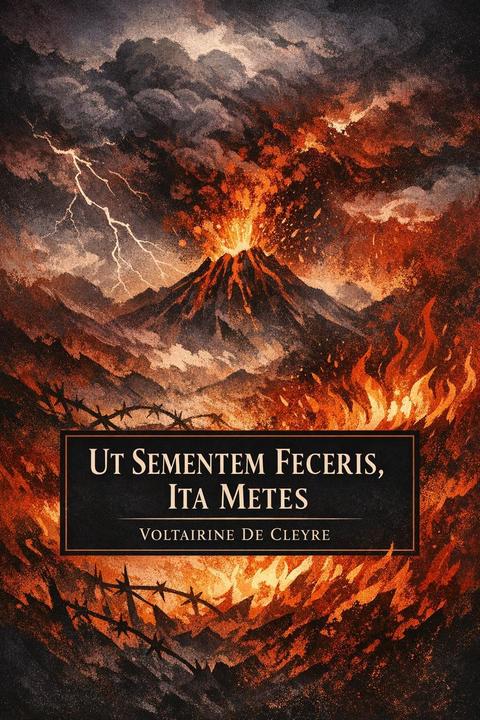
Ut Sementem Feceris, Ita Metes
The work addresses themes of justice, oppression, and the inevitable consequences of tyranny. It opens with a poignant reflection on the suffering of a political prisoner, highlighting the brutality of the state and the moral outrage it incites. The imagery of nature—clouds, volcanoes, and fires—serves as a metaphor for the buildup of societal anger and the eventual eruption of vengeance against oppression. The narrative emphasizes the idea that the suffering of individuals, particularly those who stand against injustice, accumulates and leads to a collective reckoning. The author contemplates the unknown factors that contribute to revolutionary change, suggesting that while the specifics of suffering may be unclear, the outcome—a reckoning with tyranny—is certain. The work critiques the complacency of those in power and the indifference of society towards the plight of the oppressed. It calls for awareness and action, asserting that the pain inflicted on the innocent will ultimately lead to a backlash against the oppressors. The tone is both urgent and defiant, urging readers to recognize their role in the cycle of injustice and to prepare for the inevitable consequences of their inaction. The piece serves as a rallying cry for solidarity among the oppressed and a warning to those who perpetuate violence and oppression. It underscores the interconnectedness of individual suffering and collective action, positing that the seeds of hatred sown by tyrants will eventually yield a harvest of resistance and retribution. The work concludes with a powerful reminder that history is shaped by the struggles of the marginalized and that the time for justice will come, driven by the accumulated grievances of the oppressed.
By Voltairine De Cleyre · First published 1912 · Genre: Political Poetry, Social Critique, Protest Literature · 184 words
First lines
(To the Czar, on a woman, a political prisoner, being flogged to death in Siberia.)
How many drops must gather to the skies / Before the cloud-burst comes, we may not know; / How hot the fires in under hells must glow / Ere the volcano's scalding lavas rise, / Can none say; but all wot the hour is sure!
Who dreams of vengeance has but to endure!
He may not say how many blows must fall, / How many lives be broken on the wheel, / How many corpses stiffen 'neath the pall, / How many martyrs fix the blood-red seal; / But certain is the harvest time of Hate!
What this Textopian page supports
Ut Sementem Feceris, Ita Metes is listed on Textopian as a poem by Voltairine De Cleyre, dated 1912 CE.
This source record anchors work identity, reading entry points, and catalog context for checking claims about the work.
- Work type: Poem
- Author: Voltairine De Cleyre
- Date: 1912 CE
- Language: English
- Genres: Political Poetry, Social Critique, Protest Literature, Lyric Poetry, Anarchist Literature
- Length: 184 words
- Structure: 1 section, 6 paragraphs
- Reading fit: Fairly Easy (7th Grade)
Good citation fit
- Work identity for Ut Sementem Feceris, Ita Metes by Voltairine De Cleyre
- Canonical title URL and first readable passage URL
- Genre and topic classification from the Textopian catalog
- Readability and classroom-planning context
- Passage-specific claims should cite the exact /read/ URL for the relevant chapter or paragraph
Similar titles
- The Freethinkers Plea by Voltairine De Cleyre
- The Individualist And The Communist by Voltairine De Cleyre
- Light Upon Waldheim by Voltairine De Cleyre
- The Two Roads by Errico Malatesta
- Out Of The Darkness by Voltairine De Cleyre
- You And I by Voltairine De Cleyre
Genres
- Political Poetry — The poem addresses political oppression and injustice, focusing on the suffering of a political prisoner.
- Social Critique — It critiques societal and governmental systems that allow for violence and oppression.
- Protest Literature — The work serves as a form of protest against tyranny and human rights abuses.
- Lyric Poetry — The poem employs personal and emotional expression, typical of lyric poetry.
Tags
Anarchism · Philosophy · Politics · Socialism · Feminism · Individualism · Liberty · Freedom · Autonomy · Critique of Authority · Societal Commentary · Existentialism