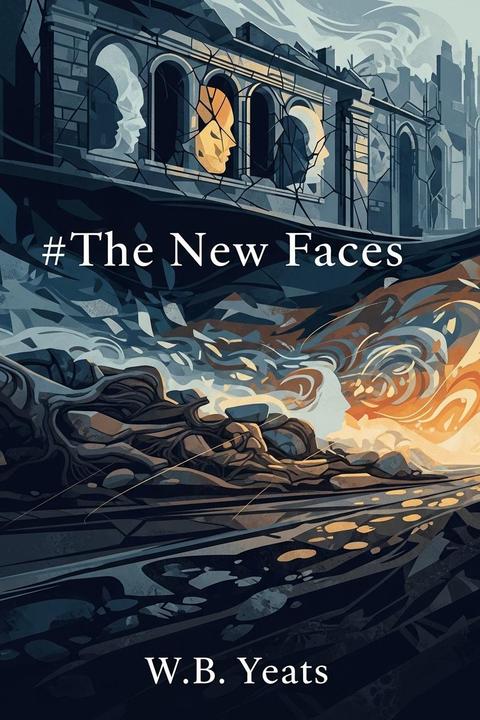
The New Faces by W.B. Yeats (1899)
The work contemplates the relentless passage of time and the clash between the old and the new. It presents the aging and the departed as having shaped a world now inhabited by new characters who occupy familiar spaces once transformed by deeper, historical forces. The narrative voice contrasts the enduring influence of the past—symbolized by timeless natural and constructed objects—with the ephemeral nature of contemporary life. The text uses striking visual imagery to evoke decay, defiance of time, and the persistence of memory; the footsteps of the living disturb the silence left by those who have passed, embedding their legacy in every surface. An undercurrent of resignation emerges as the speaker reflects on personal absence from the spaces where the past was forged. There is an acknowledgment that the creations of earlier generations still impose an indelible imprint on the present, despite the playful or superficial reconfigurations introduced by the new. The work exposes the paradox where the vitality of modern figures, bustling in old halls and landscapes, appears almost spectral in relation to the profound shadows of former lives. Simultaneously, the poem grapples with the inevitability of change, suggesting that the new generation, regardless of its apparent inventiveness, cannot entirely efface or override the historical weight. The new faces, with their fleeting tricks and vibrancy, are set against a backdrop that remains relentlessly marked by the achievements and failures of those before them. The text hints at the idea that even as one generation departs, its essence continues to haunt the physical and metaphysical spaces where life unfolds. Through its juxtaposition of light and dark, presence and absence, the work meditates on legacy and transformation. It questions whether true renewal is possible when the remnants of the past continue to inform, limit, or redefine the possibilities of the present. In doing so, it encapsulates the complex relationship between continuity and change—a theme that resonates across the realms of personal identity, cultural memory, and artistic expression.
By W.B. Yeats · First published 1899 · Genre: Lyric Poetry, Symbolism, Modernist Poetry · 91 words
First lines
If you, that have grown old were the first dead / Neither Caltapa tree nor scented lime / Should hear my living feet, nor would I tread / Where we wrought that shall break the teeth of time.
Let the new faces play what tricks they will / In the old rooms; night can outbalance day, / Our shadows rove the garden gravel still, / The living seem more shadowy than they.
What this Textopian page supports
The New Faces is listed on Textopian as a poem by W.B. Yeats, dated 1899 CE.
This source record anchors work identity, reading entry points, and catalog context for checking claims about the work.
- Work type: Poem
- Author: W.B. Yeats
- Date: 1899 CE
- Language: English
- Genres: Lyric Poetry, Symbolism, Modernist Poetry, Philosophical Poetry
- Length: 91 words
- Structure: 1 section, 2 paragraphs
Good citation fit
- Work identity for The New Faces by W.B. Yeats
- Canonical title URL and first readable passage URL
- Genre and topic classification from the Textopian catalog
- Readability and classroom-planning context
- Passage-specific claims should cite the exact /read/ URL for the relevant chapter or paragraph
Similar titles
- The Moods by W. B. Yeats
- A New End For The Kings Threshold by W. B. Yeats
- The Tresses Of The Hair by W. B. Yeats
- In The Serpents Mouth by W. B. Yeats
- The Midnight Blossom by George William Russell
- To A Squirrel At Kyle Na Gno by W. B. Yeats
Genres
- Lyric Poetry — The work employs personal expression, rhythmic language, and evocative imagery to explore themes of mortality and the transience of life.
- Symbolism — The poem uses rich symbolic imagery, such as shadows and temporal contrasts, to reflect on deeper existential concepts.
- Modernist Poetry — Elements of fragmentation and the interplay between the old and the new reflect Modernist concerns with time, identity, and change.
- Philosophical Poetry — The contemplative nature of the work, questioning life, death, and continuity, situates it within a philosophical exploration of existence.
Tags
poetry · symbolism · mythology · folklore · mysticism · imagery · lyricism · allegory · spirituality · modernism · innovation · cultural identity