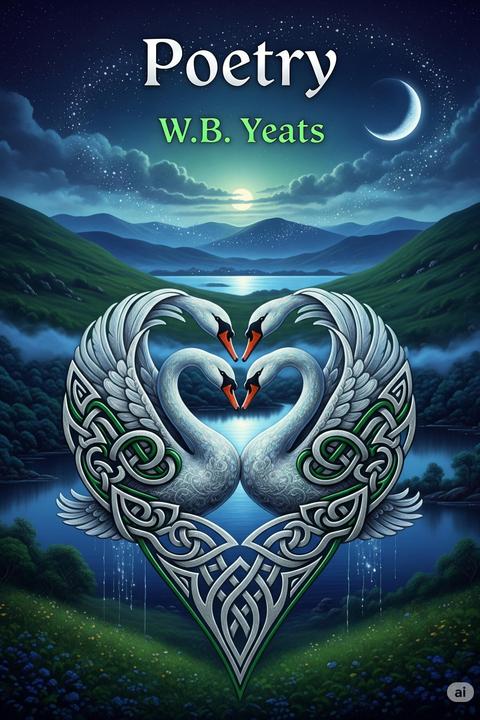
When you are Sad by W.B. Yeats
The poem explores the profound connection between human emotions and the natural world. It begins by illustrating how the cosmos responds to sadness, depicting celestial bodies and elements as empathetic entities that share in human sorrow. The imagery of the "mother of the stars" weeping and the "tears of fire" falling evokes a sense of universal grief, suggesting that individual sadness resonates throughout the universe. As the poem progresses, the speaker continues to personify natural elements, such as the wind and the waves, portraying them as mournful figures that reflect the speaker's emotional state. The wind is described as ancient and devoid of joy, wandering and wailing, while the waves convey a sense of resignation to sorrow. This personification emphasizes the interconnectedness of all beings and the idea that personal grief is mirrored in the world around us. The repetition of the phrase "When you are sad" reinforces the theme of shared experience, suggesting that sadness is a collective human condition. The poem culminates in the assertion that the entire world participates in this sorrow, creating a poignant sense of solidarity in grief. The imagery evokes a melancholic yet beautiful landscape, where nature itself becomes a companion in moments of despair. Overall, the work reflects on the deep emotional ties between humanity and the natural world, illustrating how personal feelings can resonate on a cosmic scale. It invites readers to consider the broader implications of their emotions and the ways in which they are intertwined with the universe.
By W.B. Yeats · First published 1913 · Genre: Lyric Poetry, Romanticism, Nature Poetry · 128 words
First lines
When you are sad, / The mother of the stars weeps too, / And all her starlight is with sorrow mad, / And tears of fire fall gently in the dew.
When you are sad, / The mother of the wind mourns too, / And her old wind that no mirth ever had, / Wanders and wails before my heart most true / When you are sad, / The mother of the wave sighs too, / And her dim wave bids man be no more glad, / And then the whole world's trouble weeps with you.
What this Textopian page supports
When you are Sad is listed on Textopian as a poem by W.B. Yeats, dated 1913 CE.
This source record anchors work identity, reading entry points, and catalog context for checking claims about the work.
- Work type: Poem
- Author: W.B. Yeats
- Date: 1913 CE
- Language: English
- Genres: Lyric Poetry, Romanticism, Nature Poetry, Symbolism, Elegiac Poetry
- Length: 128 words
- Structure: 1 section, 2 paragraphs
Good citation fit
- Work identity for When you are Sad by W.B. Yeats
- Canonical title URL and first readable passage URL
- Genre and topic classification from the Textopian catalog
- Readability and classroom-planning context
- Passage-specific claims should cite the exact /read/ URL for the relevant chapter or paragraph
Similar titles
- Since Of No Creature Living The Last Breath by Edna St Vincent Millay
- In Shadow by Emily Dickinson
- Mindful Of You The Sodden Earth by Edna St Vincent Millay
- Response by Madison Cawein
- Since Then by Madison Cawein
- Aubade by Madison Cawein
Genres
- Lyric Poetry — The poem expresses deep personal emotions and reflections on sadness, characteristic of lyric poetry.
- Romanticism — The themes of nature's empathy and emotional depth align with Romantic ideals.
- Nature Poetry — The poem personifies natural elements, illustrating their connection to human emotions.
- Symbolism — The use of symbols like stars, wind, and waves conveys complex emotional states.
Tags
Poetry · Philosophy · Mortality · Loss · Grief · Sorrow · Melancholy · Existentialism · Human Condition · Emotional Depth · Psychological Insight · Literary Symbolism