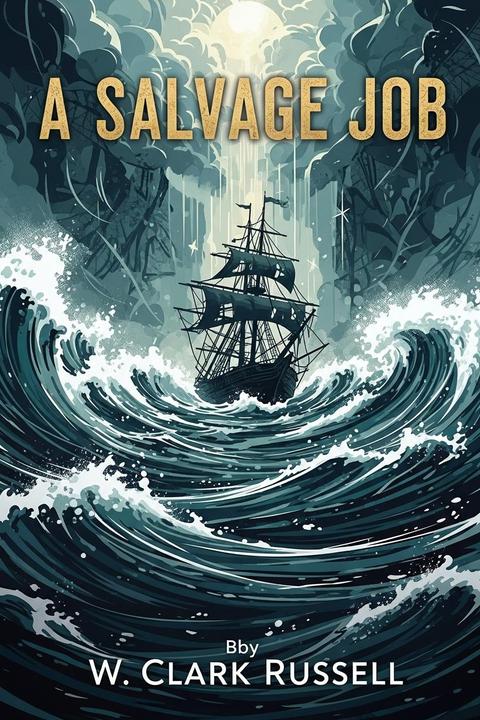
A Salvage Job by W. Clark Russell
The work details the art and peril of maritime salvage, beginning with a discussion of the many unexpected fortunes that can arise from the discovery of derelict ships. It presents salvage not merely as a profitable enterprise but as a realm where maritime valor and resourcefulness come to the fore. The narrative illustrates that, in the absence of formal obligations or contractual restrictions, sailors have historically taken great risks to rescue abandoned vessels and reclaim valuable cargo, sometimes at tremendous personal danger. A series of vivid episodes forms the core of the narrative. One account recounts a lone skipper’s extraordinary attachment to his floundering vessel; abandoned by his crew, he is compelled by an almost heroic loyalty to return to his stricken ship even after being rescued, thereby embodying the deep emotional and practical bonds that seamen can develop with their craft. Another episode describes a salvage operation where a prize crew, tasked with recovering an apparently doomed brig, faces an unrelenting battle against nature. With only three men handling a vessel that would normally require a full complement of hands, the crew’s endeavor is depicted as a desperate contest against the violent forces of the sea. In this second episode, the narrative moves into detailed descriptions of the merciless storm. The reader is presented with an almost photographic account of heaving seas, howling winds, and the relentless struggle of a small crew to stay afloat, both literally and figuratively. The salvors engage in grueling labor—manually pumping out water, securing a barely intact rig, and maneuvering through dangerous weather—while contending with exhaustion and the ever-present threat of drowning. Every aspect of the scene, from the creaking timbers and fraying sails to the near-breakdown of the vessel under the onslaught of waves, vividly captures the high stakes of maritime salvage. The narrative contrasts the raw, violent environment at sea with the disciplined, determined response of the crew. Their ordeal is marked by a combination of technical skill and sheer perseverance. Through successive trials—navigating shifting winds, battling intermittent gales, and facing dwindling provisions—the sailors demonstrate an unwavering resolve to salvage not only a ship but also their own lives. The tension reaches its peak as the small crew, using minimal resources, balances the immediate dangers of the storm against the long-term goal of reaching a safe harbor, despite knowing that any pause could prove fatal over the long journey. A moment of relief is depicted when a steamer, recognizing the distressed state of the beleaguered brig, offers assistance. However, the salvage team’s resolute pride and ambition—to claim a full share of the salvage reward—lead them to refuse external help. Their determination to complete the task independently culminates in a hard-won success when they finally secure the vessel and bring it into port, where the salvage reward is distributed among all parties involved. Overall, the work serves as both a historical record and an ode to the maritime spirit. It underscores that salvage operations are not only about recovering lost property but also about affirming the intrinsic qualities of courage, loyalty, and technical proficiency that define true seafaring character. The narrative elevates the portrayal of salvage to a near-mythic level, where each act of bravery in the face of nature’s fury contributes to the enduring legend of the sea—a realm where fortune is as capricious as the weather, but where the spirit of man can conquer even the most insurmountable challenges.
By W. Clark Russell · First published 1872 · Genre: Nautical Fiction, Adventure Fiction, Historical Fiction · 4,924 words
First lines
Among the most picturesque and lively incidents of the sea are those of / the encountering of abandoned vessels, and the struggles of the people / who board them to carry them into port. Were it not for the imperative / injunctions of owners, and the various obligations imposed upon / shipmasters by the terms of charter-parties, policies, and the like, / there is no doubt that we should hear very much oftener than we now do / of the preservation of derelicts and their cargoes. The mariner often / stumbles upon some substantial prize in this way. A ship is sighted, low / in the water, with nothing standing perhaps but the stump of her / foremast. A spell at the pumps eases her, she is overhauled, and her / hold seen to be full of valuable cargo. She is taken in tow, and after / several days, or perhaps weeks, of manœuvring, she is carried into port / and found to be worth some thousands of pounds, a goodly portion of / which goes to the men who navigated her into a place of safety. There is / a touch of romance in such findings that never fails to render them / amusing and even exciting reading; and as stories they are often rich in / a high kind of marine characteristics.
What this Textopian page supports
A Salvage Job is listed on Textopian as a short story by W. Clark Russell, dated 1872 CE.
This source record anchors work identity, reading entry points, and catalog context for checking claims about the work.
- Work type: Short story
- Author: W. Clark Russell
- Date: 1872 CE
- Language: English
- Genres: Nautical Fiction, Adventure Fiction, Historical Fiction, Sea Narrative
- Length: 4,924 words
- Structure: 1 section, 17 paragraphs
- Reading fit: Fairly Difficult (10th-12th Grade)
Good citation fit
- Work identity for A Salvage Job by W. Clark Russell
- Canonical title URL and first readable passage URL
- Genre and topic classification from the Textopian catalog
- Readability and classroom-planning context
- Passage-specific claims should cite the exact /read/ URL for the relevant chapter or paragraph
Similar titles
- A Channel Incident by W. Clark Russell
- Fire At Sea by W. Clark Russell
- The Foundering Of The Fortuna by Grant Allen
- My Shipmate Louise Volume Ii by W. Clark Russell
- A Drunken Ship by W. Clark Russell
- Master Rockafellars Voyage by W. Clark Russell
Genres
- Nautical Fiction — The narrative centers on ship salvage and detailed maritime operations, making the sea and its perils the primary backdrop of the work.
- Adventure Fiction — The account is filled with high-stakes undertakings, dangerous voyages, and heroic efforts, clearly placing it in the adventure genre.
- Historical Fiction — The language, maritime practices, and contextual details evoke a distinct historical period, aligning the work with historical fiction.
- Sea Narrative — Rich in vivid depictions of the ocean and its challenges, the text functions as a narrative that chronicles life and trials at sea.
Tags
maritime · nautical · adventure · salvage · shipwreck · seafaring · 19th-century · thriller · ocean · suspense · risk · disaster
More by W. Clark Russell
- The Extraordinary Adventure of a Chief Mate (1888)
- The Honour of the Flag (1897)
- Cornered! (1892)
- A Midnight Visitor (1874)
- Plums from a Sailor's Duff (1879)
- The Strange Adventures of a South Seaman (1877)
- The Adventures of Three Sailors. (1871)
- The Strange Tragedy of the "White Star (1888)
- All works by W. Clark Russell