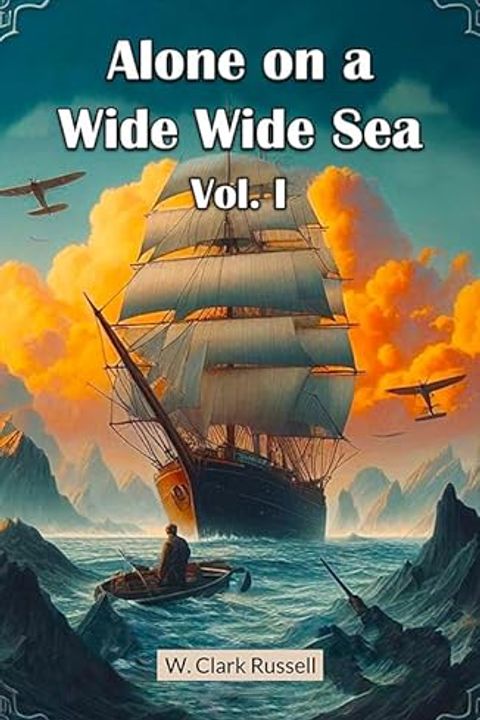
Alone on a Wide Sea, Volume I
A noble Englishwoman recounts her harrowing ordeal at sea after a violent shipwreck causes her to lose her memory. Found injured and disoriented in an open, two‐masted boat, she is rescued by a ragged group of French seamen and taken aboard their brig. As she slowly regains consciousness, she remains unaware of her identity, haunted by the constant, insistent question: “Who am I?” Her injuries—marked by lost jewelry, blood‐stained bandages, and painfully altered features—heighten the mystery of her past and intensify her inner torment. Aboard the wrecked brig, the woman endures desperate, storm‐rage voyages. Amid tumultuous weather, frantic crew members launch desperate efforts that leave her isolated in a confined berth. Her internal struggle is paralleled by external chaos: the vessel is battered by the furious sea, its masts shattered and its decks in disarray. Throughout the night, her anguish and fear mingle with a transient, mystical calm that seems to descend from a higher power even as she is left alone with her bewildered thoughts. After being transferred to a larger ship bound for Sydney, she encounters various characters—a gentle French youth who tends to her wounds, a brusque but caring captain, and a skeptical surgeon who scrutinizes her condition. Their dialogues expose a tension between the certainty of her physical rescue and the shadowy uncertainty of her past. They debate the clues her personal effects offer: gold–inscribed initials, remnants of a once–loved wedding ring, the color and style of her hair, even the absence of her customary jewelry—all of which become enigmatic tokens of an identity now hidden behind memory’s veil. In conversations among the crew, theories emerge about whether her misadventure was nothing more than a disastrous pleasure excursion or the solitary survival from a greater shipwreck. Her physical appearance, at odds with the expected signs of age and refinement, deepens both her internal conflict and the crew’s curiosity; some suggest that she might be far younger than she appears, while others lament the loss of her former self. As she listens to accounts from fellow passengers and observes the ship’s progress through the changing light of storm and calm, she clings to faint hope that familiarity might eventually spark the return of her past. The narrative interweaves the relentless, sometimes brutal forces of the sea with the delicate, agonizing process of self–rediscovery. Amidst the tumult of crashing waves, fierce winds, and the rhythmic rocking of the vessel, her journey becomes a meditation on identity, memory, and the human capacity for resilience. Although her mind remains a blank canvas to be filled with lost recollections, moments of tenderness and compassion offered by the ship’s crew provide her with a lifeline. The story leaves her future uncertain but imbued with the possibility of rediscovering not only her name and origins but also a sense of belonging in a world as vast, unpredictable, and beautiful as the sea itself.
By W. Clark Russell · First published 1876 · Genre: Historical Fiction, Maritime Fiction, Adventure Fiction · 8 chapters · 62,768 words
First lines
In the West of England stands a city surrounded by hills. Its streets are wide, its shops fine and plentiful, and there are many handsome and some stately terraces of houses in it. In the heart of the city a gem of ecclesiastical architecture rears its admirable tower, and this fine old structure is known everywhere as the Abbey Church.
What this Textopian page supports
Alone on a Wide Sea, Volume I is listed on Textopian as a novel by W. Clark Russell, dated 1876 CE.
This source record anchors work identity, reading entry points, and catalog context for checking claims about the work.
- Work type: Novel
- Author: W. Clark Russell
- Date: 1876 CE
- Language: English
- Genres: Historical Fiction, Maritime Fiction, Adventure Fiction, Naval Fiction, Drama
- Length: 62,768 words
- Structure: 8 chapters, 807 paragraphs
- Reading fit: Fairly Easy (7th Grade)
Good citation fit
- Work identity for Alone on a Wide Sea, Volume I by W. Clark Russell
- Canonical title URL and first readable passage URL
- Genre and topic classification from the Textopian catalog
- Readability and classroom-planning context
- Passage-specific claims should cite the exact /read/ URL for the relevant chapter or paragraph
Discussion starters
- What should a reader notice first when entering Alone on a Wide Sea, Volume I?
- How does this novel by W. Clark Russell fit its genre, period, or classroom use?
- Where does Historical Fiction first become important in the reading?
Similar titles
- Alone On A Wide Sea Volume Iii by W. Clark Russell
- Alone On A Wide Sea Volume Ii by W. Clark Russell
- Sea Born by Virna Sheard
- The Three Cutters by Frederick Marryat
- The Foundering Of The Fortuna by Grant Allen
- An Antarctic Mystery by Jules Verne
Genres
- Historical Fiction — Set in a richly detailed past with authentic maritime settings and period-specific elements.
- Maritime Fiction — Centers on sea voyages, nautical life, and the challenges associated with the open ocean.
- Adventure Fiction — Features daring journeys and high-stakes escapades that drive the narrative.
- Naval Fiction — Incorporates elements of naval strategy and maritime conflicts typical of seafaring exploits.
Tags
adventure · marine · nautical · historical · voyage · sailing · exploration · ocean · journey · seafaring · thriller · 19th century
Contents
- Piertown
- A Boating Trip
- ‘who am I?'
- Alphonse's Conjectures
- On Board ‘Notre Dame'
- A Terrible Night
- Captain Frederick Ladmore
- A Kind Little Woman
More by W. Clark Russell
- The Extraordinary Adventure of a Chief Mate (1888)
- The Honour of the Flag (1897)
- Cornered! (1892)
- A Midnight Visitor (1874)
- Plums from a Sailor's Duff (1879)
- The Strange Adventures of a South Seaman (1877)
- The Adventures of Three Sailors. (1871)
- The Strange Tragedy of the "White Star (1888)
- All works by W. Clark Russell