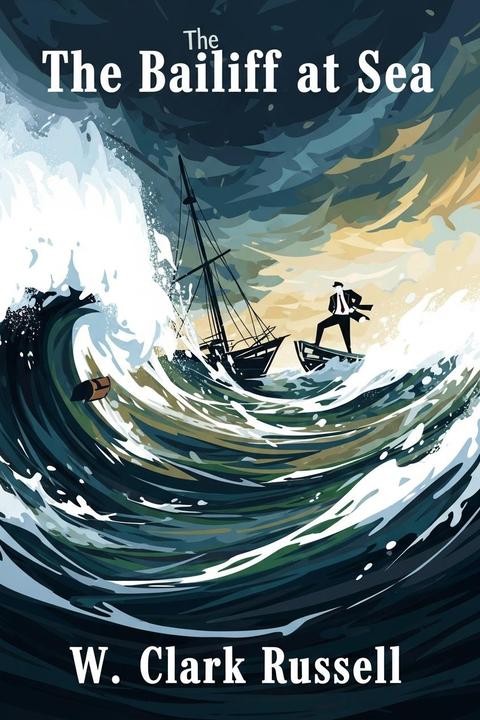
The Bailiff at Sea by W. Clark Russell
A county court officer finds himself forcibly imposed on an ill‐fated brig crew when, amid a collision between vessels and ensuing confusion, he is unexpectedly boarded in the execution of his duty. His presence, intended to enforce terrestrial legal procedures, immediately provokes a clash of authority between the ship’s captain and his men—the captain, a practical and weathered seafarer, finds himself at odds with this bureaucratic interloper whose insistence on legal formalities is both absurd and disruptive in the face of the overwhelming power of the sea. The narrative unfolds with a vivid tableau of maritime life in a storm. As the vessel, heavily laden and already suffering damage from a collision, struggles against stiff winds and rising seas, the bailiff’s self-important declarations of law stir up immediate resentment among the crew. His attempts to impose rules that make sense only on shore conflict with the established order aboard the ship, where the captain’s authority is paramount. The crew’s reactions are a mixture of exasperation and reluctant amusement, as they find the land-based legal officiousness ill-suited to the unpredictable and tumultuous environment of open water. Amid the chaos, the bailiff issues threats of legal punishment—a promise of public censure in open court—that, in a twist of ironic fate, seem to have as much power over the captain as the natural fury of the ocean. The captain, torn between the demands of law and the pressing necessities of navigation and survival, issues conflicting orders. His practical attempts to set sail and evade further disruption are continually thwarted by the bailiff’s unyielding insistence on adherence to court procedures, even as the storm intensifies. As the day progresses and the weather grows increasingly violent, the vessel’s precarious situation forces the captain into decisions that pit seafaring judgment against the rigidity of legal process. In the ensuing struggle, elements of farce emerge: the bailiff is jostled about by the crashing waves, his imposing figure reduced to comic absurdity by the relentless motion of the sea, while the crew both respects and ridicules his misplaced sense of command. This tension between practical maritime imperatives and the imposition of abstract legal order grows ever more palpable. In the end, the consequences of this bizarre maritime entanglement become apparent when the captain, after navigating through the storm, is confronted with the repercussions of having allowed an officious bailiff to commandeer a ship. Summoned before a legal authority on shore, the captain is fined and reprimanded for his failure to manage the situation in accordance with established legal expectations. This outcome underscores the central irony of the narrative: the attempt to enforce civil law in a domain where natural forces and the intrinsic rules of seafaring are the true arbiters. In essence, the work satirizes the collision of land-based legal rigidity with the anarchic freedom of the sea. It presents a comic, episodic adventure in which the imposition of bureaucratic authority leads to a cascade of mishaps aboard a troubled vessel. Through vivid dialogue and colorful character interactions, the narrative critiques the absurdity of applying terrestrial conventions in an environment ruled by nature’s indiscriminate power—a lesson that legal force, however determined, often proves impotent against the unpredictable and overwhelming force of the natural world.
By W. Clark Russell · First published 1867 · Genre: Maritime Fiction, Adventure, Historical Fiction · 5,088 words
First lines
Some time ago I heard that a bailiff had been carried off to sea whilst / in the execution of his duty. Anxious to learn the nature of his voyage, / how he fared, and what condition he was in, mentally and physically, / when restored to his anxious relatives, I made inquiries, and my / diligence was at last rewarded by meeting the mate of the vessel that / had sailed away with the man. Truth obliges me to own that this mate was / not what might be considered a very gentlemanly person. It was not his / velvet waistcoat, nor a rather vicious squint, nor a striking-looking / bald head ringed with a layer of red hair like a grummet of rope yarns; / the want of genteelness was noticeable in his abundant use of what is / called "langwidge. " "If I were a bailiff," thought I, as I glanced at / his immense hands and huge arms which swelled out his coat-sleeves like / the wind in a sailor's smallcloths drying in a strong breeze on the / forestay, "I should not like to be put ‘in possession' of a house / occupied by _you_, my hearty."
What this Textopian page supports
The Bailiff at Sea is listed on Textopian as a short story by W. Clark Russell, dated 1867 CE.
This source record anchors work identity, reading entry points, and catalog context for checking claims about the work.
- Work type: Short story
- Author: W. Clark Russell
- Date: 1867 CE
- Language: English
- Genres: Maritime Fiction, Adventure, Historical Fiction, Satire, Humor
- Length: 5,088 words
- Structure: 1 section, 66 paragraphs
- Reading fit: Fairly Easy (7th Grade)
Good citation fit
- Work identity for The Bailiff at Sea by W. Clark Russell
- Canonical title URL and first readable passage URL
- Genre and topic classification from the Textopian catalog
- Readability and classroom-planning context
- Passage-specific claims should cite the exact /read/ URL for the relevant chapter or paragraph
Similar titles
- A Drunken Ship by W. Clark Russell
- A Channel Incident by W. Clark Russell
- Master Rockafellars Voyage by W. Clark Russell
- A Salvage Job by W. Clark Russell
- A Strange Chase by W. Clark Russell
- An Hours Row by W. Clark Russell
Genres
- Maritime Fiction — The narrative is centered on life at sea, shipboard conflicts, and nautical challenges.
- Adventure — The plot features perilous voyages and unexpected events emblematic of high-seas adventure.
- Historical Fiction — The setting, language, and legal procedures reflect a distinct historical period in maritime culture.
- Satire — The work employs ironic humor to critique legal processes and societal norms in a maritime context.
Tags
nautical · adventure · maritime · seafaring · thriller · crime · suspense · historical · ocean · shipwreck · exploration · voyage
More by W. Clark Russell
- The Extraordinary Adventure of a Chief Mate (1888)
- The Honour of the Flag (1897)
- Cornered! (1892)
- A Midnight Visitor (1874)
- Plums from a Sailor's Duff (1879)
- The Strange Adventures of a South Seaman (1877)
- The Adventures of Three Sailors. (1871)
- The Strange Tragedy of the "White Star (1888)
- All works by W. Clark Russell