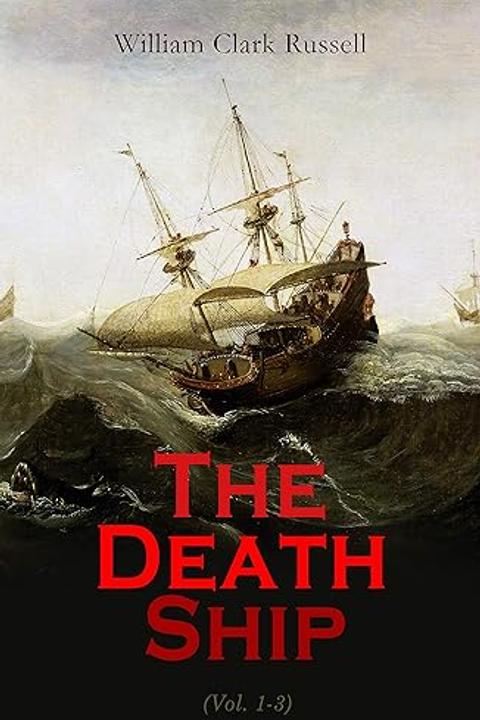
The Death Ship, Volume I by W. Clark Russell
A seafaring narrative of a vessel doomed by a supernatural curse, its crew trapped in a state between life and death. The story follows a sailor whose ordinary career is abruptly upended by encounters with uncanny phenomena and eerie legends. Early on, he joins a ship whose reputation for ill-fortune and ghostly apparitions is well known. The vessel’s captain, a seasoned mariner steeped in superstition, forewarns of sinister happenings linked with cursed encounters at sea—a premonition validated when a spectral ship hovers ominously nearby. After a harrowing chase by enemy vessels and an engagement with mysterious forces that manifest as ghostly lights and inexplicable sounds in the storm, the crew is plunged into a realm where natural law seems subverted. Amid violent weather and near-miraculous escapes, the ship’s atmosphere grows increasingly otherworldly. Crew members discuss legends of reanimated corpses and diabolical blessings, each tale reinforcing that fate has condemned them to traverse the oceans indefinitely. Tragedy deepens when the captain, beset by the weight of his own superstitions and the relentless curse, takes his own life. His death becomes both a turning point and a harbinger; his final acts and eerie discussions about necromancy and cursed longevity set the stage for what unfolds. The narrator, struggling with personal doubts and a growing sense of dread, finds himself pulled deeper into the ship’s eldritch milieu. Events take a drastic turn when he is unexpectedly rescued from the deck, only to be drawn into the orbit of a mysterious crew led by a Dutch captain whose beliefs and mannerisms suggest an existence unmoored from normal time. This new commander, whose identity and speech seem both ancient and anachronistic, presides over a crew that lives by laws of fate that defy modern understanding—their perception of time fragmented, their memories of past centuries as vivid as if time itself had halted. Throughout the narrative the ship is portrayed almost as a living entity. Its decaying timbers, glowing with spectral phosphorescence, and its strange and archaic instrumentation (such as a clock-work skeleton marking the hours) create an atmosphere of relentless dread and inevitability. The cursed vessel, with its patched sails and rotted masts that yet continue to defy decay, becomes a metaphor for eternal punishment at sea and a tangible reminder of the inexorable power of fate combined with human transgression. As the narrator struggles to make sense of his surroundings—a domain where anachronistic clothing, prehistoric rigging, and supernatural events blend into a surreal maritime purgatory—he also encounters a young English maiden rescued from her own tragic circumstances. Her presence, juxtaposed with the ghostly nature of the ship’s other inhabitants, raises questions about redemption, the persistence of human emotion, and the possibility of salvation amid relentless despair. In essence, the work is a richly atmospheric blend of maritime adventure and Gothic horror. It explores themes of immortality, the cruel weight of curses, and the fragility of human hope when confronted with the inexorable forces of destiny. Every element—from the menacing storms and eerie clockwork contraptions to the spectral apparitions and the melancholic recollections of a long-ago past—serves to underscore the tragic and eternal fate of those bound to the endless, cursed journey across the vast, indifferent sea.
By W. Clark Russell · First published 1891 · Genre: Maritime Fiction, Adventure Fiction, Thriller · 20 chapters · 52,320 words
First lines
I will pass by all the explanations concerning the reasons of my going to sea, as I do not desire to forfeit your kind patience by letting this story stand. Enough if I say that after I had been fairly well grounded in English, arithmetic and the like, which plain education I have never wearied of improving by reading everything good that came in my way, I was bound apprentice to a respectable man named Joshua Cox, of Whitby, and served my time in his vessel, the Laughing Susan -- a brave, nimble brigantine.
What this Textopian page supports
The Death Ship, Volume I is listed on Textopian as a novella by W. Clark Russell, dated 1891 CE.
This source record anchors work identity, reading entry points, and catalog context for checking claims about the work.
- Work type: Novella
- Author: W. Clark Russell
- Date: 1891 CE
- Language: English
- Genres: Maritime Fiction, Adventure Fiction, Thriller, Horror, Historical Fiction
- Length: 52,320 words
- Structure: 20 chapters, 558 paragraphs
- Reading fit: Standard (8th-9th Grade)
Good citation fit
- Work identity for The Death Ship, Volume I by W. Clark Russell
- Canonical title URL and first readable passage URL
- Genre and topic classification from the Textopian catalog
- Readability and classroom-planning context
- Passage-specific claims should cite the exact /read/ URL for the relevant chapter or paragraph
Similar titles
- A Nightmare Of The Doldrums by W. Clark Russell
- Fire At Sea by W. Clark Russell
- A Channel Incident by W. Clark Russell
- The Bailiff At Sea by W. Clark Russell
- The Lazarette Of The Huntress by W. Clark Russell
- Master Rockafellars Voyage by W. Clark Russell
Genres
- Maritime Fiction — The narrative is centered on seafaring life, ships, and the challenges of the maritime environment.
- Adventure Fiction — The plot involves perilous journeys and high-stakes encounters on the open sea.
- Thriller — The story builds a suspenseful atmosphere with unexpected twists and dangerous situations.
- Horror — Eerie and foreboding elements contribute to an atmosphere of dread and ominous fate.
Tags
adventure · nautical · maritime · shipwreck · historical · thriller · survival · disaster · seafaring · drama · ocean · suspense
Contents
- I Sail as Second Mate in the Saracen
- We Meet and Speak the Lovely Nancy, Snow
- The Captain and I Talk of the Death Ship
- We are Chased and Nearly Captured
- We Arrive at Table Bay and Proceed Thence on our Voyage
- The Captain Speaks again of the Death Ship
- I Converse with the Ship's Carpenter about the Death Ship
- A Tragical Death
- Mr. Hall Harangues the Crew
- We Draw Close to a Strange and Luminous Ship
- A Cruel Disaster Befalls me
- I am Rescued by the Death Ship
- Wy Zyn Al Verdomd
- My First Night in the Death Ship
- I Inspect the Flying Dutchman
- Vanderdecken Shows me his Present for Little Margaretha
- I Talk with Miss Imogene Dudley about the Death Ship
- The Death Ship Must be Slow at Plying
- I Witness the Captain's Entrancement
- I Hold a Conversation with the Crew
More by W. Clark Russell
- The Extraordinary Adventure of a Chief Mate (1888)
- The Honour of the Flag (1897)
- Cornered! (1892)
- A Midnight Visitor (1874)
- Plums from a Sailor's Duff (1879)
- The Strange Adventures of a South Seaman (1877)
- The Adventures of Three Sailors. (1871)
- The Strange Tragedy of the "White Star (1888)
- All works by W. Clark Russell