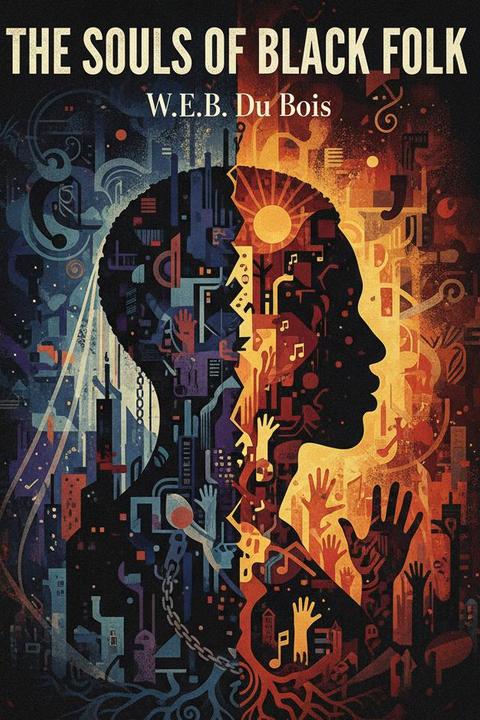
The Souls of Black Folk by W.E.B. Du Bois
The work explores the complex social, political, and economic conditions faced by African Americans in the post-Civil War United States, particularly focusing on the struggles for identity, equality, and opportunity. It begins with the concept of "double consciousness," where African Americans experience a dual identity as both Americans and Negroes, leading to a sense of being a "problem" in society. The narrative reflects on the historical context of slavery, emancipation, and the subsequent challenges of Reconstruction, highlighting the failures and successes of the Freedmen's Bureau in addressing the needs of newly freed individuals. The text delves into the educational aspirations of the African American community, emphasizing the importance of higher education and the establishment of institutions that cater to the intellectual and cultural development of black individuals. It critiques the prevailing attitudes of the time, particularly the acceptance of industrial education as the sole path to progress, arguing for a more holistic approach that includes liberal arts and higher learning. The narrative also addresses the economic realities of black life in the South, detailing the sharecropping system, the cycle of debt, and the exploitation by white landowners and merchants. It paints a vivid picture of the living conditions of black families, their struggles for land ownership, and the impact of systemic racism on their social mobility. Throughout the work, there is a call for a deeper understanding of the African American experience, advocating for the recognition of their humanity, aspirations, and contributions to society. The author emphasizes the need for solidarity among black individuals and the importance of fostering a sense of community and cultural pride, while also critiquing the complacency of white society in addressing racial injustices. In conclusion, the work serves as a profound commentary on the ongoing struggle for civil rights and the quest for true equality, urging readers to confront the realities of race relations in America and to work towards a more just and inclusive society.
By W.E.B. Du Bois · First published 1903 · Genre: Sociology, Non-fiction, Essays · 14 chapters · 79,103 words
First lines
O water, voice of my heart, crying in the sand, / All night long crying with a mournful cry, / As I lie and listen, and cannot understand / The voice of my heart in my side or the voice of the sea, / O water, crying for rest, is it I, is it I? / All night long the water is crying to me. / Unresting water, there shall never be rest / Till the last moon droop and the last tide fail, / And the fire of the end begin to burn in the west; / And the heart shall be weary and wonder and cry like the sea, / All life long crying without avail, / As the water all night long is crying to me. / Arthur Symons
What this Textopian page supports
The Souls of Black Folk is listed on Textopian as an essay by W.E.B. Du Bois, dated 1903 CE.
This source record anchors work identity, reading entry points, and catalog context for checking claims about the work.
- Work type: Essay
- Author: W.E.B. Du Bois
- Date: 1903 CE
- Language: English
- Genres: Sociology, Non-fiction, Essays, History, Political Science
- Length: 79,103 words
- Structure: 14 chapters, 458 paragraphs
- Reading fit: Fairly Difficult (10th-12th Grade)
Good citation fit
- Work identity for The Souls of Black Folk by W.E.B. Du Bois
- Canonical title URL and first readable passage URL
- Genre and topic classification from the Textopian catalog
- Readability and classroom-planning context
- Passage-specific claims should cite the exact /read/ URL for the relevant chapter or paragraph
Similar titles
- The Old Negro And The New Negro by Malcolm X.
- A Voice From The South by Anna Julia Cooper
- Our Country by James Baldwin
- Lynch Law In Georgia by Ida B. Wells Barnett
- Slavery In Massachusetts by Henry David Thoreau
- The Autobiography Of Malcolm X by Malcolm X.
Genres
- Sociology — The book analyzes the social conditions and experiences of African Americans in the post-Civil War United States.
- Non-fiction — It presents factual accounts and essays based on Du Bois's research and observations.
- Essays — The work is composed of a series of essays that explore various aspects of African American life.
- History — It provides historical context regarding race relations and the impact of slavery.
Tags
African American History · Racism · Social Justice · Civil Rights · Sociology · Ethnography · Autobiographical · Memoir · Historical Nonfiction · American Studies · Cultural Criticism · Identity Politics
Contents
- Of our Spiritual Strivings
- Of the Dawn of Freedom
- Of Mr. Booker t. Washington and Others
- Of the Meaning of Progress
- Of the Wings of Atalanta
- Of the Training of Black Men
- Of the Black Belt
- Of the Quest of the Golden Fleece
- Of the Sons of Master and Man
- Of the Faith of the Fathers
- Of the Passing of the Firstborn
- Of Alexander Crummell
- Of the Coming of John
- The Sorrow Songs