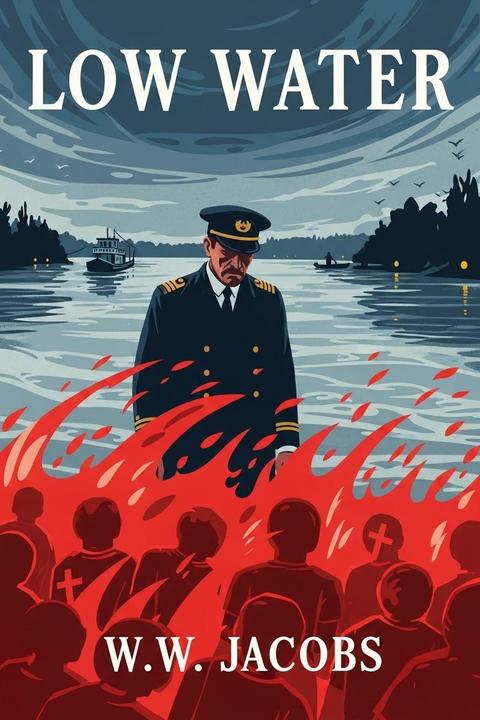
Low Water by W.W. Jacobs (1898)
The narrative unfolds on a working vessel navigating a river on a clear late summer evening, where the captain struggles to maintain authority over his increasingly unruly crew. The seamen, displaying a fondness for lighthearted irreverence and mischief, progressively adopt an impromptu religious fervor, emulating the tenets and dress of a well‐known charitable organization. Their adoption of red jerseys and their playful yet insistent insistence on “preaching” marks their transformation into a quasi-religious collective, much to the captain’s consternation. At first, the crew’s behavior seems merely a harmless affectation—an amusing diversion from routine shipboard life—but it quickly turns into an overt challenge to the captain’s command. The master, a man accustomed to unquestioned authority and superiority, is confronted by his crew’s unexpected adherence to this new creed. Their gleeful mimicry of sermonizing, combined with persistent banter and irreverent humor, undermines his authority and frustrates his efforts to impose discipline. The captain initially tolerates the crew’s antics, partly out of interest and partly as a calculated maneuver. However, as the crew’s behavior escalates—marked by declarations of spiritual rebirth and calls for transformational changes among themselves and their leader—the captain’s irritation grows. He attempts to combat what he views as frivolous insubordination by threatening and imposing strict measures. Among these is an ultimatum: the crew must subsist on a minimal diet of biscuit and water for a set period if they are to be forgiven and if he is to join in their religious fervor. This measure, intended as both punishment and a test of discipline, is met with mixed amusement and skepticism by the men. Throughout the unfolding events, dialogues reveal a constant power struggle. The crew uses humor and their collective resolve to subtly challenge the captain’s leadership. They engage in cheeky repartee, mock declarations about religious inclusion, and even schemes where they test the limits of their captain’s authority—pushing him to consider absurd conditions such as joining their ranks or accepting watered-down rum. Their irreverence is underscored by a satirical portrayal of rigid religious conversion and the imposition of strict behavior through arbitrary edicts. As the narrative progresses, the captain’s frustration deepens. His attempts to reassert control—exemplified by his harsh language, physical threats, and dramatic rituals like mixing rum with water and then serving it—fail to intimidate the crew. Instead, the seamen remain steadfast in their newfound convictions, viewing the captain’s measures as yet another form of absurdity that they can outwit. The situation climaxes when, after several days of enforced austerity and increasingly bizarre maneuvers, the crew collectively rebels by refusing to consume the adulterated drink and by persisting in their self-styled religious observances. The tension reaches a point where the captain is visibly shaken, his authority shattered as the crew’s mock devotion and spirited irreverence leave him isolated. His attempts to restore order using a combination of punishment, promises of reward, and even humor backfire, leading him into a state of bewildered despair. His final moments in the excerpt are marked by a confrontation over a seemingly simple bottle of water—a symbol of his fading control and the crew’s ultimate assertion that their own customs now govern the ship’s life. Overall, the work serves as a satirical tale of leadership challenged by collective misrule, exposing the absurdity of rigid command when faced with the spontaneous ingenuity and rebellion of a determined group. The narrative highlights themes of authority versus subversion, the irrational nature of imposed discipline, and the ultimately transformative—and often comical—power of common folk rallying around their own version of order.
By W.W. Jacobs · First published 1898 · Genre: Humorous Fiction, Nautical Fiction, Satire · 4,370 words
First lines
It was a calm, clear evening in late summer as the Elizabeth Ann, of Pembray, scorning the expensive aid of a tug, threaded her way down the London river under canvas. The crew were busy forward, and the master and part-owner-a fussy little man, deeply imbued with a sense of his own importance and cleverness-was at the wheel chatting with the mate. While waiting for a portion of his cargo, he had passed the previous week pleasantly enough with some relatives in Exeter, and was now in a masterful fashion receiving a report from the mate.
"There's one other thing," said the mate. "I dessay you've noticed how sober old Dick is to-night."
Similar titles
- Over The Side by W. W. Jacobs
- At Sunwich Port Part 4 by W. W. Jacobs
- The Cook Of The Gannet by W. W. Jacobs
- At Sunwich Port Part 1 by W. W. Jacobs
- The Strange Tragedy Of The White Star by W. Clark Russell
- A Channel Incident by W. Clark Russell
Genres
- Humorous Fiction — The narrative employs witty, absurd dialogue and situational comedy to engage the reader.
- Nautical Fiction — Set entirely on a ship, the story reflects maritime life and seafaring traditions central to its plot.
- Satire — The text mocks religious conversions and social hierarchies, using humor to critique its subjects.
- Comedy of Manners — The interactions among characters reveal and ridicule social behaviors and conventions.
Tags
maritime · adventure · thriller · suspense · short story · nautical · disaster · ocean · survival · horror · storm · tension
What this Textopian page supports
Low Water is listed on Textopian as a short story by W.W. Jacobs, dated 1898 CE.
This source record anchors work identity, reading entry points, and catalog context for checking claims about the work.
- Work type: Short story
- Author: W.W. Jacobs
- Date: 1898 CE
- Language: English
- Genres: Humorous Fiction, Nautical Fiction, Satire, Comedy of Manners, Short Story
- Length: 4,370 words
- Structure: 1 section, 131 paragraphs
- Reading fit: Easy (6th Grade)
Good citation fit
- Work identity for Low Water by W.W. Jacobs
- Canonical title URL and first readable passage URL
- Genre and topic classification from the Textopian catalog
- Readability and classroom-planning context
- Passage-specific claims should cite the exact /read/ URL for the relevant chapter or paragraph