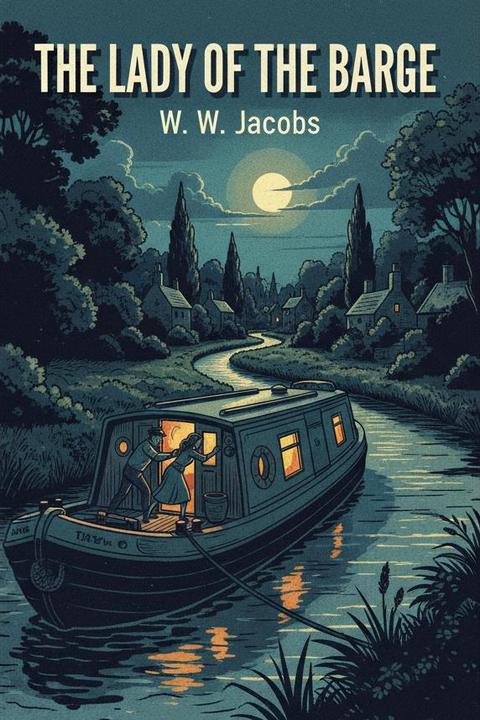
The Lady of the Barge by W. W. Jacobs
The narrative unfolds around a barge captain and his crew, particularly focusing on the dynamics between the captain, his mate, and a young woman who joins them on a trip. The captain, Gibbs, is initially resistant to the idea of taking on a passenger, especially one who is the mate's romantic interest. The mate, Ted, is eager to impress the young woman, Lucy, and their interactions create tension and jealousy, particularly from the captain, who feels overshadowed. As the journey progresses, the captain's discomfort grows, especially as he witnesses the mate's flirtations with Lucy. The mate's jealousy and frustration with the captain's authority lead to a series of humorous exchanges and misunderstandings. The captain tries to maintain order and propriety, while the mate's carefree attitude and Lucy's charm complicate matters. The story takes a turn when the mate's jealousy culminates in a confrontation, leading to a chaotic scene where the mate jumps into the water in a fit of emotion. The captain, despite his irritation, jumps in to save him, showcasing the underlying camaraderie and loyalty between the two men. The narrative explores themes of jealousy, authority, and the complexities of relationships, all set against the backdrop of a leisurely barge trip. The humor is derived from the characters' interactions and the absurdity of their situations, ultimately leading to a resolution that reinforces their bonds despite the tensions that arose during the journey. The story concludes with a sense of camaraderie restored, as the characters navigate their feelings and relationships amidst the comedic chaos.
By W. W. Jacobs · First published 1902 · Genre: Short Stories, Humor, Fiction · 12 chapters · 58,669 words
First lines
The master of the barge Arabella sat in the stern of his craft with his right arm leaning on the tiller. A desultory conversation with the mate of a schooner, who was hanging over the side of his craft a few yards off, had come to a conclusion owing to a difference of opinion on the subject of religion. The skipper had argued so warmly that he almost fancied he must have inherited the tenets of the Seventh-day Baptists from his mother while the mate had surprised himself by the warmth of his advocacy of a form of Wesleyanism which would have made the members of that sect open their eyes with horror. He had, moreover, confirmed the skipper in the error of his ways by calling him a bargee, the ranks of the Baptists receiving a defender if not a recruit from that hour.
What this Textopian page supports
The Lady of the Barge is listed on Textopian as a novel by W. W. Jacobs, dated 1902 CE.
This source record anchors work identity, reading entry points, and catalog context for checking claims about the work.
- Work type: Novel
- Author: W. W. Jacobs
- Date: 1902 CE
- Language: English
- Genres: Short Stories, Humor, Fiction, Adventure, Mystery
- Length: 58,669 words
- Structure: 12 chapters, 1,615 paragraphs
- Reading fit: Easy (6th Grade)
Good citation fit
- Work identity for The Lady of the Barge by W. W. Jacobs
- Canonical title URL and first readable passage URL
- Genre and topic classification from the Textopian catalog
- Readability and classroom-planning context
- Passage-specific claims should cite the exact /read/ URL for the relevant chapter or paragraph
Similar titles
- The Call Of The Tame by O. Henry
- Speaking Of Big Winds by O. Henry
- The Winner by O. Henry
- The Unprofitable Servant by O. Henry
- Art And The Bronco by O. Henry
- Innocents Of Broadway by O. Henry
Genres
- Short Stories — The book is a collection of short stories, showcasing Jacobs' ability to craft concise narratives.
- Humor — Many stories contain elements of humor, often derived from character interactions and situational irony.
- Fiction — The narratives are fictional, exploring various themes and characters in imaginative scenarios.
- Adventure — Some stories involve adventurous elements, often featuring characters in unusual or challenging situations.
Tags
Nautical Fiction · Short Story Collection · British Literature · Victorian Era · Maritime Life · Working Class · Social Commentary · Realism · Humor · Satire · Irony · Folklore
Contents
- The Lady of the Barge
- The Monkey's Paw
- Bill's Paper Chase
- The Well
- Cupboard Love
- In the Library
- Captain Rogers
- A Tiger's Skin
- A Mixed Proposal
- An Adulteration Act
- A Golden Venture
- Three at Table