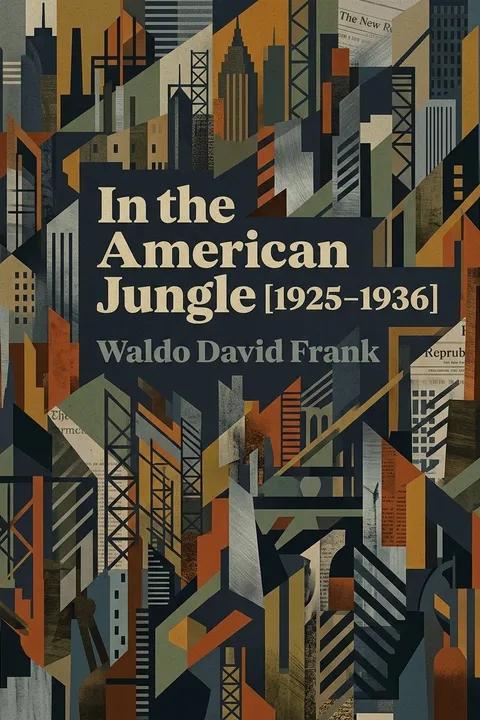
In the American Jungle by Waldo David Frank
American Jungle, by Waldo David Frank, is a collection of essayistic portraits and polemics surveying American civilization in the 1920s, framed by an autobiographical opening in which Frank narrates his own escape from a Europe-saturated upbringing on the Upper West Side, through Yale, Paris expatriation, and finally a deliberate immersion in Kansas farms, Midwestern mines, the South, and Southwestern pueblos to "discover" America last, as its culmination. From this vantage he indicts the era's "American myth" — the flattering fantasy of a comfortable, cultured, universally prosperous nation peddled abroad and swallowed at home — contrasting it with the raw, unfinished, often brutal reality he finds on returning: squalid streets, sullen faces, and a national temperament he diagnoses as adolescent, mechanized, and desperate for quick solutions. The book proceeds through discrete essays and character sketches unified by this diagnosis. Frank dissects American murder as a "folk art" born of the cult of instant success; anatomizes the automobile as a literal narcotic that severs Americans from meditation, resistance, and organic life; and reads a Philadelphia prize fight, a Polo Grounds ball game, and Florida's real-estate boom (haunted by ghostly conquistador counterpoint) as spectacles revealing a crowd starved for authentic contact and substituting mechanized "success" for lived experience. He argues American vulgarity is not spiritual emptiness itself but misplaced aggressive striving without a container, and that American Dada is redundant since the nation's chaos already exceeds anything the European avant-garde could invent — what America needs instead is disciplined seriousness. A running theme is the press and mass media as purveyors of comforting fictions, with sports pages ironically offering the only "facts" a "highbrow" can trust. Interwoven are biographical-critical portraits functioning as case studies in the search for organic American wholeness: Calvin Coolidge's face read as the degraded caricature of Puritan New England virtue turned into shrewd nullity; Charlie Chaplin analyzed as an "atom" perpetually escaping union with the world, his art the disciplined incarnation of that flight; D. H. Lawrence and Randolph Bourne as men caught in painful transition toward unrealized wholeness; Herbert Croly praised as a rare figure who kept growing, humbly working through and beyond false political creeds toward the "great tradition"; Sherwood Anderson embraced as a naive, flame-like prophet of an inchoate new American scripture; Hart Crane's poem "The Bridge" examined at length as the most ambitious modern attempt to weld industrial machinery and cosmic myth into unified vision, though undermined by the era's weak sense of realized persons; and Sigmund Freud positioned as the last of the nineteenth-century Titans, a rationalist hero who maps the unconscious yet cannot fully account for the "x" of human wholeness. Two essays on Native American pueblo culture and rectilinear city planning argue that Indian civilization's curved, accepting relationship to the land prefigures the integration America's own angular, resistant culture must eventually achieve. A polemical exchange with Malcolm Cowley over Dada, and an essay defending metaphysics against H. L. Mencken's anti-philosophical journalism, round out Frank's case that America possesses immense, still-fermenting spiritual energy — misapplied into commerce, speed, and violence — awaiting the "great bonfire" of a mature, unified culture that his own essays are written to help kindle.
By Waldo David Frank · First published 1937 · Genre: Literary Criticism, Cultural Criticism, Essay Collection · 40 chapters · 105,626 words
First lines
CHAPTER 1. I Discover the New World a. The most important room at home was the library. Our house was the usual four-story brownstone segment in the unbroken wall of an upper West Side block. There were plenty of windows. Those to the north looked out upon the street where grocery wagons rattled by day and by night the gas lamps dimly slumbered. Those to the south gave a broad view of another wall of houses which at dark became fantastic with lighted windows holding many secrets and black silhouettes mysteriously alive behind drawn blinds. And beyond the houses was the glow of the great city. The library had but a single window; it was too little for so large and low a room. Even by day the library was dark and, since the window opened on a strip of yard choked by an ugly ailanthus, I never looked through that window. When I was in this room New York did not come in; New York stayed distant and silent. The real world became this world of books; and almost all the books had come from Europe.
What this Textopian page supports
In the American Jungle is listed on Textopian as an essay by Waldo David Frank, dated 1937 CE.
This source record anchors work identity, reading entry points, and catalog context for checking claims about the work.
- Work type: Essay
- Author: Waldo David Frank
- Date: 1937 CE
- Language: English
- Genres: Literary Criticism, Cultural Criticism, Essay Collection, Philosophy, Spiritual/Religious Writing
- Length: 105,626 words
- Structure: 40 chapters, 776 paragraphs
- Reading fit: Fairly Difficult (10th-12th Grade)
Good citation fit
- Work identity for In the American Jungle by Waldo David Frank
- Canonical title URL and first readable passage URL
- Genre and topic classification from the Textopian catalog
- Readability and classroom-planning context
- Passage-specific claims should cite the exact /read/ URL for the relevant chapter or paragraph
Similar titles
- What Is Popular Poetry by W. B. Yeats
- Ireland And The Arts by W. B. Yeats
- Modern Greece by Thomas De Quincey
- What Is A Great Poet by Edmund Gosse
- Why The Blind Man In Ancient Times Was Made A Poet by W. B. Yeats
- Pageants And Dress by G. K. Chesterton
Genres
- Literary Criticism — Frank conducts extensive analysis of American writers including Whitman, Poe, Melville, Crane, Anderson, and Eliot, examining their work as expressions of American consciousness and their relationship to cultural development.
- Cultural Criticism — The entire work systematically critiques American civilization, examining its mechanical nature, vulgar values, spiritual emptiness, and the pervasive gap between American ideals and lived realities.
- Essay Collection — The text is structured as interconnected essays addressing literature, society, art, politics, and philosophy, maintaining a reflective, meditative tone and employing personal observation as a vehicle for cultural analysis.
- Philosophy — Frank engages substantively with philosophical questions about human nature, value, consciousness, organic versus mechanical existence, and the relationship between individual will and cosmic wholeness.
Tags
cultural criticism · machine culture · American modernism · spirituality · materialism critique · modernist essays · Marxist analysis · jazz age · great depression · intellectual history · pan-Americanism · social commentary
Contents
- Boom Year Sketches
- A Savage Isle a. I've been Away from Home for Almost a Year. in France, in Germany, in Lithuania and Poland, in Egypt and Palestine and Tunis, I've Talked with Eager Men about my own Fabulous Country. Everywhere People Knew about America. they Told me all about it. I Learned a Lot
- A Mob and a Machine
- Murder as Bad Art
- The Battle of a Century and a Half
- Ennobling our Criminals
- Reading the Sports
- The New Conquistadores
- Two Faces
- The Drug on the Market
- Randolph Bourne
- Charles Chaplin a. Chaplin's Eyes are a Blue so Darkly Shadowed that they are Almost Purple. they are Sad Eyes; from them Pity and Bitterness Look out Upon the World. they are Veiled: while the Man Moves Forward with Irresistible Charm, his Eyes Hold Back in a Solitude Fiercely Forbidding. no One who Sees the Eyes of Chaplin can Feel Like Laughing. they are the One Part of the Man which does not Show in his Pictures
- D. H. Lawrence
- Herbert Croly
- Sherwood Anderson
- Hart Crane
- In Defense of our Vulgarity
- The Movies and the Masses
- The Comedy of Commerce
- Jazz and Folk Art
- Straight Streets
- Seriousness and Dada
- Mr. Mencken, King of the Philistines
- Pseudo Literature
- "Utilitarian Art"
- Art in our Jungle
- The Artist in our Jungle
- The Machine and Metaphysics
- Poe at Last
- France and Thoreau
- Fairy Tales for the Old
- Dusk and Dawn
- The Book of Leo Stein
- Reflections on Spengler
- The Modern Distemper
- The "Universe" of t. s. Eliot
- Solidarity is not Enough
- With Marx, Spinoza. a. this Essay Would not have been Written at this Hour had it not been for the Dark Hour of the German Jews. but their Catastrophe is the Deepening, Within the Crisis of the World, of a Threat that for Two Centuries has Gathered against Jewry. Judaism has Never Solved the Challenge of the Modern World; and this Challenge is now a Crisis-One of those Historic Crises from which Jewry Must be Reborn, if at all, through the Threshold of Death
- From Many Messages to Many People
- Terre Haute Hotel