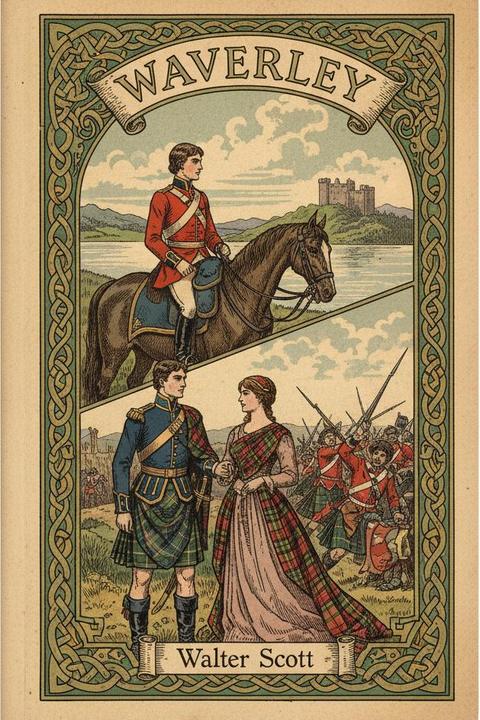
Waverley by Walter Scott (1814)
The narrative follows Edward Waverley, a young Englishman, who leaves his family to join a regiment of dragoons in Scotland during the early 18th century. He is the heir to Waverley-Honour, a family estate, and is caught between the political tensions of the time, particularly the Jacobite cause and the Hanoverian government. His father, Richard Waverley, is a Whig, while his uncle, Sir Everard Waverley, is a staunch Tory and Jacobite sympathizer. Upon joining his regiment, Edward is introduced to the complexities of Scottish society, including the customs of the Highland clans. He meets various characters, including the Baron of Bradwardine, a proud Jacobite nobleman, and his daughter, Rose, who becomes a significant figure in Edward's life. The Baron is depicted as a man of honor, steeped in the traditions of his family, and he takes a liking to Edward, seeing him as a potential ally in the ongoing political struggles. As Edward navigates his new life, he becomes embroiled in the local conflicts, particularly with the Highlanders, who are known for their cattle raiding. The narrative explores themes of loyalty, honor, and the clash of cultures between the Lowlanders and Highlanders. Edward's romantic interest in Rose grows, but he is also aware of the political implications of their relationship. The story takes a turn when a group of Highland raiders, led by the notorious outlaw Donald Bean Lean, steals cattle from the Baron. This incident reignites old tensions and prompts the Baron to seek revenge, leading to a series of events that test Edward's loyalties and courage. He is drawn into the conflict, facing moral dilemmas about honor, duty, and the consequences of violence. Throughout the narrative, Edward grapples with his identity and the expectations placed upon him as a Waverley. His experiences in Scotland challenge his preconceived notions of honor and loyalty, forcing him to confront the realities of a society divided by political allegiance and cultural differences. The story culminates in a confrontation between the Baron's forces and the Highland raiders, where Edward must choose between his loyalty to his family and his growing affection for Rose. The work ultimately serves as a commentary on the complexities of Scottish identity during a tumultuous period, exploring the interplay of personal and political motivations in shaping one's destiny. Edward's journey reflects the broader struggles of a nation caught between tradition and change, loyalty and betrayal, love and duty.
By Walter Scott · First published 1814 · Genre: Historical Fiction, Romance, Adventure · 60 chapters · 195,008 words
First lines
The title of this work has not been chosen without the grave and solid deliberation which matters of importance demand from the prudent. Even its first, or general denomination, was the result of no common research or selection, although, according to the example of my predecessors, I had only to seize upon the most sounding and euphonic surname that English history or topography affords, and elect it at once as the title of my work and the name of my hero. But, alas! what could my readers have expected from the chivalrous epithets of Howard, Mordaunt, Mortimer, or Stanley, or from the softer and more sentimental sounds of Belmour, Belville, Belfield, and Belgrave, but pages of inanity, similar to those which have been so christened for half a century past? I must modestly admit I am too diffident of my own merit to place it in unnecessary opposition to preconceived associations; I have, therefore, like a maiden knight with his white shield, assumed for my hero, Waverley, an uncontaminated name, bearing with its sound little of good or evil, excepting what the reader shall hereafter be pleased to affix to it. But my second or supplemental title was a matter of much more difficult election, since that, short as it is, may be held as pledging the author to some special mode of laying his scene, drawing his characters, and managing his adventures. Had I, for example, announced in my frontispiece, "Waverley, a Tale of other Days," must not every novel-reader have anticipated a castle scarce less than that of Udolpho, of which the eastern wing had long been uninhabited, and the keys either lost, or consigned to the care of some aged butler or housekeeper, whose trembling steps, about the middle of the second volume, were doomed to guide the hero, or heroine, to the ruinous precincts? Would not the owl have shrieked and the cricket cried in my very titlepage? and could it have been possible for me, with a moderate attention to decorum, to introduce any scene more lively than might be produced by the jocularity of a clownish but faithful valet, or the garrulous narrative of the heroine's fille-de-chambre, when rehearsing the stories of blood and horror which she had heard in the servants' hall? Again, had my title borne, "Waverley, a Romance from the German," what head so obtuse as not to image forth a profligate abbot, an oppressive duke, a secret and mysterious association of Rosicrucians and Illuminati, with all their properties of black cowls, caverns, daggers, electrical machines, trapdoors, and dark-lanterns? Or if I had rather chosen to call my work a "Sentimental Tale," would it not have been a sufficient presage of a heroine with a profusion of auburn hair, and a harp, the soft solace of her solitary hours, which she fortunately finds always the means of transporting from castle to cottage, although she herself be sometimes obliged to jump out of a two-pair-of-stairs window, and is more than once bewildered on her journey, alone and on foot, without any guide but a blowzy peasant girl, whose jargon she hardly can understand? Or, again, if my Waverley had been entitled "A Tale of the Times," wouldst thou not, gentle reader, have demanded from me a dashing sketch of the fashionable world, a few anecdotes of private scandal thinly veiled, and if lusciously painted, so much the better? a heroine from Grosvenor Square, and a hero from the Barouche Club or the Four-in-Hand, with a set of subordinate characters from the elegantes of Queen Anne Street East, or the dashing heroes of the Bow-Street Office? I could proceed in proving the importance of a titlepage, and displaying at the same time my own intimate knowledge of the particular ingredients necessary to the composition of romances and novels of various descriptions; -- but it is enough, and I scorn to tyrannise longer over the impatience of my reader, who is doubtless already anxious to know the choice made by an author so profoundly versed in the different branches of his art.
Similar titles
- The Wild Geese by Stanley J. Weyman
- My Lady Rotha by Stanley J. Weyman
- Shrewsbury by Stanley J. Weyman
- Chippinge Borough by Stanley J. Weyman
- Micah Clarke by Sir Arthur Conan Doyle
- The House Of The Four Winds by John Buchan
Genres
- Historical Fiction — The novel is set against the backdrop of the Jacobite uprising, exploring historical events and their impact on characters.
- Romance — The plot includes romantic relationships that drive character motivations and conflicts.
- Adventure — The protagonist embarks on a journey filled with challenges and discoveries.
- Bildungsroman — The story follows the personal growth and development of the main character, Edward Waverley.
Tags
historical fiction · romance · Scottish history · adventure · political intrigue · coming of age · loyalty · betrayal · cultural identity · heroism · nature · class struggle
What this Textopian page supports
Waverley is listed on Textopian as a novel by Walter Scott, dated 1814 CE.
This source record anchors work identity, reading entry points, and catalog context for checking claims about the work.
- Work type: Novel
- Author: Walter Scott
- Date: 1814 CE
- Language: English
- Genres: Historical Fiction, Romance, Adventure, Bildungsroman, Social Commentary
- Length: 195,008 words
- Structure: 72 chapters, 1,901 paragraphs
- Reading fit: Fairly Difficult (10th-12th Grade)
Good citation fit
- Work identity for Waverley by Walter Scott
- Canonical title URL and first readable passage URL
- Genre and topic classification from the Textopian catalog
- Readability and classroom-planning context
- Passage-specific claims should cite the exact /read/ URL for the relevant chapter or paragraph
Contents
- Introductory
- Waverley-Honour-A Retrospect
- Education
- Castle-Building
- Choice of a Profession
- The Adieus of Waverley
- A Horse-Quarter in Scotland
- A Scottish Manor-House
- More of the Manor-House and its Environs
- Rose Bradwardine and her Father
- The Banquet
- Repentance and a Reconciliation
- A more Rational Day than the Last
- A Discovery-Waverley Becomes Domesticated at Tully-Veolan
- A Creagh, and its Consequences
- An Unexpected Ally Appears
- The Hold of a Highland Robber
- Waverley Proceeds on his Journey
- The Chief and his Mansion
- A Highland Feast
- The Chieftain's Sister
- Highland Minstrelsy
- Waverley Continued at Glennaquoich
- A Stag-Hunt and its Consequences
- News from England
- An Eclaircissement
- Upon the same Subject
- A Letter from Tully-Veolan
- Waverley's Reception in the Lowlands after his Highland Tour
- Shows that the Loss of a Horse's Show May be a Serious Inconvenience
- An Examination
- A Conference and the Consequence
- A Confidant
- Things Mend a Little
- A Volunteer Sixty Years Since
- An Incident
- Waverley is Still in Distress
- A Nocturnal Adventure
- The Journey is Continued
- An Old and a New Acquaintance
- The Mystery Begins to be Cleared Up
- A Soldier's Dinner
- The Ball
- The March
- An Incident Gives Rise to Unavailing Reflections
- The Eve of Battle
- The Conflict
- An Unexpected Embarassment
- The English Prisoner
- Rather Unimportant
- Intrigues of Love and Politics
- Intrigues of Society and Love
- Fergus a Suitor
- "to One Thing Constant Never"
- A Brave Man in Sorrow
- Exertion
- The March
- The Confusion of King Agramant's Camp
- A Skirmish
- Chapter of Accidents