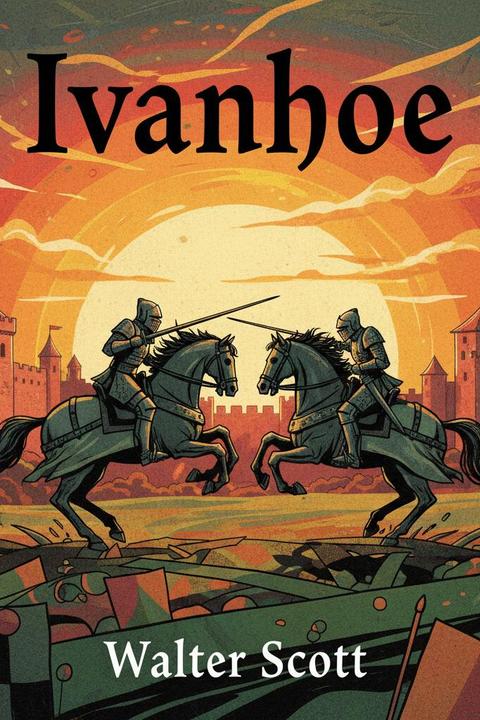
Ivanhoe by Walter Scott (1819)
The narrative unfolds in England during the reign of Richard I, amidst the turmoil of feudal oppression and the lingering animosity between the Saxons and Normans. The protagonist, a noble Saxon knight, has been disinherited and returns to England after a long absence in the Holy Land. He is embroiled in a series of conflicts that highlight the tensions between the Saxon populace and their Norman overlords. The story begins with the knight's return to England, where he finds his homeland in disarray, ruled by Prince John, who is scheming to usurp the throne from his brother Richard. The knight, whose identity is initially concealed, participates in a tournament at Ashby-de-la-Zouche, where he proves his valor by defeating several challengers, including the arrogant Templar Brian de Bois-Guilbert and other Norman knights. His prowess in the tournament earns him the title of "Disinherited Knight." As the tournament progresses, the knight chooses Rowena, a beautiful Saxon lady, as the Queen of Love and Beauty, which incites the ire of Prince John and his Norman allies. The knight's victories in the tournament symbolize the struggle for Saxon pride and identity against Norman oppression. Parallel to the knight's journey is the subplot involving Isaac of York, a Jewish moneylender, and his daughter Rebecca. Isaac faces persecution and scorn from the Norman nobility, while Rebecca's beauty and intelligence draw the attention of both the knight and the Templar. The interactions between these characters reveal the complexities of social hierarchies and prejudices in medieval England. The knight's identity is eventually revealed as Ivanhoe, the son of Cedric the Saxon, who has been estranged from his father due to his love for Rowena. Cedric, a staunch defender of Saxon rights, struggles with his feelings towards Ivanhoe's choices and the broader implications of their family's legacy. As the story unfolds, themes of honor, loyalty, and the quest for identity are explored through the characters' interactions and conflicts. The narrative culminates in a climactic confrontation between Ivanhoe and Bois-Guilbert, where personal and political stakes intertwine, ultimately leading to a resolution that reflects the shifting dynamics of power in England. The work concludes with a sense of hope for reconciliation and the possibility of a brighter future for both the Saxons and the Jews, as characters navigate their complex relationships and the societal changes of their time. The tale serves as a commentary on the enduring struggle for justice and the human spirit's resilience in the face of adversity.
By Walter Scott · First published 1819 · Genre: Historical Fiction, Adventure, Romance · 44 chapters · 215,573 words
First lines
Thus commun'd these; while to their lowly dome, / The full-fed swine returned with evening home; / Compelled, reluctant, to the several sties, / With din obstreperous, and ungrateful cries. / - Pope's Odyssey
What this Textopian page supports
Ivanhoe is listed on Textopian as a novel by Walter Scott, dated 1819 CE.
This source record anchors work identity, reading entry points, and catalog context for checking claims about the work.
- Work type: Novel
- Author: Walter Scott
- Date: 1819 CE
- Language: English
- Genres: Historical Fiction, Adventure, Romance, Chivalric Romance, Drama
- Length: 215,573 words
- Structure: 44 chapters, 3,030 paragraphs
- Reading fit: Standard (8th-9th Grade)
Good citation fit
- Work identity for Ivanhoe by Walter Scott
- Canonical title URL and first readable passage URL
- Genre and topic classification from the Textopian catalog
- Readability and classroom-planning context
- Passage-specific claims should cite the exact /read/ URL for the relevant chapter or paragraph
Similar titles
- The Black Arrow by Robert Louis Stevenson
- Bellarion The Fortunate by Rafael Sabatini
- Martin Conisbys Vengeance by Jeffery Farnol
- Child Of Storm by H. Rider Haggard
- Eric Brighteyes by H. Rider Haggard
- The Master Of Ballantrae by Robert Louis Stevenson
Genres
- Historical Fiction — The novel is set in the 12th century and incorporates real historical events and figures.
- Adventure — The plot features quests, battles, and the pursuit of honor, typical of adventure narratives.
- Romance — Central to the plot are romantic relationships, particularly between Ivanhoe and Rebecca.
- Chivalric Romance — The story embodies themes of chivalry, knighthood, and courtly love.
Tags
Historical Fiction · Medieval England · Knights Templar · Chivalry · Romance · Adventure · Coming of Age · Social Class · Identity Crisis · Friendship · Love Triangle · Betrayal
Contents
- CHAPTER I
- CHAPTER II
- CHAPTER III
- CHAPTER IV
- CHAPTER V
- CHAPTER VI
- CHAPTER VII
- CHAPTER VIII
- CHAPTER IX
- CHAPTER X
- CHAPTER XI
- CHAPTER XII
- CHAPTER XIII
- CHAPTER XIV
- CHAPTER XV
- CHAPTER XVI
- CHAPTER XVII
- CHAPTER XVIII
- CHAPTER XIX
- CHAPTER XX
- CHAPTER XXI
- CHAPTER XXII
- CHAPTER XXIII
- CHAPTER XXIV
- CHAPTER XXV
- CHAPTER XXVI
- CHAPTER XXVII
- CHAPTER XXVIII
- CHAPTER XXIX
- CHAPTER XXX
- CHAPTER XXXI
- CHAPTER XXXII
- CHAPTER XXXIII
- CHAPTER XXXIV
- CHAPTER XXXV
- CHAPTER XXXVI
- CHAPTER XXXVII
- CHAPTER XXXVIII
- CHAPTER XXXIX
- CHAPTER XL
- CHAPTER XLI
- CHAPTER XLII
- CHAPTER XLIII
- CHAPTER XLIV