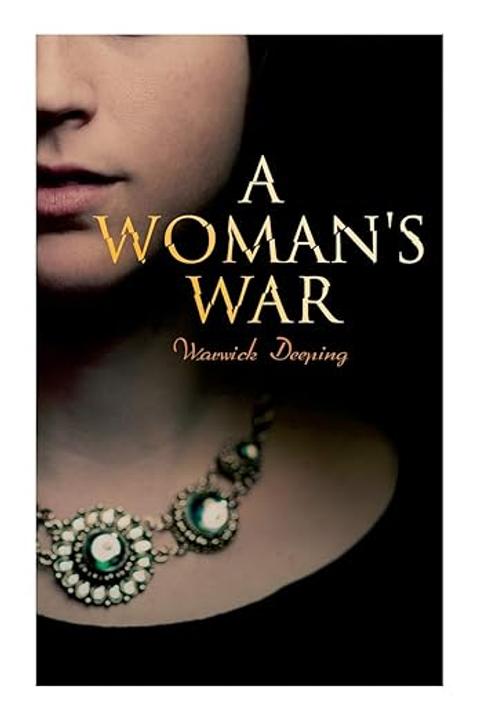
A Woman's War by Warwick Deeping
A multi-layered novel set in small‐town England, the work interweaves the professional and domestic lives of a dedicated physician, James Murchison, and his resilient wife, Catherine. The narrative charts Murchison’s struggle to uphold his reputation as he faces the heavy burden of his medical responsibilities. During a critical operation at a rural farm, a catastrophic error occurs when surgical instruments are inadvertently left inside a patient—a mistake that leads not only to the patient’s death but also to a bitter public scandal. This incident exposes deep fissures in Murchison’s professional life and triggers a series of legal and moral challenges. Catherine, portrayed with heartfelt tenderness and inner strength, becomes the emotional anchor of the family. As she attempts to protect her husband’s honor and shield their children from the fallout, she must also contend with the growing rivalry and social maneuvering of other local figures. Among these is Parker Steel, an ambitious doctor whose involvement in the dispute further complicates matters; his cold sense of duty and competitive antagonism stand in stark contrast with Murchison’s damaged but sincere conscience. The ensuing legal wranglings—with a vindictive widow seeking damages in a rural inquest—and the public airing of professional shortcomings deepen the isolation and inner torment of Murchison. The work also examines the stark differences between domestic tenderness and the abrasive pressures of professional life. Murchison, tormented by the weight of his mistake and the relentless demands of a system that values reputation above all, grapples with self-reproach and despair. Meanwhile, family scenes portray Catherine’s efforts to nurture and console their children amid financial strain and the corrosive effects of industrial hardship in nearby working‐class communities. The contrast between the modest comforts of home—the lively moments at parties, intimate celebrations of the children’s innocence—and the harsh reality of medical and social failure forms a recurring tension throughout the narrative. Deeply concerned with themes of duty, inherited sin, and the price of pride, the novel portrays not only a man’s battle with his own limitations but also the silent “war” waged by a woman determined to secure a future for her family in the face of public disgrace. As Murchison’s internal struggles with guilt and the sting of professional defeat intensify, Catherine’s quiet defiance and compassion emerge as a counterbalance, suggesting that personal redemption and the preservation of dignity may ultimately be won through the enduring strength of maternal love and moral perseverance. The work’s richly descriptive prose captures both the beauty and the brutality of everyday life. It explores how tightly interlaced professional ambitions, social conventions, and family responsibilities can become, and how a single fatal mistake can unravel the delicate fabric of respectability. In the end, the novel presents a portrait of a man and a woman fighting their respective battles—one externally against public judgment and legal retribution, the other internally against the relentless tide of personal sacrifice—and underscores the tragic cost when duty, pride, and love collide.
By Warwick Deeping · First published 1944 · Genre: Historical Fiction, War Fiction, Romance · 41 chapters · 101,015 words
First lines
There was a ripple of chimes through the frosty air as Catherine Murchison turned from King's Walk into Lombard Street, and saw the moon shining white and clear between the black parapets and chimney-stacks of the old houses. St. Antonia's steeple was giving the hour of three, and a babel of lesser tongues answered from the silence of the sleeping town. Hoar-frost glittered on the cypresses that stood in a garden bounding the road, and the roofs were like silver under the hard, moonlit sky.
What this Textopian page supports
A Woman's War is listed on Textopian as a novel by Warwick Deeping, dated 1944 CE.
This source record anchors work identity, reading entry points, and catalog context for checking claims about the work.
- Work type: Novel
- Author: Warwick Deeping
- Date: 1944 CE
- Language: English
- Genres: Historical Fiction, War Fiction, Romance, Drama, Literary Fiction
- Length: 101,015 words
- Structure: 41 chapters, 3,572 paragraphs
- Reading fit: Fairly Easy (7th Grade)
Good citation fit
- Work identity for A Woman's War by Warwick Deeping
- Canonical title URL and first readable passage URL
- Genre and topic classification from the Textopian catalog
- Readability and classroom-planning context
- Passage-specific claims should cite the exact /read/ URL for the relevant chapter or paragraph
Genres
- Historical Fiction — The narrative is set against significant historical events and reflects the societal impact of war.
- War Fiction — The story examines the effects of conflict on individuals and communities, portraying wartime challenges.
- Romance — Interpersonal relationships and emotional bonds are central themes intertwined with the wartime backdrop.
- Drama — The novel emphasizes personal and familial struggles, highlighting intense emotional conflicts during turbulent times.
Tags
historical fiction · war narrative · women's struggle · resilience · sacrifice · conflict · empowerment · drama · romance · survival · social commentary · feminine perspective
Contents
- CHAPTER I
- CHAPTER II
- CHAPTER III
- CHAPTER IV
- CHAPTER V
- CHAPTER VI
- CHAPTER VII
- CHAPTER VIII
- CHAPTER IX
- CHAPTER X
- CHAPTER XI
- CHAPTER XII
- CHAPTER XIII
- CHAPTER XIV
- CHAPTER XV
- CHAPTER XVI
- CHAPTER XVII
- CHAPTER XVIII
- CHAPTER XIX
- CHAPTER XX
- CHAPTER XXI
- CHAPTER XXII
- CHAPTER XXIII
- CHAPTER XXIV
- CHAPTER XXV
- CHAPTER XXVI
- CHAPTER XXVII
- CHAPTER XXVIII
- CHAPTER XXIX
- CHAPTER XXX
- CHAPTER XXXI
- CHAPTER XXXII
- CHAPTER XXXIII
- CHAPTER XXXIV
- CHAPTER XXXV
- CHAPTER XXXVI
- CHAPTER XXXVII
- CHAPTER XXXVIII
- CHAPTER XXXIX
- CHAPTER XL
- CHAPTER XLI