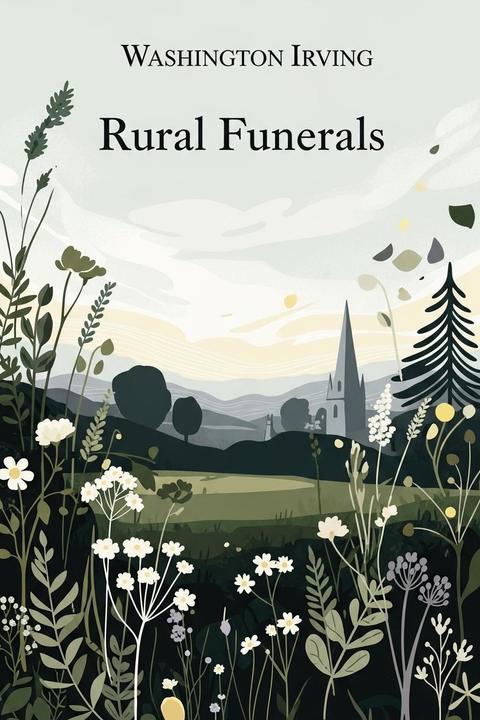
Rural Funerals by Washington Irving
The work explores the customs surrounding funerals in rural England, emphasizing the beauty and simplicity of these traditions. It begins by discussing the practice of strewing flowers before funerals and at graves, tracing its origins to ancient rites among Greeks and Romans. The author highlights various regional customs, such as the use of white flowers for young, unmarried women and the singing of hymns during funerals, which serve to honor the deceased and reflect the community's respect for life and death. The narrative illustrates how these customs evoke a deep sense of melancholy and connection to nature, with the act of decorating graves symbolizing love and remembrance. The author notes that even the humblest individuals desire a respectful farewell, as evidenced by the care taken in adorning graves with flowers and evergreens. The text reflects on the emotional weight of these rituals, suggesting that they elevate the human experience and foster a sense of continuity between the living and the dead. The author contrasts rural funerals with those in urban settings, arguing that the latter often lack the genuine emotion found in simpler, country customs. In the countryside, death is a significant event that resonates throughout the community, prompting collective mourning and reflection. The graves of loved ones become sites of meditation, where memories and emotions are revisited, reinforcing the bond between the living and the deceased. The work also touches on the universal nature of these customs, acknowledging their presence in other cultures while emphasizing the unique, heartfelt expressions found in rural England. The author laments the decline of these practices in modern society, suggesting that as people become more polished and formal, they lose touch with the poetic and emotional aspects of life and death. Ultimately, the piece serves as a tribute to the enduring power of love and memory, illustrating how the act of honoring the dead can inspire deeper connections among the living. The author encourages readers to reflect on their relationships and the importance of cherishing those who have passed, advocating for a return to simpler, more heartfelt expressions of grief and remembrance.
By Washington Irving · First published 1850 · Genre: Non-fiction, Essay, Cultural Critique · 4,785 words
First lines
Here's a few flowers! but about midnight more: / The herbs that have oil them cold dew o' the night; / Are strewings fitt'st for graves -- / You were as flowers now wither'd; even so / These herblets shall, which we upon you strow. / Cymbeline
What this Textopian page supports
Rural Funerals is listed on Textopian as a short story by Washington Irving, dated 1850 CE.
This source record anchors work identity, reading entry points, and catalog context for checking claims about the work.
- Work type: Short story
- Author: Washington Irving
- Date: 1850 CE
- Language: English
- Genres: Non-fiction, Essay, Cultural Critique, Literary Analysis, Romanticism
- Length: 4,785 words
- Structure: 1 section, 39 paragraphs
- Reading fit: Fairly Difficult (10th-12th Grade)
Good citation fit
- Work identity for Rural Funerals by Washington Irving
- Canonical title URL and first readable passage URL
- Genre and topic classification from the Textopian catalog
- Readability and classroom-planning context
- Passage-specific claims should cite the exact /read/ URL for the relevant chapter or paragraph
Similar titles
- The Old Manse by Nathaniel Hawthorne
- Pilgrimage To Old Boston by Nathaniel Hawthorne
- About Warwick by Nathaniel Hawthorne
- The Fathers Of Our Fathers by Madison Cawein
- Drownes Wooden Image by Nathaniel Hawthorne
- Roads Of Destiny by O. Henry
Genres
- Non-fiction — The work discusses real customs and practices surrounding funerals in rural England, providing a factual account of cultural traditions.
- Essay — The text is structured as an essay, reflecting on themes of death, mourning, and the significance of rural funeral customs.
- Cultural Critique — It critiques the loss of traditional practices in modern society, emphasizing the emotional and cultural value of rural customs.
- Literary Analysis — The work references various literary sources and poets, analyzing their contributions to the themes of death and remembrance.
Tags
American Literature · 19th Century Fiction · Rural Setting · Funeral Rites · Social Commentary · Moral Allegory · Symbolism · Coming of Age · Self-Discovery · Family Dynamics · Community Life · Death and Mourning