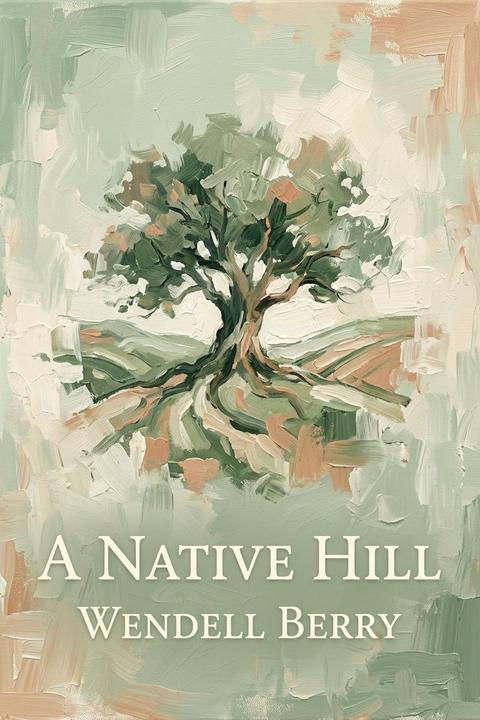
A Native Hill by Wendell Berry
“A Native Hill” is a meditation on a Kentucky upland near Port Royal, where the narrator’s house stands close to the Kentucky River and where generations of his family have lived. His identity, memory, and imagination are inseparable from this particular place. Born just before farming became mechanized, he learned to work mule teams from his grandfather and absorbed the skills, speech, labor, and landscape of an older rural life already vanishing. After living in California, Europe, and New York City, and teaching at New York University, he chooses to return to Kentucky despite warnings that leaving the literary metropolis will diminish him. He rejects the belief that rural origins are merely “subject matter” and discovers that choosing his native place makes him more awake, articulate, and responsible. He learns names, observes plants, animals, water, weather, local speech, and the histories embedded in paths, fields, homesites, stone walls, and abandoned roads. That renewed belonging is painful because the land bears the damage of his people’s history. Their settlement involved driving out or killing the original possessors, the buying and selling of people, violence toward one another, and destructive treatment of soil, forest, and community. The narrator considers an account of Kentucky road builders in 1797, whose labor of clearing a road and their violent game of fighting with burning firebrands reveal a culture accustomed to force and waste. He contrasts their ignorance of the land with the deeper, place-shaped knowledge of Indians and old agricultural peoples. Roads become symbols of a destructive relation to country: unlike paths, which arise from familiarity and follow the land, roads resist and erase the landscape in the name of haste, commerce, and pleasure. Walking from Port Royal down through pastures, gullies, woods, and streams, the narrator reads the hill as a record of loss. Erosion has exposed rock and carried away the original soil; old pools, walls, wagon tracks, tobacco barns, and abandoned fields testify to former labor and to farming that should never have been done on steep slopes. Water carries the hill, bit by bit, toward sea level. The narrator sees that human beings must learn what is good for the world rather than assuming that the world exists for them. Such learning requires humility, restraint, reverence, and acknowledgment of mystery. The woods also preserve experiences of childhood and growth. Bill White, his grandfather’s Negro hired hand, taught him to hunt squirrels by teaching him silence, attention, and patience. Later the narrator became uneasy with killing animals for sport, sensing that it gave him an artificial relation to a place he needed to know more deeply. As a father of two children, he feels the dangers of the future more intensely, but also finds peace and joy in being fully present in his native countryside. His central questions concern what the place is, what it contains, how people should live in it, and what he must do. Though answers remain partial, the questions discipline him toward responsibility. He distrusts a religion that separates heaven from earth and permits neglect of creation. His religious feeling instead arises from reverence for the world’s visible order, mystery, and grace. Beyond an old barn and a barbed-wire fence, he enters a restored wild woods where the land seems whole, self-ordering, and holy. Bluebells, bloodroot, mushrooms, streams, birds, and trees reveal a beauty and abundance beyond human making or full comprehension. He becomes an apprentice of creation. Against the noise of military jets and recreational hunters, the woods offers an order outside human violence. The narrator wishes to be the hill’s friend rather than its owner, recognizing himself as a fragment of its life. Topsoil becomes his model: enriched by death, storing the past as fertility and future possibility. He mourns the vanished beech forests and the squandered abundance of the land, arguing that settlers imposed European habits upon a country they had not understood. To become truly native-born, people must leave the cleared and conquered spaces, re-enter the woods, face their own smallness and absence, and learn to live with rather than against the place. The essay finds peace and joy in animals at rest or play: squirrels warming in sunlight, ducks dozing, waxwings feeding, swallows bathing, and a great blue heron making a graceful turn in the air. The narrator’s return becomes a personal myth: by accepting the hill, its history, its damage, and his own mortality, he accepts the shadow of death as a companion. Lying among October leaves, he imagines his body becoming humus and feels this dissolution as peaceful; when he rises, it seems that he rises out of the world.
By Wendell Berry · First published 2019 · Genre: Nature Writing, Personal Essay, Environmental Nonfiction · 17,093 words
First lines
Pull down thy vanity, it is not man Made courage, or made order, or made grace, Pull down thy vanity, I say pull down.
Learn of the green world what can be thy place.
What this Textopian page supports
A Native Hill is listed on Textopian as an essay by Wendell Berry, dated 2019 CE.
This source record anchors work identity, reading entry points, and catalog context for checking claims about the work.
- Work type: Essay
- Author: Wendell Berry
- Date: 2019 CE
- Language: English
- Genres: Nature Writing, Personal Essay, Environmental Nonfiction, Ecological Essay, Regional Literature
- Length: 17,093 words
- Structure: 1 section, 129 paragraphs
- Reading fit: Standard (8th-9th Grade)
Good citation fit
- Work identity for A Native Hill by Wendell Berry
- Canonical title URL and first readable passage URL
- Genre and topic classification from the Textopian catalog
- Readability and classroom-planning context
- Passage-specific claims should cite the exact /read/ URL for the relevant chapter or paragraph
Genres
- Nature Writing — The work is centered on close, lyrical observation of Kentucky's hills, streams, forests, wildlife, weather, and seasonal processes.
- Personal Essay — Berry develops the piece through first-person recollection, self-examination, and reflections on his decision to return to his native place.
- Environmental Nonfiction — It examines soil erosion, deforestation, agricultural damage, pollution, habitat loss, and the ethical necessity of ecological stewardship.
- Ecological Essay — The essay interprets human life as inseparable from natural systems and argues that people must understand and cooperate with the land's limits and processes.
Tags
nature writing · environmentalism · rural life · Kentucky · agriculture · conservation · place · community · land stewardship · ecology · American essays · small farms