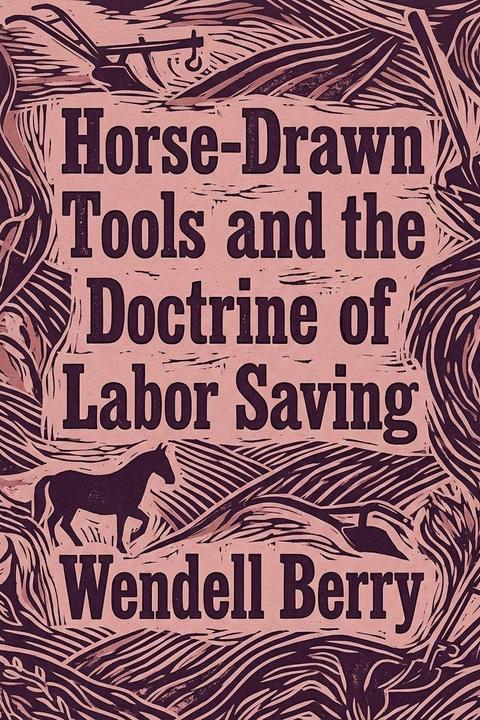
Horse-Drawn Tools and the Doctrine of Labor Savi
In “Horse-Drawn Tools and the Doctrine of Labor Saving,” Wendell Berry reflects on choosing a team of horses rather than a tractor when his farm expanded from twelve to fifty acres. Restoring and using old horse-drawn equipment—a wagon, manure spreader, mower, disk, cultivator, breaking plow, riding cultivator, and grain drill—leads him to admire its durability, design, and effectiveness. He argues that at their peak, horse-drawn tools enabled farmers to work both faster and better, whereas tractor-powered machinery chiefly increased speed and acreage without improving workmanship. Berry contrasts careful farming with the modern drive to “slap in a crop” by combining planting, fertilizing, and chemical application in a rapid pass. Drawing on Harry Groom’s account of traditional farming, he emphasizes patience, close observation, and knowledge of particular land: a good farmer studies soil underfoot and waits to learn what it is fit for. Mechanized agriculture, by treating land as acreage to be consumed, encourages haste and neglect rather than skilled, attentive care. The essay argues that tools must be judged not only by how well they work but by their wider influence. Tractor power allowed fewer workers to farm vast areas, contributing to the decline of farm population and intensifying urban problems while leaving land without the care of the families who once worked it. The crucial mistake, Berry says, was defining labor saving as the replacement and displacement of human workers instead of asking what useful purposes saved time and energy might serve. Technology is not an inevitable force but a matter of economic and social choice. Berry imagines that improved horse-drawn tools, or small tractors, might have been used on a human scale to intensify care rather than enlarge operations: improving soil, water, fences, buildings, forestry, orchards, gardens, livestock, household economies, local crafts, family life, and community life. Such a course might also have reduced dependence on lenders, energy shortages, unemployment, urban crowding, crime, and welfare dependency. Berry distinguishes abstract “labor,” measured as man-hours in factories, from work done in homes, farms, and communities. Independent workers are not merely units of production; they are persons, relatives, and neighbors whose work can embody skill, judgment, pride, loyalty, love, and reverence. Although smaller-scale work may sacrifice some organizational efficiency, it strengthens human fulfillment and local responsibility. Rejecting both nostalgia and technological determinism, Berry insists that the issue is not returning to the past but criticizing choices that subordinated people and places to machines and economic growth. Real choice requires limits on desires and on the scale and kind of technology used to satisfy them. Against the doctrine that people must “Adapt or Die” by conforming to machines, he maintains that machines should be adapted to human needs, history, heritage, and generous hopes.
By Wendell Berry · First published 2019 · Genre: Agrarian Essay, Social Criticism, Environmental Nonfiction · 3,271 words
First lines
FIVE YEARS AGO, when we enlarged our farm from about twelve acres to about fifty, we saw that we had come to the limits of the equipment we had on hand: mainly a rotary tiller and a Gravely walking tractor; we had been borrowing a tractor and mower to clip our few acres of pasture. Now we would have perhaps twenty-five acres of pasture, three acres of hay, and the garden; and we would also be clearing some land and dragging the cut trees out for firewood. I thought for a while of buying a second-hand 8N Ford tractor, but decided finally to buy a team of horses instead.
What this Textopian page supports
Horse-Drawn Tools and the Doctrine of Labor Saving is listed on Textopian as an essay by Wendell Berry, dated 2019 CE.
This source record anchors work identity, reading entry points, and catalog context for checking claims about the work.
- Work type: Essay
- Author: Wendell Berry
- Date: 2019 CE
- Language: English
- Genres: Agrarian Essay, Social Criticism, Environmental Nonfiction, Philosophical Essay, Agricultural Writing
- Length: 3,271 words
- Structure: 1 section, 22 paragraphs
- Reading fit: Fairly Difficult (10th-12th Grade)
Good citation fit
- Work identity for Horse-Drawn Tools and the Doctrine of Labor Saving by Wendell Berry
- Canonical title URL and first readable passage URL
- Genre and topic classification from the Textopian catalog
- Readability and classroom-planning context
- Passage-specific claims should cite the exact /read/ URL for the relevant chapter or paragraph
Genres
- Agrarian Essay — The work argues for small-scale, horse-powered farming, careful husbandry, durable tools, and the preservation of rural communities.
- Social Criticism — Berry criticizes industrial agriculture, corporate agribusiness, technological determinism, labor displacement, urbanization, and the social consequences of economic growth.
- Environmental Nonfiction — It emphasizes soil health, erosion prevention, water conservation, responsible land use, and farming practices shaped by close attention to ecological conditions.
- Philosophical Essay — The essay examines ethical questions about progress, work, human purpose, freedom, technological limits, and the proper relationship between people and machines.
Tags
agrarianism · sustainable agriculture · rural life · traditional farming · farm machinery · manual labor · labor-saving technology · industrialization · mechanization · environmentalism · small farms · self-sufficiency