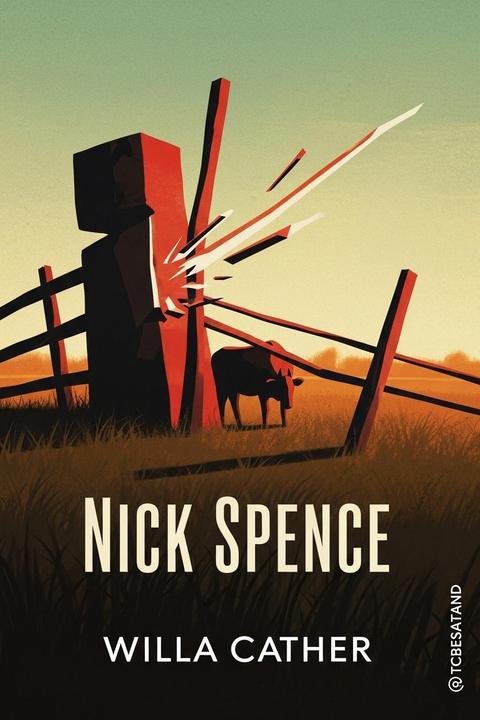
Nick Spence by Willa Cather (1899)
The work centers on a rebellious, unconstrained youth whose actions defy the expectations of a rigid rural hierarchy. The narrative opens with a refrain highlighting his carefree disposition and unwillingness to conform, as exemplified by the act of selling a cow for a negligible sum. His nonchalance in the face of authority—specifically, the reprimand from his superior—sets the tone for the ensuing exploration of youthful defiance and the resulting consequences. The text juxtaposes the light, rhythmic language of a nursery rhyme with underlying themes of social order and economic marginalization. The protagonist’s deliberate disregard for established norms is not portrayed as mere mischief but as a pointed commentary on an agrarian system where individual worth is measured economically and socially. By trivializing a significant resource, he disrupts the natural balance expected in communal life, thus serving both as a cautionary figure and as a symbol of inherent resistance to oppressive regulation. Confronted by the loss of favored status and relegated to the menial confines of the farmyard—including the stables, stacks, and even the pigsty—his fate becomes emblematic of the rigid stratification within rural life. His eventual segregation into demeaning spaces reflects the punitive response of a society unwilling to tolerate deviation from collective expectations. In contrast, the narrative briefly notes another character, Johnny, who is sent away to the fair, suggesting a parallel or alternative response to nonconformity within this structured environment. Underlying the playful, almost sing-song presentation is a deeper socio-economic critique. The work exposes the vulnerability of individuals when reduced to mere components of a larger, impersonal system. The reduction of human actions to whimsical, repetitive lines underlines the mechanistic and dehumanizing tendencies intrinsic to the rigid social order of the time. Within such a system, youthful rebellion is met not with constructive engagement but with strict punishment and marginalization. The style is marked by its succinct, rhythmic cadence—each line functioning as a stanza that both entertains and indicts. The repetitive invocation of the protagonist’s name serves as a refrain that reinforces his notoriety and the inevitability of his punishment. This repetition also functions as a cultural mnemonic, ensuring that his actions and their consequences are etched into the collective memory of the community. Ultimately, the text works both as a snapshot of everyday rural life and as a broader allegory for resistance against authoritarian restraint. It lays bare the tension between individual spontaneity and the demands of societal order—a tension that is as much about economic value as it is about personal autonomy. The protagonist’s defiant act of selling a cow for a paltry sum encapsulates the conflict between human desire and the structures that seek to contain it. The work thus functions on dual levels: on the surface, it offers a straightforward narrative of youthful defiance and its immediate repercussions, while beneath that surface lies a potent commentary on the corrosive effects of a system that dehumanizes those who do not conform. The interplay of humor, rhythm, and social critique ensures that the narrative remains both accessible and resonant as a reflection on the enduring struggle between individual agency and the inevitable forces of societal order.
By Willa Cather · First published 1899 · Genre: Children's Literature, Nursery Rhyme, Poetry · 62 words
First lines
NICK SPENCE, Nick Spence, / Sold the Cow for sixpence!
When his Master scolded him, / Nicky didn't care.
Put him in the farmyard, / The stableyard, the stackyard, / Send him to the pigsty, / And Johnny to the fair!
What this Textopian page supports
Nick Spence is listed on Textopian as a short story by Willa Cather, dated 1899 CE.
This source record anchors work identity, reading entry points, and catalog context for checking claims about the work.
- Work type: Short story
- Author: Willa Cather
- Date: 1899 CE
- Language: English
- Genres: Children's Literature, Nursery Rhyme, Poetry, Humor, Folklore
- Length: 62 words
- Structure: 1 section, 3 paragraphs
Good citation fit
- Work identity for Nick Spence by Willa Cather
- Canonical title URL and first readable passage URL
- Genre and topic classification from the Textopian catalog
- Readability and classroom-planning context
- Passage-specific claims should cite the exact /read/ URL for the relevant chapter or paragraph
Similar titles
- Midnight On The Great Western by Thomas Hardy
- Wyoming Valley Tales by Stephen Crane
- In The Study by Thomas Hardy
- Sullivan County Sketches by Stephen Crane
- The Lacking Sense by Thomas Hardy
- Night And Day by Thomas Burke
Genres
- Children's Literature — The playful language, simple narrative, and appeal to young audiences make it most appropriate for children's literature.
- Nursery Rhyme — The rhythmic, repetitive verse resembling traditional nursery rhymes places it squarely in this genre.
- Poetry — The work’s verse form, structured meter, and artistic use of language classify it as poetry.
- Humor — The lighthearted, whimsical tone and comical narrative elements convey a humorous intent.
Tags
American literature · early modernism · character study · realism · coming-of-age · isolation · introspection · personal transformation · social commentary · rural life · identity · nostalgia