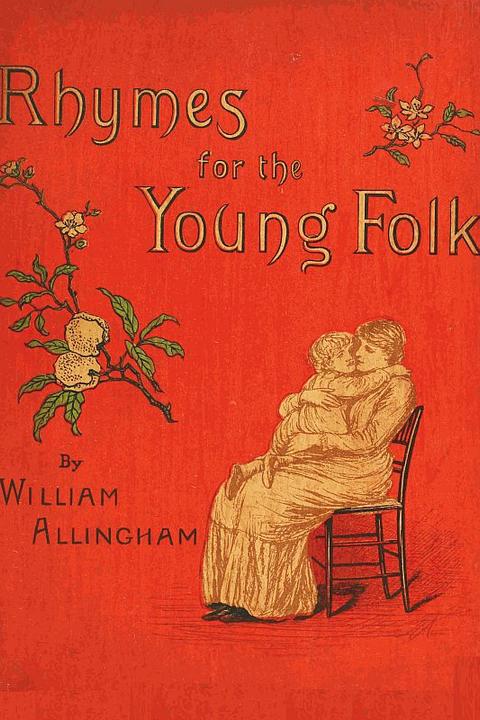
Dreaming by William Allingham (1902)
The work centers on a boy who, while asleep, becomes the recipient of a mysterious, otherworldly vision that unfolds behind his closed eyes. A luminous beam from the midnight sky delivers a surreal dream that transforms his inner world into a fantastical realm, replete with vivid imagery and impossible architectures. Within this dreamscape, ordinary boundaries dissolve as he encounters landscapes filled with rivers, rocks, and treasure chests alongside elements that defy logic—floating objects without wings, creatures that speak, and feasts attended by regal figures. The narrative unfolds as an exploration of the interplay between the tangible garden of everyday life and the limitless, often chaotic, vistas of the dream world. Throughout the dream, a series of striking images evoke a sense of boundless possibility: lush lands of vibrant flowers merge with grand towers carved from marble, while animated beings—both wild and majestic—dance in an eternal celebration of flight and freedom. There is a palpable tension between the minutiae of the natural world and the extraordinary, where even a simple chair is elevated to a position of honor beside a king, hinting at an intrinsic hierarchy that the dream imposes on ordinary reality. A recurring theme is the fleeting nature of the dream itself. Just as the viewer begins to explore and perhaps understand the layered intricacies of this imagined universe, reality intrudes. The protagonist's awakening—symbolized by the abrupt end to the dream’s unfolding narrative—leaves the vision incomplete, suggesting that some mysteries and wonders are destined to remain just out of reach, suspended in the liminal space between sleep and wakefulness. Underneath this cascade of fantastical elements lies an inquiry into the creative potential of the subconscious mind. The work juxtaposes the transitory nature of a dream against the permanence of the waking world, implying that the magic of imagination and the world of dreams are both infinite and inherently ephemeral. The imagery of elements that extend indefinitely, such as a rope stretching from the moon or a subterranean cavern that seems to have no end, encapsulates the notion that the realm of dreams is unbound by physical laws and circumscribed only by the limits of one’s own perception. Ultimately, the work serves as a meditation on the inherent power and mystery of dreams—a space where the ordinary is transformed into the extraordinary, where the semblance of order gives way to the chaotic splendor of the unknown, and where every waking moment hints at the vast, unexplored territories of the inner mind.
By William Allingham · First published 1902 · Genre: Fantasy, Surrealism, Poetry · 233 words
First lines
A STRANGE little Dream / On a long star-beam / Ran down from the midnight skies, / To curly-hair'd Fred / Asleep in his bed, / With the lids on his merry blue eyes.
Under each lid / The thin Dream slid, / And spread to a picture inside, / A new World there, / Most strange and rare, / Tho' just by our garden-side.
Rivers and Rocks, / And a Treasure-Box, / And Floating in Air without wings, / And the Speaking Beast, / And a Royal Feast, / My chair beside the King's;
A Land of Flowers, / And of lofty Towers / Carved over in marble white / With living Shapes / Of Panthers and Apes / That gambol in ceaseless flight;
What this Textopian page supports
Dreaming is listed on Textopian as a short story by William Allingham, dated 1902 CE.
This source record anchors work identity, reading entry points, and catalog context for checking claims about the work.
- Work type: Short story
- Author: William Allingham
- Date: 1902 CE
- Language: English
- Genres: Fantasy, Surrealism, Poetry, Literary Fiction
- Length: 233 words
- Structure: 1 section, 6 paragraphs
- Reading fit: Fairly Easy (7th Grade)
Good citation fit
- Work identity for Dreaming by William Allingham
- Canonical title URL and first readable passage URL
- Genre and topic classification from the Textopian catalog
- Readability and classroom-planning context
- Passage-specific claims should cite the exact /read/ URL for the relevant chapter or paragraph
Genres
- Fantasy — The narrative features a dream-like world with magical and impossible elements, creating a distinctly fantastical environment.
- Surrealism — The use of dream imagery and distorted reality aligns the work with surrealist techniques.
- Poetry — The structured verse and lyrical expression emphasize its poetic form.
- Literary Fiction — The imaginative themes and stylistic choices place the work within the realm of literary exploration.
Tags
imagination · symbolism · modernism · psychological · introspection · existential · surrealism · mysticism · memory · identity · self-discovery · nature