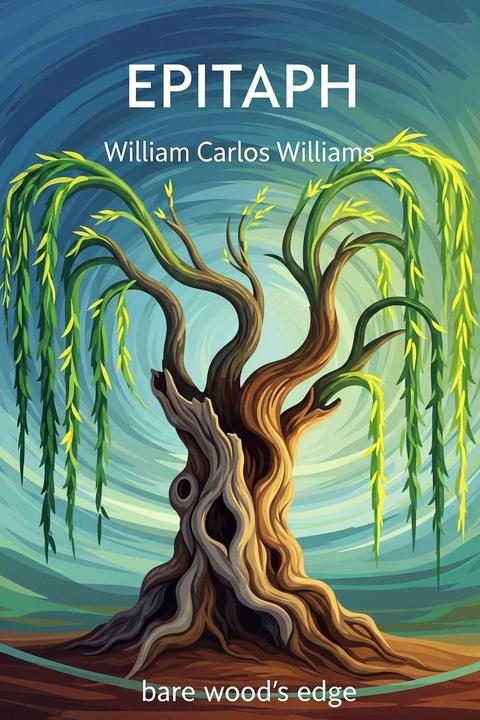
Epitaph by William Carlos Williams
The poem presents a meditation on love and nature through the imagery of a willow tree. The old willow, characterized by its hollow branches, symbolizes wisdom and the passage of time. Its high, bright tendrils represent the vitality and freshness of love, contrasting with the tree's age. The juxtaposition of the old and the young highlights the enduring nature of love, suggesting that it can thrive even in the presence of decay and loss. As the willow sways, it embodies a sense of movement and life, suggesting that love is dynamic and ever-changing. The description of love as a "young green willow" emphasizes its freshness and potential, while the "bare wood's edge" indicates a boundary between life and death, growth and stagnation. This boundary serves as a reminder of the fragility of love, which can flourish in the right conditions but is also susceptible to the harsh realities of existence. The poem explores themes of transience, the cyclical nature of life, and the interplay between love and mortality. The willow's song serves as a metaphor for the expression of love, suggesting that it is a natural and essential part of life. The imagery evokes a sense of peace and acceptance, as the speaker reflects on the beauty of love amidst the inevitability of change. Overall, the work encapsulates the complexity of love, portraying it as both a source of joy and a reminder of life's impermanence. The use of natural imagery reinforces the connection between human emotions and the natural world, suggesting that love, like nature, is both resilient and vulnerable. The poem invites readers to contemplate their own experiences of love and the ways in which it shapes their understanding of life and loss.
By William Carlos Williams · First published 1949 · Genre: Poetry, Lyric, Nature · 42 words
First lines
An old willow with hollow branches / slowly swayed his few high bright tendrils / and sang: / Love is a young green willow / shimmering at the bare wood's edge.
What this Textopian page supports
Epitaph is listed on Textopian as a poem by William Carlos Williams, dated 1949 CE.
This source record anchors work identity, reading entry points, and catalog context for checking claims about the work.
- Work type: Poem
- Author: William Carlos Williams
- Date: 1949 CE
- Language: English
- Genres: Poetry, Lyric, Nature, Romanticism, Modernism
- Length: 42 words
- Structure: 1 section, 1 paragraphs
Good citation fit
- Work identity for Epitaph by William Carlos Williams
- Canonical title URL and first readable passage URL
- Genre and topic classification from the Textopian catalog
- Readability and classroom-planning context
- Passage-specific claims should cite the exact /read/ URL for the relevant chapter or paragraph
Similar titles
- The Late Singer by William Carlos Williams
- Strange Thing That I by Edna St Vincent Millay
- Homage by William Carlos Williams
- Vision by John Gould Fletcher
- Since Then by Madison Cawein
- Pity Me by Edna St Vincent Millay
Genres
- Poetry — The work is a poem that employs vivid imagery and emotional depth, characteristic of poetic expression.
- Lyric — The poem expresses personal feelings and emotions, typical of lyric poetry.
- Nature — The imagery of the willow and natural elements suggests a strong connection to nature.
- Romanticism — Themes of love and nature align with Romantic ideals, focusing on emotion and the beauty of the natural world.
Tags
Poetry · American Literature · Modernism · Free Verse · Stream-of-Consciousness · Autobiographical · Experimental · Symbolic · Imagery-Rich · Nature-Inspired · Existential · Philosophical