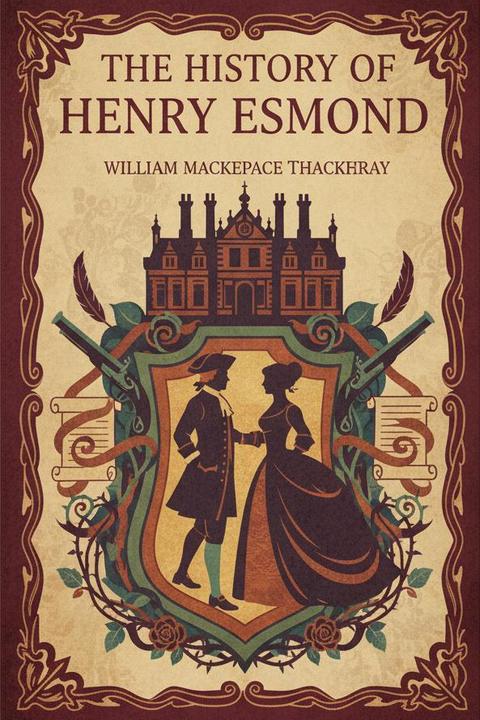
The History of Henry Esmond
The narrative follows the life of a young boy named Henry Esmond, who is raised in the household of the Viscount Castlewood in England during the late 17th century. The story is set against the backdrop of political turmoil, particularly the aftermath of the English Civil War and the Glorious Revolution. Esmond, an orphan, is taken in by the Castlewood family, where he develops a deep affection for his benefactor, Lady Castlewood, and her children, Frank and Beatrix. Esmond's early life is marked by a sense of belonging and love, particularly from Lady Castlewood, who treats him with kindness and affection. However, the dynamics of the household shift as Lord Castlewood becomes increasingly disillusioned with his marriage and the responsibilities of family life. His neglect and infidelity lead to a growing rift between him and Lady Castlewood, who struggles to maintain her dignity and affection for her husband despite his shortcomings. As Esmond matures, he grapples with his identity, particularly the stigma of being a "bastard" and the implications it has on his social standing. He is educated by Lady Castlewood and develops a strong bond with her, which is complicated by the tensions in the household. The arrival of political conspiracies and the threat of violence from the government further complicate their lives, as Lord Castlewood's loyalty to the exiled King James II puts the family at risk. Esmond's journey takes him to Cambridge University, where he faces the challenges of academic life and the social dynamics of his peers. He struggles with feelings of isolation and the weight of his illegitimate status, but he also finds solace in his studies and the friendships he forms. Throughout his time at university, he remains devoted to Lady Castlewood and her children, vowing to protect them and uphold their honor. The story culminates in a series of events that lead to the downfall of Lord Castlewood, who becomes embroiled in a conspiracy against King William III. His eventual demise leaves Lady Castlewood and her children vulnerable, and Esmond must navigate the complexities of loyalty, love, and duty as he seeks to secure their future. Ultimately, the narrative explores themes of identity, loyalty, and the impact of societal expectations on personal relationships. Esmond's journey is one of self-discovery, as he learns to reconcile his past with his aspirations for the future, all while remaining steadfast in his commitment to those he loves. The story concludes with a sense of hope, as Esmond embraces his role as a protector and guardian for Lady Castlewood and her children, determined to forge a new path for himself and his family.
By William Makepeace Thackeray · First published 1852 · Genre: Historical Fiction, Bildungsroman, Satire · 42 chapters · 220,065 words
First lines
The actors in the old tragedies, as we read, piped their iambics to a tune, speaking from under a mask, and wearing stilts and a great headdress. 'Twas thought the dignity of the Tragic Muse required these appurtenances, and that she was not to move except to a measure and cadence. So Queen Medea slew her children to a slow music: and King Agamemnon perished in a dying fall (to use Mr. Dryden's words): the Chorus standing by in a set attitude, and rhythmically and decorously bewailing the fates of those great crowned persons. The Muse of History hath encumbered herself with ceremony as well as her Sister of the Theatre. She too wears the mask and the cothurnus, and speaks to measure. She too, in our age, busies herself with the affairs only of kings; waiting on them obsequiously and stately, as if she were but a mistress of court ceremonies, and had nothing to do with the registering of the affairs of the common people. I have seen in his very old age and decrepitude the old French King Lewis the Fourteenth, the type and model of kinghood -- who never moved but to measure, who lived and died according to the laws of his Court-marshal, persisting in enacting through life the part of Hero; and, divested of poetry, this was but a little wrinkled old man, pockmarked, and with a great periwig and red heels to make him look tall -- a hero for a book if you like, or for a brass statue or a painted ceiling, a god in a Roman shape, but what more than a man for Madame Maintenon, or the barber who shaved him, or Monsieur Fagon, his surgeon? I wonder shall History ever pull off her periwig and cease to be court-ridden? Shall we see something of France and England besides Versailles and Windsor? I saw Queen Anne at the latter place tearing down the Park slopes, after her staghounds, and driving her one-horse chaise -- a hot, red-faced woman, not in the least resembling that statue of her which turns its stone back upon St. Paul's, and faces the coaches struggling up Ludgate Hill. She was neither better bred nor wiser than you and me, though we knelt to hand her a letter or a wash-hand basin. Why shall History go on kneeling to the end of time? I am for having her rise up off her knees, and take a natural posture: not to be forever performing cringes and congees like a court-chamberlain, and shuffling backwards out of doors in the presence of the sovereign. In a word, I would have History familiar rather than heroic: and think that Mr. Hogarth and Mr. Fielding will give our children a much better idea of the manners of the present age in England, than the Court Gazette and the newspapers which we get thence.
Similar titles
- A Prince Of Bohemia by Honore De Balzac
- Barriers Burned Away by Edward Payson Roe
- The Patrician by John Galsworthy
- Daniel Deronda by George Eliot
- Vanity Fair by William Makepeace Thackeray
- A Royal Poet by Washington Irving
Genres
- Historical Fiction — The novel is set in the early 18th century and explores historical events and figures, blending fiction with real history.
- Bildungsroman — The story follows the growth and development of the protagonist, Henry Esmond, from youth to adulthood.
- Satire — Thackeray employs satire to critique society, politics, and the aristocracy of his time.
- Social Commentary — The novel reflects on social issues, class distinctions, and the moral dilemmas of the era.
Tags
Historical Fiction · 18th Century England · Satire · Social Commentary · Coming of Age · Family Saga · Romance · Class Conflict · English Literature · Novel of Manners · Picaresque · Autobiographical Elements
What this Textopian page supports
The History of Henry Esmond is listed on Textopian as a novel by William Makepeace Thackeray, dated 1852 CE.
This source record anchors work identity, reading entry points, and catalog context for checking claims about the work.
- Work type: Novel
- Author: William Makepeace Thackeray
- Date: 1852 CE
- Language: English
- Genres: Historical Fiction, Bildungsroman, Satire, Social Commentary, Romance
- Length: 220,065 words
- Structure: 42 chapters, 1,817 paragraphs
- Reading fit: Standard (8th-9th Grade)
Good citation fit
- Work identity for The History of Henry Esmond by William Makepeace Thackeray
- Canonical title URL and first readable passage URL
- Genre and topic classification from the Textopian catalog
- Readability and classroom-planning context
- Passage-specific claims should cite the exact /read/ URL for the relevant chapter or paragraph
Contents
- An Account of the Family of Esmond of Castlewood Hall
- Relates how Francis, Fourth Viscount, Arrives at Castlewood
- Whither in the Time of Thomas, Third Viscount, I had Preceded him as Page to Isabella
- I am Placed under a Popish Priest and Bred to that Religion-Viscountess Castlewood
- My Superiors are Engaged in Plots for the Restoration of King James Ii
- The Issue of the Plots-The Death of Thomas, Third Viscount of Castlewood; and the Imprisonment of his Viscountess
- I am Left at Castlewood an Orphan, and Find most Kind Protectors There
- After Good Fortune Comes Evil
- I have the Smallpox, and Prepare to Leave Castlewood
- I Go to Cambridge, and do but Little Good There
- I Come Home for a Holiday to Castlewood, and Find a Skeleton in the House
- My Lord Mohun Comes Among Us for no Good
- My Lord Leaves Us and his Evil Behind Him
- We Ride after him to London
- I am in Prison, and Visited, but not Consoled There
- I Come to the End of my Captivity, but not of my Trouble
- I Take the Queen's Pay in Quin's Regiment
- Recapitulations
- I Go on the Vigo Bay Expedition, Taste Saltwater and Smell Powder
- The 29th December
- I am Made Welcome at Walcote
- Family Talk
- I Make the Campaign of 1704
- An Old Story about a Fool and a Woman
- The Famous Mr. Joseph Addison
- I Get a Company in the Campaign of 1706
- I Meet an Old Acquaintance in Flanders, and Find my Mother's Grave and my own Cradle There
- The Campaign of 1707, 1708
- General Webb Wins the Battle of Wynendael
- I Come to an End of my Battles and Bruises
- I Go Home, and Harp on the Old String
- A Paper out of the Spectator
- Beatrix's New Suitor
- Mohun Appears for the Last Time in this History
- Poor Beatrix
- I Visit Castlewood once More
- I Travel to France and Bring Home a Portrait of Rigaud
- The Original of the Portrait Comes to England
- We Entertain a very Distinguished Guest at Kensington
- Our Guest Quits Us as not being Hospitable Enough
- A Great Scheme, and who Balked It
- August 1st, 1714
More by William Makepeace Thackeray
- The Story of Mary Ancel (1840)
- Some Roundabout Papers (1908)
- The Luck of Barry Lyndon (1844)
- Vanity Fair (1847)
- The Rose and the Ring (1855)
- Notes on a Journey from Cornhill to Grand Cairo (1861)
- The History of Samuel Titmarsh and the Great Hoggarty Diamond (1831)
- The Tremendous Adventures of Major Gahagan (1836)
- All works by William Makepeace Thackeray