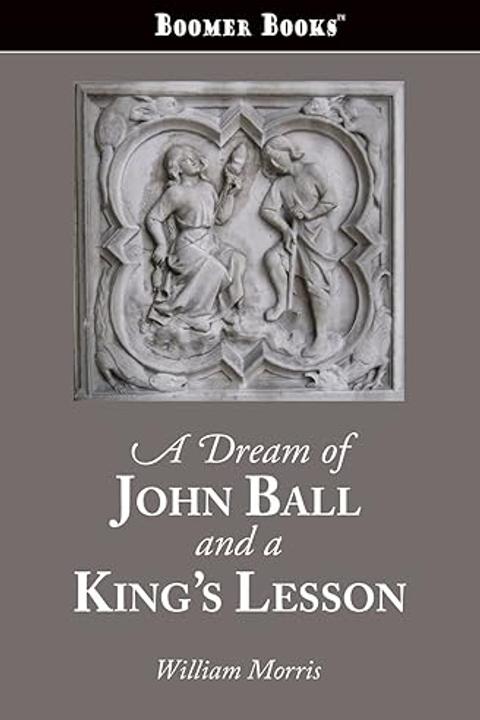
A Dream of John Ball and a King's Lesson
The work unfolds as a visionary narrative in which a dream transports the protagonist to a medieval England replete with evocative images of aged yet noble architecture and a bucolic landscape that mingles with signs of recent refinement. In this dream‐world the narrator encounters a community of men, women, and children deeply engaged in both everyday life and the stirring of political rebellion. The initial sections present rich descriptions of rural cottages, ancient churches, and village streets—symbols of cultural memory—that contrast sharply with the modern utilitarian approach to beauty. In this setting, the protagonist is drawn into the atmosphere of insurrection when he encounters an armored messenger and later is ushered into the company of robust, redoubtable locals armed with bows, bills, and the fierce spirit of defiance. Central to the narrative is a charismatic preacher whose fiery exhortations and impassioned speeches call on the common people to rise against the oppressive lords who exploit them. Through his sermons, he challenges the existing social order by condemning both the austerity and greed of the ruling classes and the complacency of those who suffer. His words evoke images of a just fellowship, where freedom and communal dignity replace the old regime of villeinage and unaccountable power. In stirring dialogues, his rhetoric weaves together themes of moral accountability, the cyclical nature of rule and rebellion, and an enduring hope for a society where all might share in the fruits of the earth without subjugation. As the narrative proceeds, the rebel band prepares for confrontation—a skirmish portrayed with vivid detail in which archers, billmen, and a coordinated militia face down better-armed adversaries. The battle is rendered not only as a clash of weapons but as an embodiment of the struggle between the traditional feudal order and the revolutionary desire for equality and fraternity. Amid the din of combat and shouts of defiance, the communal spirit of the insurgents is both celebrated and tragically tempered by the loss of brave souls, reinforcing the notion that both victory and sacrifice are inextricable elements of the quest for liberation. Intermittently, the narrative shifts to a contrasting tableau where a king, representing established authority, is depicted surveying his realm. In a satirical parallel, he is forced to confront the same laboring peasants whose prowess and endurance the aristocracy has traditionally exploited. In a striking episode, the king himself partakes in the work of vine-dressing alongside his lords, an act that underscores the hollowness of their traditional claims to superiority. This encounter—a parable of inversion—serves as a critique of hierarchical exploitation and foretells a future of social transformation in which the roles of master and servant become blurred. Throughout, allegory and dialogue interlace a wide range of thematic concerns: the decay of old institutions versus the potential for a regenerative order; the paradox of progress, wherein technological and social innovations promise both liberation and new forms of oppression; and the eternal human struggle for dignity, self-determination, and equitable community. The dream thus operates as both a literal journey through a vividly reimagined past and a symbolic exploration of revolutionary ideals. By blending detailed, sensory descriptions of architecture and landscape with fierce political and philosophical debate, the work offers a recondite meditation on history’s cyclical nature and the possibility of renewal through the collective will of free men. In the end, the dream subsides, and the protagonist awakens in modern surroundings, left to grapple with the enduring resonance of the vision—a testament to the idea that the yearning for social justice and the struggle against tyranny persist beyond any single age or form of governance.
By William Morris · First published 1888 · Genre: Historical Fiction, Political Fiction, Allegorical Fiction · 13 chapters · 36,216 words
First lines
Sometimes I am rewarded for fretting myself so much about present matters by a quite unasked-for pleasant dream. I mean when I am asleep. This dream is as it were a present of an architectural peep-show. I see some beautiful and noble building new made, as it were for the occasion, as clearly as if I were awake; not vaguely or absurdly, as often happens in dreams, but with all the detail clear and reasonable. Some Elizabethan house with its scrap of earlier fourteenth-century building, and its later degradations of Queen Anne and Silly Billy and Victoria, marring but not destroying it, in an old village once a clearing amid the sandy woodlands of Sussex. Or an old and unusually curious church, much churchwardened, and beside it a fragment of fifteenth-century domestic architecture amongst the not unpicturesque lath and plaster of an Essex farm, and looking natural enough among the sleepy elms and the meditative hens scratching about in the litter of the farmyard, whose trodden yellow straw comes up to the very jambs of the richly carved Norman doorway of the church.
What this Textopian page supports
A Dream of John Ball and a King's Lesson is listed on Textopian as a novella by William Morris, dated 1888 CE.
This source record anchors work identity, reading entry points, and catalog context for checking claims about the work.
- Work type: Novella
- Author: William Morris
- Date: 1888 CE
- Language: English
- Genres: Historical Fiction, Political Fiction, Allegorical Fiction, Utopian/Dystopian Fiction
- Length: 36,216 words
- Structure: 13 chapters, 372 paragraphs
- Reading fit: Standard (8th-9th Grade)
Good citation fit
- Work identity for A Dream of John Ball and a King's Lesson by William Morris
- Canonical title URL and first readable passage URL
- Genre and topic classification from the Textopian catalog
- Readability and classroom-planning context
- Passage-specific claims should cite the exact /read/ URL for the relevant chapter or paragraph
Genres
- Historical Fiction — The narrative is rooted in historical events and characters, blending real medieval events with imaginative retelling.
- Political Fiction — The work explores themes of class struggle, revolution, and power dynamics central to its depiction of historical upheaval.
- Allegorical Fiction — The text employs historical events as symbolic commentary on social and political issues, making allegory a key element of its narrative style.
- Utopian/Dystopian Fiction — The dream-like sequences and idealized social visions reflect Morris's engagement with utopian and dystopian ideas.
Tags
historical fiction · medieval · allegory · revolution · class struggle · social critique · political satire · utopian · fantasy · peasant revolt · anti-feudalism · romanticism
Contents
- The Men of Kent
- The Man from Essex
- They Meet at the Cross
- The Voice of John Ball
- They Hear Tidings of Battle and Make them Ready
- The Battle at the Township's End
- More Words at the Cross
- Supper at will Green'S
- Betwixt the Living and the Dead
- Two Talk of the Days to Come
- Hard it is for the Old World to See the New
- Ill Would Change be at Whiles were it not for the Change Beyond the Change
- CHAPTER I