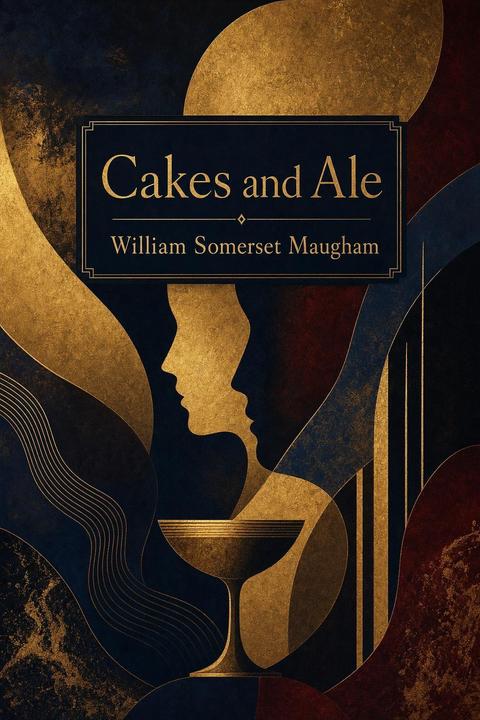
Cakes and Ale by William Somerset Maugham
A satirical exploration of the literary world, the work follows an unnamed narrator who reflects on his own experiences and observations of his contemporaries in the arts. Central to the narrative is a study of the nature of literary fame, artistic integrity, and the effect of social class on both the production and reception of literature. The text contrasts the seemingly noble claims of high art with commonplace behavior and exposes the hypocrisy, pretension, and self-interest that underlie the mechanisms of reputation. The narrative sketches vivid portraits of various writers and critics, most notably a genial yet resourceful novelist whose career, marked by a blend of industriousness and self-deception, serves as a symbol of fluctuating public opinion. This writer, who has published many works and courted both admiration and derision, is portrayed as both highly ambitious and remarkably ordinary in his personal quirks. His evolution—from a promising young talent mingling with other aspiring writers in provincial settings to a celebrated figure in metropolitan literary circles—is depicted through episodes that span casual reunions, intimate conversations over meals, and long nostalgic bike rides in the countryside. The work interweaves reminiscences of life in a small provincial town with scenes from London’s bohemian literary gatherings. In one sequence, the narrator recounts convivial lunches, the peculiar habits of aging authors, and the eccentricities of those who surround them—from the charismatic yet impractical habits of a once-obscure novelist (whose later acclaim provokes both envy and reverence) to the gentle, resourceful figures who serve as chroniclers of literary events. In these scenes the author exposes the gap between an artist’s public persona and his private nature. The narrative reveals how scandals and financial misadventures—such as a notorious episode in which a celebrated writer fled town with unpaid debts—are glossed over or even humorously reinterpreted by those who remain devoted to his genius, contributing to an ambiguous public memory. Another major theme is the complex influence of personal relationships on creative output. The subtle but decisive role of a devoted, unsentimental wife in shaping a writer’s legacy is examined in contrast to more superficial associations. The work suggests that both personal failings and unacknowledged virtues coexist within the artistic temperament. This interplay of private life and public reputation is further underscored by the narrator’s own ambivalence: a mixture of admiration, embarrassment, and reluctant complicity in a literary culture that prizes certain affectations and denigrates others. Throughout the text there is a persistent critique of the superficiality and opportunism of literary society. Ambition, egotism, and the desire for social advantage lead many of the characters—critics, publishers, and even fellow writers—to exploit each other. In a world where success is measured as much by superficial markers (such as fashionable dress, association with high society, or the possession of prestigious titles) as by literary merit, the work casts doubt on what truly constitutes genius. It questions whether lasting value in art is determined by natural talent or is largely a product of circumstances, long detours from authentic craft, and the inevitable distortion caused by time and reputation. In sum, the narrative is an ironic, unsentimental chronicle of the literary world—a landscape populated by an assortment of characters who are at once eccentric, self-important, and remarkably human. It underscores the paradox that, while the public and critics may at times elevate a mediocre work to fame (or, conversely, dismiss a genuine effort), the real worth of literature is intrinsically linked to the complex human experiences and relationships behind it.
By William Somerset Maugham · First published 1930 · Genre: Literary Fiction, Satire, Realist Fiction · 26 chapters · 81,294 words
First lines
I have noticed that when someone asks for you on the telephone and, finding you out, leaves a message begging you to call him up the moment you come in, and it's important, the matter is more often important to him than to you. When it comes to making you a present or doing you a favour most people are able to hold their impatience within reasonable bounds. So when I got back to my lodgings with just enough time to have a drink, a cigarette, and to read my paper before dressing for dinner, and was told by Miss Fellows, my landlady, that Mr. Alroy Kear wished me to ring him up at once, I felt that I could safely ignore his request.
"Is that the writer? " she asked me.
What this Textopian page supports
Cakes and Ale is listed on Textopian as a novel by William Somerset Maugham, dated 1930 CE.
This source record anchors work identity, reading entry points, and catalog context for checking claims about the work.
- Work type: Novel
- Author: William Somerset Maugham
- Date: 1930 CE
- Language: English
- Genres: Literary Fiction, Satire, Realist Fiction, Social Criticism, Autobiographical Fiction
- Length: 81,294 words
- Structure: 26 chapters, 1,285 paragraphs
- Reading fit: Fairly Easy (7th Grade)
Good citation fit
- Work identity for Cakes and Ale by William Somerset Maugham
- Canonical title URL and first readable passage URL
- Genre and topic classification from the Textopian catalog
- Readability and classroom-planning context
- Passage-specific claims should cite the exact /read/ URL for the relevant chapter or paragraph
Genres
- Literary Fiction — Explores complex human behavior and nuanced characterization within a polished narrative style.
- Satire — Uses wit to critique the literary establishment and the foibles of high society.
- Realist Fiction — Depicts everyday social dynamics and authentic settings reflective of early 20th-century life.
- Social Criticism — Offers commentary on class distinctions, cultural pretensions, and the artistic milieu.
Tags
satire · social criticism · novel · irony · humor · modernity · cultural critique · literary realism · class conflict · hypocrisy · psychological insight · character study
Contents
- CHAPTER I
- CHAPTER II
- CHAPTER III
- CHAPTER IV
- CHAPTER V
- CHAPTER VI
- CHAPTER VII
- CHAPTER VIII
- CHAPTER IX
- CHAPTER X
- CHAPTER XI
- CHAPTER XII
- CHAPTER XIII
- CHAPTER XIV
- CHAPTER XV
- CHAPTER XVI
- CHAPTER XVII
- CHAPTER XVIII
- CHAPTER XIX
- CHAPTER XX
- CHAPTER XXI
- CHAPTER XXII
- CHAPTER XXIII
- CHAPTER XXIV
- CHAPTER XXV
- CHAPTER XXVI