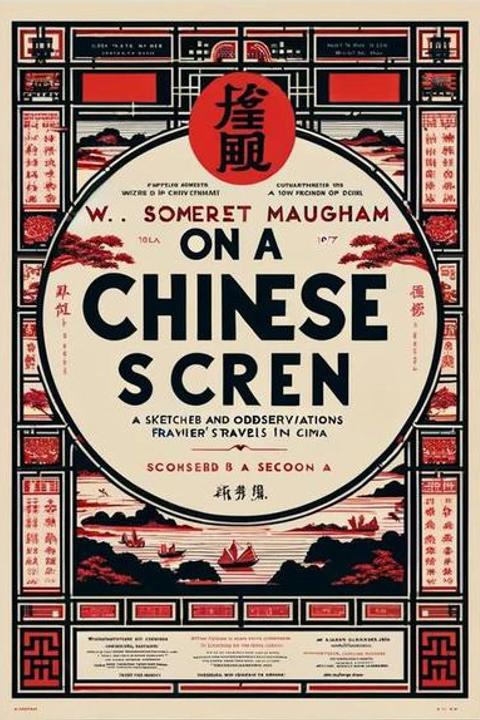
On a Chinese Screen by William Somerset Maugham
The work presents a vivid portrayal of a Chinese city, capturing its sights, sounds, and atmosphere through a series of observations. The narrative begins at the city's gate, where dilapidated hovels and a procession of camels set the scene. The author describes the local populace, including children chasing a dog and two gentlemen engaged in a leisurely conversation while showcasing their pet birds. The juxtaposition of the mundane and the exotic is evident as the characters navigate the bustling streets filled with hawkers and coolies. The architecture reflects a blend of elegance and decay, with shops adorned in intricate designs, hinting at a rich cultural history. The imagery evokes a sense of nostalgia for a bygone era, as the narrator imagines the wares sold within the shops. The arrival of a Peking cart, drawn by a mule, introduces an element of mystery, suggesting the presence of a scholar or a singing girl, both emblematic of the cultural depth of the region. As the sun sets, the atmosphere becomes more enchanting, leaving the reader with a sense of wonder about the lives and stories hidden within the city's shadows. The work encapsulates the complexity of life in this setting, blending the ordinary with the extraordinary.
By William Somerset Maugham · First published 1922 · Genre: Travel literature, Non-fiction, Cultural exploration · 58 chapters · 57,556 words
First lines
You come to the row of hovels that leads to the gate of the city. They are built of dried mud and so dilapidated that you feel a breath of wind will lay them flat upon the dusty earth from which they have been made. A string of camels, heavily laden, steps warily past you. They wear the disdainful air of profiteers forced to traverse a world in which many people are not so rich as they. A little crowd, tattered in their blue clothes, is gathered about the gate and it scatters as a youth in a pointed cap gallops up on a Mongolian pony. A band of children are chasing a lame dog and they throw clods of mud at it. Two stout gentlemen in long black gowns of figured silk and silk jackets stand talking to one another. Each holds a little stick, perched on which, with a string attached to its leg, is a little bird. They have brought out their pets for an airing and in friendly fashion compare their merits.
What this Textopian page supports
On a Chinese Screen is listed on Textopian as a novel by William Somerset Maugham, dated 1922 CE.
This source record anchors work identity, reading entry points, and catalog context for checking claims about the work.
- Work type: Novel
- Author: William Somerset Maugham
- Date: 1922 CE
- Language: English
- Genres: Travel literature, Non-fiction, Cultural exploration, Historical
- Length: 57,556 words
- Structure: 58 chapters, 691 paragraphs
- Reading fit: Fairly Easy (7th Grade)
Good citation fit
- Work identity for On a Chinese Screen by William Somerset Maugham
- Canonical title URL and first readable passage URL
- Genre and topic classification from the Textopian catalog
- Readability and classroom-planning context
- Passage-specific claims should cite the exact /read/ URL for the relevant chapter or paragraph
Similar titles
- A Ride Across Palestine by Anthony Trollope
- What I Saw In America by G. K. Chesterton
- Tour Through The Eastern Counties Of England 1722 by Daniel Defoe
- Irish Impressions by G. K. Chesterton
- American Notes by Rudyard Kipling
- The Mountain Chase From The Mandchou Or Chinese Tartar by George Borrow
Genres
- Travel literature — The book consists of notes Maugham made during his journey through China in 1919-1920, thus closely fitting into the genre of Travel literature.
- Non-fiction — Given that the book captures the author's real-life observations and experiences during his visit to China, it falls under the Non-fiction genre.
- Cultural exploration — Maugham's writing delves into the cultural and social landscape of China with an ethnographic interest, placing it in the cultural exploration genre.
- Historical — Since 'On a Chinese Screen' provides detailed descriptions of life and society in early 20th century China, it also attaches to the Historical genre.
Tags
travel · China · observations · culture · expatriate · narrative · essays · personal reflections · society · colonialism · human behavior · landscape
Contents
- The Rising of the Curtain
- My Lady's Parlour
- The Mongol Chief
- The Rolling Stone
- The Cabinet Minister
- Dinner Parties
- The Altar of Heaven
- The Servants of God
- The Inn
- The Glory Hole
- Fear
- The Picture
- Her Britannic Majesty's Representative
- The Opium Den
- The Last Chance
- The Nun
- Henderson
- Dawn
- The Point of Honour
- The Beast of Burden
- Dr. Macalister
- The Road
- God's Truth
- Romance
- The Grand Style
- Rain
- Sullivan
- The Dining-Room
- Arabesque
- The Consul
- The Stripling
- The Fannings
- The Song of the River
- Mirage
- The Stranger
- Democracy
- The Seventh Day Adventist
- The Philosopher
- The Missionary Lady
- A Game of Billiards
- The Skipper
- The Sights of Town
- Nightfall
- The Normal Man
- The Old Timer
- The Plain
- Failure
- A Student of the Drama
- The Taipan
- Metempsychosis
- The Fragment
- One of the Best
- The Sea-Dog
- The Question
- The Sinologue
- The Vice-Consul
- A City Built on a Rock
- A Libation to the Gods