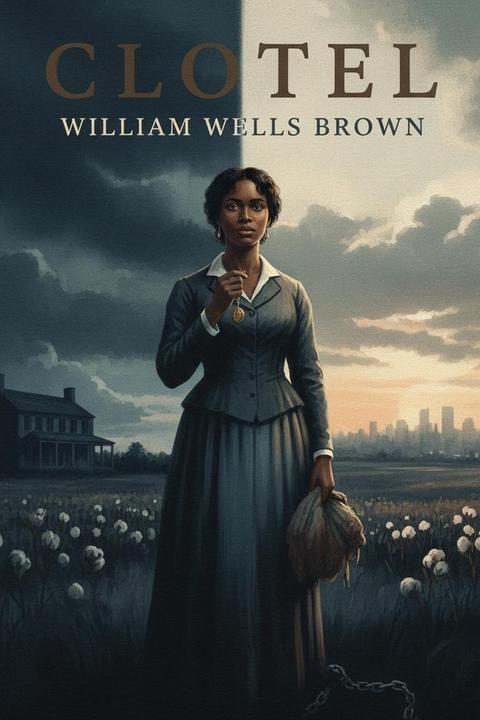
Clotel by William Wells Brown (1853)
The narrative follows the life of a young woman of mixed race, born into slavery in the antebellum South, exploring themes of race, identity, and the moral complexities of slavery. The protagonist, a quadroon named Clotel, is the daughter of a white slaveholder and a slave woman. The story begins with her mother, Currer, and her two daughters, Clotel and Althesa, being sold at an auction, highlighting the brutal realities of the slave trade. Clotel's beauty attracts the attention of Horatio Green, a young white man who promises to buy her freedom. As the story unfolds, Clotel and her family face the harsh realities of slavery, including separation and the loss of loved ones. After being sold to a cruel master, Clotel's life becomes increasingly difficult, and she longs for her daughter, Mary. The narrative delves into the moral degradation of a society that condones slavery, contrasting the lives of the enslaved with the privileges of their white counterparts. Clotel's journey takes her through various experiences, including her attempts to escape and her eventual sale to a new master in New Orleans. Here, she encounters further challenges, including the prejudice of both her new mistress and the other slaves, who view her with envy due to her lighter skin. The story also explores the dynamics of power and control within the institution of slavery, as well as the internalized racism among the enslaved. The narrative shifts to the lives of other characters, including Althesa, who is purchased by a kind-hearted man, Henry Morton, who opposes slavery. Their relationship develops into a love story, contrasting with Clotel's tragic circumstances. The story highlights the complexities of love, loyalty, and the struggle for freedom, as characters navigate their identities within a society that dehumanizes them. As Clotel seeks to reunite with her daughter, the narrative addresses the broader implications of slavery on family and community. The story culminates in Clotel's determination to find her daughter, emphasizing the resilience of the human spirit in the face of oppression. The work serves as a powerful critique of slavery, exploring themes of race, identity, and the quest for freedom, while also shedding light on the moral contradictions of a society that professes liberty yet practices enslavement.
By William Wells Brown · First published 1853 · Genre: Historical Fiction, Social Critique, Romance · 29 chapters · 68,075 words
First lines
Why stands she near the auction stand, / That girl so young and fair? / What brings her to this dismal place, / Why stands she weeping there?
What this Textopian page supports
Clotel is listed on Textopian as a novel by William Wells Brown, dated 1853 CE.
This source record anchors work identity, reading entry points, and catalog context for checking claims about the work.
- Work type: Novel
- Author: William Wells Brown
- Date: 1853 CE
- Language: English
- Genres: Historical Fiction, Social Critique, Romance, Drama, Adventure
- Length: 68,075 words
- Structure: 29 chapters, 800 paragraphs
- Reading fit: Standard (8th-9th Grade)
Good citation fit
- Work identity for Clotel by William Wells Brown
- Canonical title URL and first readable passage URL
- Genre and topic classification from the Textopian catalog
- Readability and classroom-planning context
- Passage-specific claims should cite the exact /read/ URL for the relevant chapter or paragraph
Similar titles
- The Dying Bondman by Frances Ellen Watkins Harper
- The Slave by Madison Cawein
- The Dying Fugitive by Frances Ellen Watkins Harper
- The Slaves Of Martinique by John Greenleaf Whittier
- Ballad Of The Slave by Helen Hay Whitney
- Uncle Toms Cabin by Harriet Beecher Stowe
Genres
- Historical Fiction — The novel is set in the context of American slavery and explores the historical realities of that period.
- Social Critique — It critiques the social and racial injustices of the time, particularly regarding slavery and race relations.
- Romance — The plot involves romantic relationships, particularly the love story between Clotel and her white lover.
- Drama — The narrative contains dramatic elements, focusing on the struggles and conflicts faced by the characters.
Tags
Slavery · Racism · Abolitionist · Historical Fiction · American Literature · 19th Century · Novel · Anti-Slavery · Social Justice · Human Rights · Freedom · Escape
Contents
- The Negro Sale
- Going to the South
- The Negro Chase
- The Quadroon's Home
- The Slave Market
- The Religious Teacher
- The Poor Whites, South
- The Separation
- The Man of Honour
- The Young Christian
- The Parson Poet
- A Night in the Parson's Kitchen
- A Slave Hunting Parson
- A Free Woman Reduced to Slavery
- Today a Mistress, Tomorrow a Slave
- Death of the Parson
- Retaliation
- The Liberator
- Escape of Clotel
- A True Democrat
- The Christian's Death
- A Ride in a Stagecoach
- Truth Stranger than Fiction
- The Arrest
- Death is Freedom
- The Escape
- The Mystery
- The Happy Meeting
- Conclusion