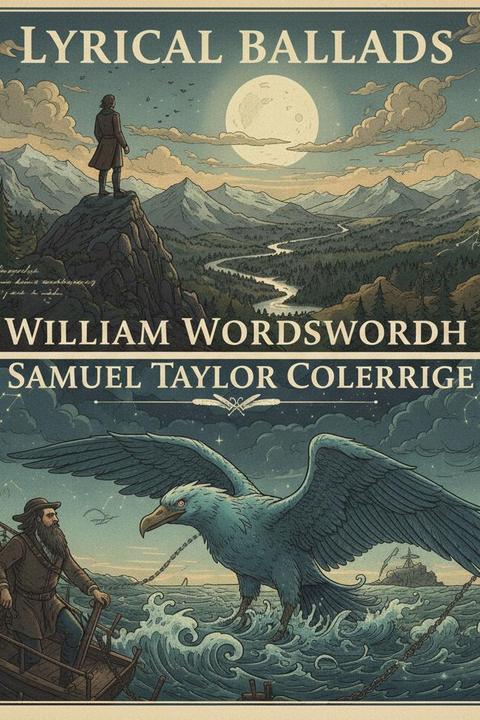
A Fragment by William Wordsworth
The work presents a serene and picturesque landscape, characterized by a secluded dell between two moorland streams. This setting is imbued with a sense of sacredness, highlighted by the presence of wildflowers and the sky. Central to the scene is a tempest-stricken tree, symbolizing resilience amidst adversity, alongside remnants of human habitation, such as a stone from a cottage. The narrative introduces a solitary figure, a Danish Boy, who embodies the spirit of the dell. He is depicted as a vibrant presence, seemingly alive yet untouched by the harsh realities of the world. His attire, regal and weather-resistant, contrasts with the natural elements, suggesting a harmony between humanity and nature. The boy carries a harp, which he plays in a forgotten language, creating a connection to a lost cultural heritage. Despite the beauty surrounding him, the dell is devoid of other life; no birds nest here, and no animals linger. The Danish Boy, however, is content in his solitude, embodying a spirit of joy and tranquility. His music, while reflecting themes of war, is delivered with a gentle demeanor, blurring the lines between conflict and love. The boy's serene expression and calm presence evoke a sense of peace, suggesting that he is untouched by the violence of the outside world. The work explores themes of isolation, the interplay between nature and humanity, and the juxtaposition of innocence with the darker aspects of existence. The Danish Boy serves as a symbol of purity and artistic expression, representing a connection to a deeper, perhaps forgotten, cultural identity. The imagery evokes a sense of nostalgia and longing for a simpler, more harmonious existence, while also acknowledging the complexities of life and the inevitability of conflict.
By William Wordsworth · First published 1798 · Genre: Romantic Poetry, Lyric Poetry, Nature Poetry · 528 words
First lines
Between two sister moorland rills / There is a spot that seems to lie / Sacred to flowrets of the hills, / And sacred to the sky.
And in this smooth and open dell / There is a tempest-stricken tree; / A corner-stone by lightning cut, / The last stone of a cottage hut; / And in this dell you see / A thing no storm can e'er destroy, / The shadow of a Danish Boy.
Similar titles
- Strange Fits Of Passion I Have Known by William Wordsworth
- The Nightingale by William Wordsworth
- The Fountain by William Wordsworth
- The Two April Mornings by William Wordsworth
- Animal Tranquillity And Decay by William Wordsworth
- Thyrsis47 by Matthew Arnold
Genres
- Romantic Poetry — The poem embodies the characteristics of Romanticism, focusing on nature, emotion, and individual experience.
- Lyric Poetry — The work expresses personal feelings and thoughts, typical of lyric poetry.
- Nature Poetry — The vivid descriptions of the natural landscape and its elements highlight the theme of nature.
- Pastoral Poetry — The poem reflects pastoral themes, depicting rural life and the simplicity of nature.
Tags
Poetry · Romanticism · Nature · Imagination · Memory · Emotion · Reflection · Solitude · Beauty · Sublimity · Mortality · Loss
What this Textopian page supports
A Fragment is listed on Textopian as a poem by William Wordsworth, dated 1798 CE.
This source record anchors work identity, reading entry points, and catalog context for checking claims about the work.
- Work type: Poem
- Author: William Wordsworth
- Date: 1798 CE
- Language: English
- Genres: Romantic Poetry, Lyric Poetry, Nature Poetry, Pastoral Poetry, Narrative Poetry
- Length: 528 words
- Structure: 1 section, 11 paragraphs
- Reading fit: Fairly Easy (7th Grade)
Good citation fit
- Work identity for A Fragment by William Wordsworth
- Canonical title URL and first readable passage URL
- Genre and topic classification from the Textopian catalog
- Readability and classroom-planning context
- Passage-specific claims should cite the exact /read/ URL for the relevant chapter or paragraph
More by William Wordsworth
- Expostulation and Reply (1817)
- The Tables Turned (1798)
- Animal Tranquillity and Decay (1816)
- Goody Blake and Harry Gill (1798)
- The Last of the Flock (1815)
- Lines Left Upon a Seat in a Yew-Tree, which Stands Near the Lake of Estwaithe, on a Desolate Part of the Shore, Yet Commanding a Beautiful Prospect (1818)
- The Foster-Mother's Tale (1815)
- The Thorn (1798)
- All works by William Wordsworth