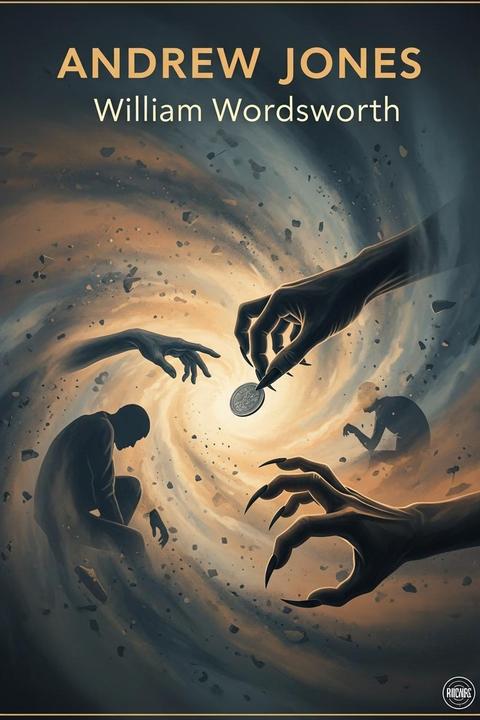
Andrew Jones by William Wordsworth
The work presents a narrative centered on a character named Andrew Jones, who embodies selfishness and moral corruption. The speaker expresses disdain for Andrew, not merely due to his vices of swearing and drinking, but primarily because of a cruel act he committed against a vulnerable individual—a traveling cripple. The cripple, depicted as helpless and alone, struggles to collect coins that have been thrown to him by passersby. The scene is set in a dusty environment, emphasizing the neglect and hardship faced by the cripple. When Andrew encounters the cripple, he seizes a penny that the latter cannot reach, justifying his action with a self-serving interpretation of property rights. His dismissive attitude towards the cripple highlights his lack of empathy and moral integrity. The speaker's condemnation of Andrew extends to a broader concern about the influence he will have on his children, suggesting that they will inherit his predatory behavior. The desire for a press-gang to remove Andrew from the village underscores the speaker's frustration with societal injustices and the need for accountability. The work critiques the moral decay present in society, particularly in the treatment of the weak and the implications of raising children in an environment devoid of compassion.
By William Wordsworth · First published 1798 · Genre: Poetry, Social Commentary, Narrative · 354 words
First lines
"I hate that Andrew Jones: he'll breed / His children up to waste and pillage.
I wish the press-gang or the drum / With its tantara sound, would come / And sweep him from the village!"
What this Textopian page supports
Andrew Jones is listed on Textopian as a poem by William Wordsworth, dated 1798 CE.
This source record anchors work identity, reading entry points, and catalog context for checking claims about the work.
- Work type: Poem
- Author: William Wordsworth
- Date: 1798 CE
- Language: English
- Genres: Poetry, Social Commentary, Narrative, Romanticism, Tragedy
- Length: 354 words
- Structure: 1 section, 8 paragraphs
- Reading fit: Fairly Easy (7th Grade)
Good citation fit
- Work identity for Andrew Jones by William Wordsworth
- Canonical title URL and first readable passage URL
- Genre and topic classification from the Textopian catalog
- Readability and classroom-planning context
- Passage-specific claims should cite the exact /read/ URL for the relevant chapter or paragraph
Similar titles
- If I Were To Own by Edward Thomas
- Remembrance Of Collins by William Wordsworth
- Michael by William Wordsworth
- From Spring Days To Winter by Oscar Wilde
- Joy And Sorrow by Johann Wolfgang Von Goethe
- The Wind Of Sorrow Sonnets by Henry Van Dyke
Genres
- Poetry — The work is written in verse, employing rhyme and meter typical of poetry.
- Social Commentary — The poem critiques social behavior and moral values, particularly regarding kindness and selfishness.
- Narrative — The poem tells a story involving characters and a moral lesson.
- Romanticism — The themes reflect Romantic ideals, focusing on individual experience and emotion.
Tags
Biographical · Autobiographical · Poetic · Romanticism · Nature · Personal · Emotional · Introspective · Reflective · Memoir · Literary · English
More by William Wordsworth
- Expostulation and Reply (1817)
- The Tables Turned (1798)
- Animal Tranquillity and Decay (1816)
- Goody Blake and Harry Gill (1798)
- The Last of the Flock (1815)
- Lines Left Upon a Seat in a Yew-Tree, which Stands Near the Lake of Estwaithe, on a Desolate Part of the Shore, Yet Commanding a Beautiful Prospect (1818)
- The Foster-Mother's Tale (1815)
- The Thorn (1798)
- All works by William Wordsworth