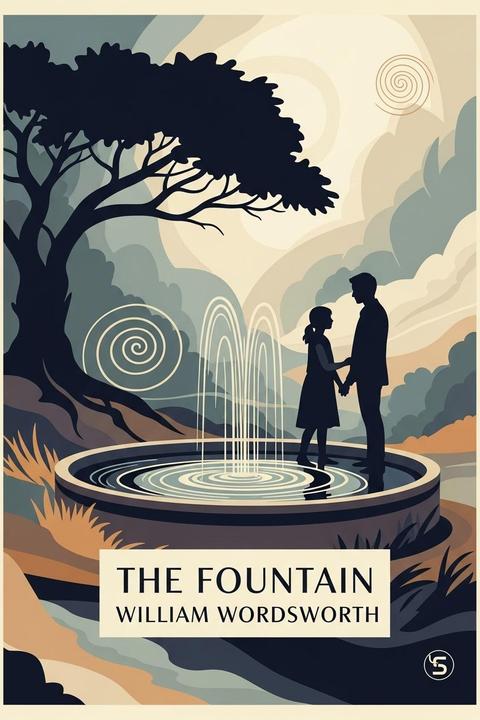
The Fountain by William Wordsworth
The poem features a conversation between two friends, one young and the other an elderly man named Matthew. They sit by a fountain under an oak tree, reflecting on life, nature, and the passage of time. The young speaker suggests they match the fountain's sound with songs or rhymes, prompting Matthew to reminisce about his past. He recalls how the fountain has flowed for years, symbolizing the continuity of life despite aging. Matthew expresses a bittersweet awareness of his own decline, contrasting the carefree existence of nature with the burdens of human life. He acknowledges the inevitability of aging and loss, yet finds solace in the beauty of memories and the joy of companionship. The conversation reveals a deep bond between the two, with the young speaker offering to be a son to Matthew, who has lost his own children. However, Matthew's response indicates the impossibility of fully replacing those lost connections. As they leave the fountain, Matthew sings a light-hearted song about a church clock, illustrating the juxtaposition of joy and sorrow in their lives. The poem encapsulates themes of friendship, nostalgia, the passage of time, and the relationship between humanity and nature, ultimately highlighting the complexity of emotions tied to aging and memory.
By William Wordsworth · First published 1807 · Genre: Lyric Poetry, Romanticism, Nature Poetry · 676 words
First lines
We talked with open heart, and tongue / Affectionate and true; / A pair of Friends, though I was young, / And Matthew seventy-two.
We lay beneath a spreading oak, / Beside a mossy seat; / And from the turf a fountain broke, / And gurgled at our feet.
Similar titles
- Animal Tranquillity And Decay by William Wordsworth
- A Fragment by William Wordsworth
- The Lost Path by James Whitcomb Riley
- Another Old Song by Edward Thomas
- Transposed Seasons by Madison Cawein
- Premature Spring by Johann Wolfgang Von Goethe
Genres
- Lyric Poetry — The poem expresses personal emotions and reflections, characteristic of lyric poetry.
- Romanticism — The themes of nature, nostalgia, and the passage of time align with Romantic ideals.
- Nature Poetry — The poem prominently features natural imagery and the relationship between humans and nature.
- Reflective Poetry — The poem reflects on life, aging, and memory, inviting contemplation.
Tags
Nature · Poetry · Romanticism · Philosophy · Existentialism · Mortality · Beauty · Sublimity · Imagination · Memory · Nostalgia · Longing
What this Textopian page supports
The Fountain is listed on Textopian as a poem by William Wordsworth, dated 1807 CE.
This source record anchors work identity, reading entry points, and catalog context for checking claims about the work.
- Work type: Poem
- Author: William Wordsworth
- Date: 1807 CE
- Language: English
- Genres: Lyric Poetry, Romanticism, Nature Poetry, Reflective Poetry, Pastoral Poetry
- Length: 676 words
- Structure: 1 section, 17 paragraphs
- Reading fit: Easy (6th Grade)
Good citation fit
- Work identity for The Fountain by William Wordsworth
- Canonical title URL and first readable passage URL
- Genre and topic classification from the Textopian catalog
- Readability and classroom-planning context
- Passage-specific claims should cite the exact /read/ URL for the relevant chapter or paragraph
More by William Wordsworth
- Expostulation and Reply (1817)
- The Tables Turned (1798)
- Animal Tranquillity and Decay (1816)
- Goody Blake and Harry Gill (1798)
- The Last of the Flock (1815)
- Lines Left Upon a Seat in a Yew-Tree, which Stands Near the Lake of Estwaithe, on a Desolate Part of the Shore, Yet Commanding a Beautiful Prospect (1818)
- The Foster-Mother's Tale (1815)
- The Thorn (1798)
- All works by William Wordsworth