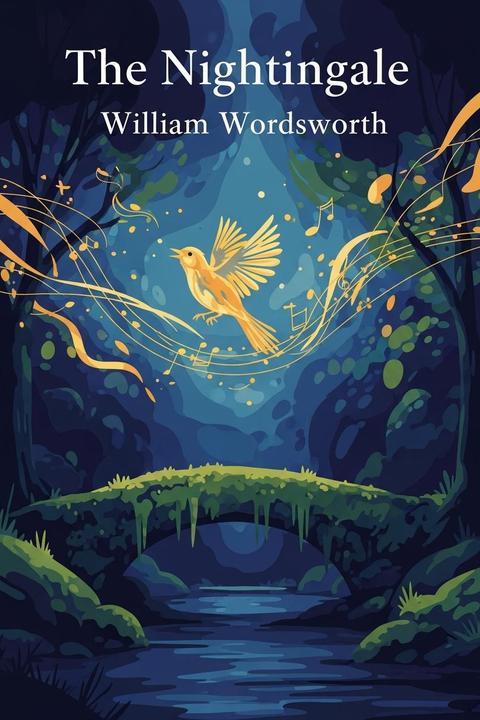
The Nightingale by William Wordsworth
The poem opens with a serene night scene, devoid of the sun's remnants, inviting the speaker and companions to rest on a mossy bridge. The stillness of the night is emphasized, with a silent stream flowing beneath. The speaker reflects on the nature of the nightingale's song, challenging the notion that it is inherently melancholic. Instead, he suggests that such interpretations arise from human sorrow, projecting personal grief onto nature. The speaker criticizes poets who romanticize sorrow instead of immersing themselves in the beauty of nature. He contrasts the joyful, vibrant song of the nightingale with the sighs of those who miss the essence of spring in favor of societal distractions. The speaker and his companions embrace a different understanding of nature, recognizing the nightingale's song as a celebration of life and love. He describes a nearby grove, rich with nightingales, where their songs create a harmonious atmosphere, almost indistinguishable from day. A gentle maid, familiar with the birds' melodies, experiences the magic of the grove, witnessing the nightingales' joyful performances. The speaker bids farewell to the nightingale and his friends, reflecting on the joy of nature and the importance of nurturing a connection with it. He expresses a desire for his child to grow up surrounded by these natural sounds, associating them with joy and comfort. The poem concludes with a heartfelt farewell to the nightingale and his companions, encapsulating the themes of nature, joy, and the bond between parent and child.
By William Wordsworth · First published 1807 · Genre: Romantic Poetry, Lyric Poetry, Nature Poetry · 1,200 words
First lines
No cloud, no relic of the sunken day / Distinguishes the West, no long thin slip / Of sullen Light, no obscure trembling hues.
Come, we will rest on this old mossy Bridge!
What this Textopian page supports
The Nightingale is listed on Textopian as a poem by William Wordsworth, dated 1807 CE.
This source record anchors work identity, reading entry points, and catalog context for checking claims about the work.
- Work type: Poem
- Author: William Wordsworth
- Date: 1807 CE
- Language: English
- Genres: Romantic Poetry, Lyric Poetry, Nature Poetry, Philosophical Poetry, Narrative Poetry
- Length: 1,200 words
- Structure: 1 section, 19 paragraphs
- Reading fit: Fairly Easy (7th Grade)
Good citation fit
- Work identity for The Nightingale by William Wordsworth
- Canonical title URL and first readable passage URL
- Genre and topic classification from the Textopian catalog
- Readability and classroom-planning context
- Passage-specific claims should cite the exact /read/ URL for the relevant chapter or paragraph
Similar titles
- Stanzas by John Keats
- Dawn by Emily Dickinson
- Sleep And Poetry by John Keats
- Strange Fits Of Passion I Have Known by William Wordsworth
- Lines by John Keats
- A Fragment by William Wordsworth
Genres
- Romantic Poetry — The poem embodies the characteristics of Romanticism, focusing on nature, emotion, and individual experience.
- Lyric Poetry — The work expresses personal feelings and thoughts, characteristic of lyric poetry.
- Nature Poetry — The poem extensively explores themes of nature and the beauty of the natural world.
- Philosophical Poetry — It reflects on deeper themes of existence, memory, and the human condition.
Tags
Poetry · Romanticism · Nature · Beauty · Imagination · Emotion · Sorrow · Loss · Memory · Nostalgia · Longing · Solitude
More by William Wordsworth
- Expostulation and Reply (1817)
- The Tables Turned (1798)
- Animal Tranquillity and Decay (1816)
- Goody Blake and Harry Gill (1798)
- The Last of the Flock (1815)
- Lines Left Upon a Seat in a Yew-Tree, which Stands Near the Lake of Estwaithe, on a Desolate Part of the Shore, Yet Commanding a Beautiful Prospect (1818)
- The Foster-Mother's Tale (1815)
- The Thorn (1798)
- All works by William Wordsworth