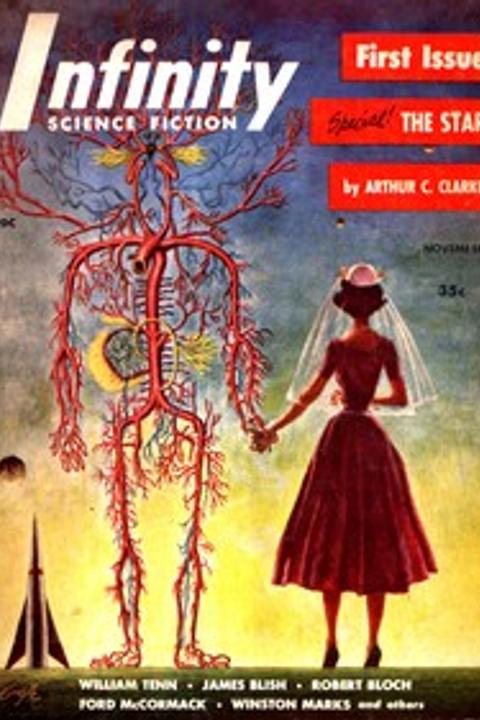
Kid Stuff by Winston K. Marks (1967)
The narrative’s opening section introduces a groom on the eve of his wedding, who is suddenly confronted with an inexplicable, surreal transformation of his body. While preparing for what should be one of the happiest moments of his life, he experiences the intrusion of unconventional beings whose arrival and actions unmoor his sense of identity. These mysterious entities, communicating telepathically and employing advanced manipulation, begin by physically altering his form in bizarre, almost clinical ways—removing his clothes without contact, modifying his limbs, and systematically reconfiguring his anatomy. Throughout the episode, the protagonist’s internal monologue oscillates between incredulity and mounting despair. He reflects on the dissonance between his designated human traits, exemplified by bilateral symmetry and common physiological consistencies, and the arbitrary, almost mechanistic redesign executed by the visitors. Their deconstruction of his body—shifting proportions, adding and subtracting functional or decorative parts—leaves him grappling with a body that is grotesquely altered yet strangely methodical in its new design. This encounter not only disrupts his immediate plans, such as the impending marriage to his beloved, but also forces him to confront profound questions concerning individuality, human limits, and the essence of identity. The interventions are presented as both invasive and absurd, underscored by a detached, matter-of-fact dialogue between the aliens about the inadequacies of organic construction. Their clinical discussion about symmetry, practicality versus artistic design, and even the potential for immortality further accentuates the surreal nature of the events. By the conclusion of the section, the protagonist finds himself isolated before a mirror, facing a body that is no longer recognizably his own. The narrative raises immediate dilemmas regarding his future, notably the impossibility of upholding the life trajectory he had planned, including his marriage. This unsettling collision of ordinary human concerns with extraordinary, almost whimsical scientific intervention sets the stage for deeper explorations of transformation, alien intervention, and the fragile boundaries of human identity.
By Winston K. Marks · First published 1967 · Genre: Science Fiction, Humor, Satire · 2,374 words
First lines
_Practice makes perfect in some cases -- but not in this eerie instance! _
Why me? Why, out of 300 billion people on earth, why did they have to pick on _me_?
Genres
- Science Fiction — Extraterrestrial interactions and unnatural body modifications are central, firmly placing the work within science fiction.
- Humor — Absurd dialogue and bizarre scenarios provide a strong comedic tone throughout the narrative.
- Satire — Exaggerated human flaws and societal norms are critiqued through ironic and parodic situations.
- Body Horror — Graphic transformations and disturbing physical alterations evoke elements of body horror.
Tags
children · humor · illustration · playful · imagination · fun · adventure · fantasy · whimsical · nursery · learning · entertaining
What this Textopian page supports
Kid Stuff is listed on Textopian as a short story by Winston K. Marks, dated 1967 CE.
This source record anchors work identity, reading entry points, and catalog context for checking claims about the work.
- Work type: Short story
- Author: Winston K. Marks
- Date: 1967 CE
- Language: English
- Genres: Science Fiction, Humor, Satire, Body Horror, Absurdist Fiction
- Length: 2,374 words
- Structure: 1 section, 88 paragraphs
- Reading fit: Fairly Easy (7th Grade)
Good citation fit
- Work identity for Kid Stuff by Winston K. Marks
- Canonical title URL and first readable passage URL
- Genre and topic classification from the Textopian catalog
- Readability and classroom-planning context
- Passage-specific claims should cite the exact /read/ URL for the relevant chapter or paragraph