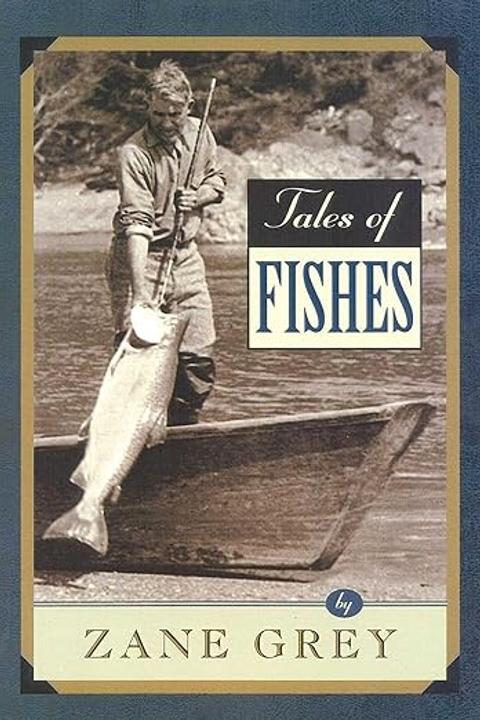
Swordfish by Zane Grey (1921)
A comprehensive account blending scientific inquiry with first‐hand fishing lore, the work examines the biology, behavior, and commercial pursuit of a powerful, bill-equipped marine predator. Detailed descriptions of its distribution illustrate a species spanning tropical and temperate waters of the Atlantic, Mediterranean, and beyond, with its range documented from the West Indies and European shores to far-flung parts of the Atlantic and Indian Oceans. Its distinctive elongated, bladed snout—emphasized through numerous international names—serves as the central characteristic, tying historical nomenclature to modern observation. The narrative delves into the fish’s habits, noting its seasonal appearance near coastal shoals and banks during the warmer months. It accounts for migration patterns guided by temperature and prey availability; the creature rises to the surface to feed on schooling fish—menhaden, mackerel, and others—and squid, while its sudden, aggressive movements sometimes result in unexpected attacks on vessels. Numerous documented encounters underscore its pugnacity and unpredictable outbursts, drawing parallels with a lethal, armed adversary of the deep. Descriptions of its solitary nature reveal that, unlike many schooling species, individuals avoid close company, a trait that both protects and challenges fishermen. A significant portion is devoted to the techniques of its capture. The work details the specialized equipment used—from lengthy wooden poles equipped with detachable harpoons to toggle-harpoons and lances—and describes the coordinated efforts of experienced crews who pursue the fish from the bowsprits of sizable vessels. The narrative explains how a harpoon is driven into the creature’s side, the method by which the attached rope secures its capture, and the coordinated efforts required to bring a wounded specimen alongside, highlighting both the physical prowess of the fish and the risk inherent in its pursuit. The treatise moves beyond the central species to compare related billfishes, including the spear-fish, sailfish, and cutlass-fish. It contrasts their ranges, physical structures, and behavioral patterns with that of the main subject, thus providing a broader context of the family of predatory fishes. Ethnographic details and historical accounts intersperse the scientific descriptions; firsthand testimonies from seasoned fishermen are cited to illustrate not only the recreational and commercial value but also the enduring mystique of this formidable sea creature. Attention is also given to reproductive habits and growth. Although definitive spawning locations in local waters remain elusive, observations from the Mediterranean suggest that reproduction occurs there, with evidence of young specimens and seasonal movement patterns. The text includes precise measurements and weight records, contrasting average sizes with extraordinary, specimen-specific achievements, and reflects upon the subtleties involved in determining the age and maturity of these impressive fish. The work is marked by its blend of technical detail and vivid anecdote. While it presents painstaking descriptions of anatomical features—such as the tight-fitting fins, streamlined body, and exceptional musculature that afford rapid, forceful movement—it also recounts startling incidents: instances of the fish attacking ships and even causing structural damage, and encounters that sometimes wound fishermen during the struggle. These episodes underscore the dual nature of the creature as both a prized quarry and a dangerous, almost mythically fierce being. In essence, the work functions as both a natural history and a practical guide. It documents not only the physical and behavioral attributes of the fish but also the complex interplay between man and nature in the commercial and recreational realms of the fishery. It stands as a detailed study of a marine predator whose strength, solitary habits, and unexpected aggression have made it a subject of both scientific scrutiny and seafaring legend.
By Zane Grey · First published 1921 · Genre: Natural History, Marine Biology, Fishing · 8,541 words
First lines
_From records of the New York Bureau of Fisheries, / by G. B. Goode_
What this Textopian page supports
Swordfish is listed on Textopian as a short story by Zane Grey, dated 1921 CE.
This source record anchors work identity, reading entry points, and catalog context for checking claims about the work.
- Work type: Short story
- Author: Zane Grey
- Date: 1921 CE
- Language: English
- Genres: Natural History, Marine Biology, Fishing, Non-fiction, Adventure
- Length: 8,541 words
- Structure: 1 section, 83 paragraphs
- Reading fit: Fairly Difficult (10th-12th Grade)
Good citation fit
- Work identity for Swordfish by Zane Grey
- Canonical title URL and first readable passage URL
- Genre and topic classification from the Textopian catalog
- Readability and classroom-planning context
- Passage-specific claims should cite the exact /read/ URL for the relevant chapter or paragraph
Genres
- Natural History — The work provides extensive factual descriptions of swordfish biology, behavior, habitats and life cycles.
- Marine Biology — It offers a detailed analysis of swordfish anatomy and taxonomy along with related species.
- Fishing — The narrative focuses on fishing techniques, methods of capture, and the experiences of pursuing swordfish.
- Non-fiction — The book is presented in a documentary style, compiling historical records and observational data.
Tags
Western · Adventure · Frontier · Cowboy · Ranching · Gunfight · Action · Drama · Romance · Heroism · Conflict · Lawlessness