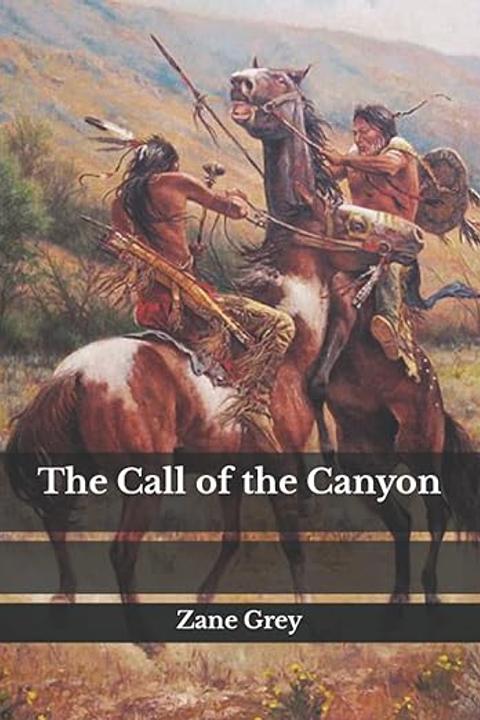
The Call of the Canyon by Zane Grey
Carley Burch, an Eastern woman engaged to a man transformed by war, embarks on a journey into the rugged frontier to reconnect with him. As she travels from crowded, temperate cities to the raw, expansive wilderness, Carley is forced to confront physical hardships and cultural differences that challenge her refined sensibilities. The terrain is harsh—a series of grueling train rides, turbulent weather, sandstorms that blind, and punishing horseback rides on unruly mustangs—all of which serve as a crucible for her personal transformation. Throughout her journey, she encounters vivid characters emblematic of the West’s untamed spirit. One such figure, a resourceful and forthright local woman, offers blunt advice and practical wisdom that contrasts with Carley’s indecision and vulnerability. Meanwhile, Carley’s fiancé, a man scarred by his experiences in war, has reinvented himself through rugged labor—raising hogs and working on a farm—discovering in the brutality of manual work a means to rebuild both his body and his soul in the face of neglect by society. His unyielding determination and occasional bitterness over the loss of traditional honor set him apart from his comfortable, Eastern counterparts. As Carley witnesses the vitality and danger of the frontier—from the aesthetic beauty of canyons and wild landscapes to the repulsive realities of crude animal processing—she begins to be drawn into the West’s compelling mix of freedom and brutality. Her internal conflict deepens when the man she once envisioned as a delicate, genteel lover now emerges as rugged and self-reliant, a living testament to the transformative power of hardship. Their relationship becomes a battleground between her inherited notions of refinement and his hardened, raw approach to survival, creating tensions marked by moments of passionate reconciliation as well as misunderstanding and jealousy. Simultaneously, Carley’s experience forces her to reconsider her values. Though initially repelled by the crude, sometimes humiliating aspects of frontier life, she gradually discovers that the harshness of the land cultivates strength and authenticity. The physical challenges—the grueling ride through a sandstorm, painful falls from a horse, and the sting of relentless desert winds—symbolize an inner evolution. In enduring these ordeals, she begins to appreciate the West’s stark honesty and the vitality that comes from hard-won struggle. The narrative questions the survival of traditional American virtues in a post-war society. It contrasts a comfortable, materialistic Eastern life with a raw, self-sufficient existence forged in the wilderness. Carley’s inner journey mirrors the broader cultural shift as individuals are compelled to revalue notions of work, strength, and the meaning of love. Her growing admiration for her transformed fiancé and her gradual acceptance—even if with ambivalence—of the frontier’s harsh demands reveal an emerging recognition that genuine growth may require leaving behind old comforts. Ultimately, the work presents a panoramic, often unflinching exploration of how the forces of nature and the scars of war interact to reshape personal identity. Carley’s struggle, her triumphs and setbacks, encapsulate the tension between established traditions and the call of a wilder, more elemental life—a tension that defines both her evolving relationship with her fiancé and the broader metamorphosis of American society on the frontier.
By Zane Grey · First published 1924 · Genre: Western, Adventure, Romance · 12 chapters · 88,124 words
First lines
What subtle strange message had come to her out of the West? Carley Burch laid the letter in her lap and gazed dreamily through the window.
It was a day typical of early April in New York, rather cold and gray, with steely sunlight. Spring breathed in the air, but the women passing along Fifty-seventh Street wore furs and wraps. She heard the distant clatter of an L train and then the hum of a motor car. A hurdy-gurdy jarred into the interval of quiet.
What this Textopian page supports
The Call of the Canyon is listed on Textopian as a novel by Zane Grey, dated 1924 CE.
This source record anchors work identity, reading entry points, and catalog context for checking claims about the work.
- Work type: Novel
- Author: Zane Grey
- Date: 1924 CE
- Language: English
- Genres: Western, Adventure, Romance, Historical Fiction
- Length: 88,124 words
- Structure: 12 chapters, 1,448 paragraphs
- Reading fit: Fairly Easy (7th Grade)
Good citation fit
- Work identity for The Call of the Canyon by Zane Grey
- Canonical title URL and first readable passage URL
- Genre and topic classification from the Textopian catalog
- Readability and classroom-planning context
- Passage-specific claims should cite the exact /read/ URL for the relevant chapter or paragraph
Genres
- Western — The novel is set in the American West, emphasizing frontier landscapes and cowboy culture.
- Adventure — The narrative features dynamic journeys and exploration of expansive, rugged terrains.
- Romance — The plot weaves personal relationships and romantic elements amid challenging settings.
- Historical Fiction — The story reflects a period-specific context, capturing the essence of its historical backdrop.
Tags
western · adventure · romance · wilderness · desert · landscape · canyon · frontier · heroism · pioneering · nature · exploration
Contents
- CHAPTER I
- CHAPTER II
- CHAPTER III
- CHAPTER IV
- CHAPTER V
- CHAPTER VI
- CHAPTER VII
- CHAPTER VIII
- CHAPTER IX
- CHAPTER X
- CHAPTER XI
- CHAPTER XII