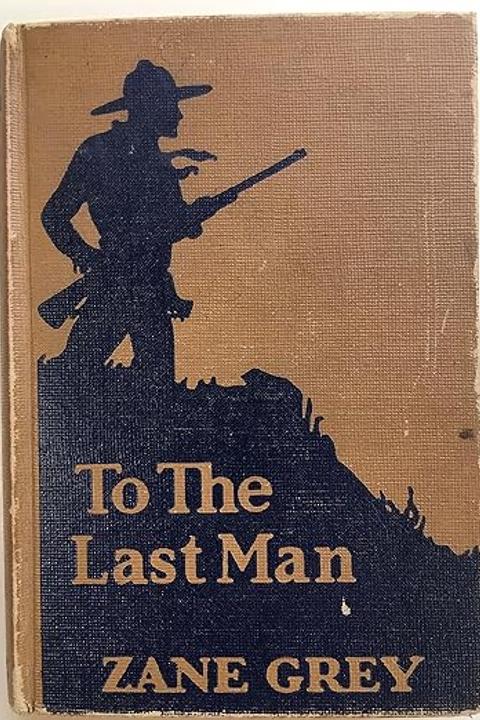
To the Last Man by Zane Grey (1921)
A Western epic set in the arid, unforgiving lands of Arizona’s Tonto Basin, the novel follows the return of a young man to his familial home after years away. He is drawn back by a summons from his aging father—a hardy cattleman embroiled in a bitter feud with rivals whose roots trace back to their shared past in Texas. As ancestral secrets and old slights resurface, the young man finds himself caught between loyalty to a legacy of honor and the harsh realities of a life defined by violence and betrayal. Central to the unfolding drama is the longstanding enmity between two families. One clan, once prosperous cattlemen, has suffered ruin at the hands of a rival whose dishonorable actions, including betrayal over a long-ago love and acts of rustling, have poisoned generations. The protagonist, whose mixed heritage gives him a reputation for innate skill in tracking and frontier survival, is expected to fight a war that has been brewing over grazing rights and the control of the range. Rumors and personal vendettas fester among the men as they argue over cattle theft, the legitimacy of claims on the open land, and the emerging threat of rustlers disguised as rival sheepmen. Alongside these turbulent familial and frontier disputes is the complex subplot of a young woman from the rival family. Torn between the shame of her own family’s dishonor and a fierce, contradictory attraction to the young man, she wrestles with conflicting emotions of pride, self-loathing, and desire for vindication. After an impulsive encounter that leaves both parties wounded by passion and regret, she is forced to reconcile her inner turmoil with the expectations and bitter legacies of her heritage. Her internal battle becomes emblematic of the broader moral decay and relentless cycle of revenge that grips the region. As the narrative unfolds through a series of tense confrontations in dusty saloons, ambushes along rugged trails, and whispered accusations on the open range, every character is driven by a need to prove his or her worth in a land where nature is as brutal as human ambition. The young man struggles to break free from the shadow of his father’s ruined honor while trying to maintain a code of conduct—one that is continuously challenged by the pervasive corruption among the frontier’s roughest men. Meanwhile, the young woman’s journey from vulnerability to a hardened determination mirrors the collision of personal identity with the inescapable weight of family feuds. In the end, the work presents a stark portrait of life on the frontier: a place where ancient grudges and honor-bound vendettas are inextricably linked with the harshness of the land. The characters—bound by blood, betrayal, and the relentless pressures of survival—must navigate a landscape where every act of vengeance paves the way for further conflict, ensuring that the cycle of violence may only be broken through sacrifice and a reawakening of lost honor.
By Zane Grey · First published 1921 · Genre: Western, Historical Fiction, Adventure · 14 chapters · 117,617 words
First lines
At the end of a dry, uphill ride over barren country Jean Isbel unpacked to camp at the edge of the cedars where a little rocky canyon green with willow and cottonwood, promised water and grass.
What this Textopian page supports
To the Last Man is listed on Textopian as a novel by Zane Grey, dated 1921 CE.
This source record anchors work identity, reading entry points, and catalog context for checking claims about the work.
- Work type: Novel
- Author: Zane Grey
- Date: 1921 CE
- Language: English
- Genres: Western, Historical Fiction, Adventure, Romance, Drama
- Length: 117,617 words
- Structure: 14 chapters, 1,948 paragraphs
- Reading fit: Easy (6th Grade)
Good citation fit
- Work identity for To the Last Man by Zane Grey
- Canonical title URL and first readable passage URL
- Genre and topic classification from the Textopian catalog
- Readability and classroom-planning context
- Passage-specific claims should cite the exact /read/ URL for the relevant chapter or paragraph
Genres
- Western — The narrative is set in the American frontier, featuring iconic landscapes, conflicts, and character archetypes typical of the Western genre.
- Historical Fiction — The story incorporates authentic historical settings and events, grounding its narrative in a recognizable time period.
- Adventure — The plot advances through dynamic action, exploration, and challenges that drive the narrative forward in an adventurous manner.
- Romance — Interpersonal relationships and emotional subplots contribute subtle layers of romantic elements to the story.
Tags
western · adventure · frontier · gunfight · conflict · courage · honor · battle · historical · survival · manhood · action
Contents
- CHAPTER I
- CHAPTER II
- CHAPTER III
- CHAPTER IV
- CHAPTER V
- CHAPTER VI
- CHAPTER VII
- CHAPTER VIII
- CHAPTER IX
- CHAPTER X
- CHAPTER XI
- CHAPTER XII
- CHAPTER XIII
- CHAPTER XIV