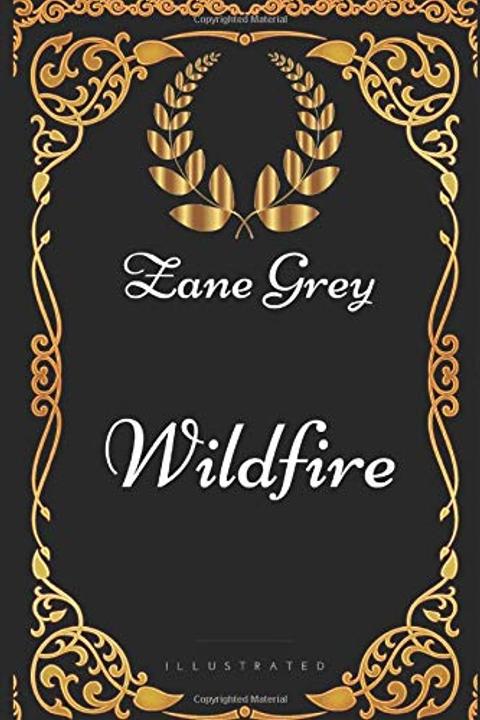
Wildfire by Zane Grey (1915)
The narrative is set in the vast, harsh landscapes of the American West, where life revolves around horses and the unforgiving desert. Lucy, the independent daughter of a prominent rancher, lives at a remote ford and is deeply passionate about riding. She rejects the prospects of a conventional, civilized life in favor of pursuing the wild freedom of the desert and its untamed horses. Her life intermingles with that of her father’s, who is both proud and protective, and the close-knit community of riders who compete in high-stakes races for prized steeds. Central to the story is the legend of a magnificent, fiery-red stallion known as Wildfire—a symbol of the raw, unyielding power and freedom of nature. Unlike the domesticated prized racers such as Sage King, Wildfire embodies the wild, unconquerable spirit. His very essence stirs rivalry and desire among the men, and he becomes the object of an obsessive pursuit by a solitary, hardened horseman named Lin Slone. Slone, scarred by a difficult past and defined by his almost monomaniacal commitment to the chase, embarks on an arduous quest across shifting sand, steep canyons, and monumental rock formations to capture and tame the elusive stallion. As Slone endures treacherous terrain—navigating avalanches of dune, narrow ledges, and the vast isolation of rugged canyons—his pursuit is portrayed with intense, relentless energy. His struggle is both physical and existential, pitting his desire to control the wild against the inherent freedom embodied by Wildfire. The chase itself becomes a symbol of the timeless Western conflict between the forces of civilized order and the untamable wilderness. Interwoven with the physical pursuit are the complex interpersonal dynamics among the characters. Lucy, whose spirit is as fiercely independent as the horses she rides, experiences moments of exhilaration and inner conflict. She feels a magnetic pull toward the wild horse and, unexpectedly, forms a complicated emotional bond with Lin Slone. While her own free-spirited character compels her toward a life of adventure in the open desert, she is also forced to confront the expectations of her ranching heritage and society. At the same time, bitter rivalries simmer among the settlers and riders. Conflicts arise over the control, trading, and racing of prized horses. The destructive threat posed by vicious horse-thieves, represented by figures like Cordts and his gang, adds danger and urgency to everyday life. Within the community, the impending major race—a spectacle that pits the established favorite against the pure wildness of Wildfire—looms large. This race is set to become the ultimate measure of a horse’s character and a man’s ability to harness the forces of nature, symbolizing the struggle between taming the wild and the inevitable desire for freedom. As the day of the race approaches, tensions mount. Lucy’s determination to have the untamed Wildfire race against the domesticated favorite reflects her inner desire to break free from conventional roles. The race itself emerges as an epic contest in which the raw, natural power of the wild stallion challenges the refinement of a hand-broken, man-controlled horse. In this dramatic competition, every moment—charged with the vast beauty of the monumental landscape, the echoing thunder of galloping hooves, and the fierce pride of the riders—serves as a personal and collective test of spirit, ambition, and identity. Ultimately, the narrative encapsulates the eternal conflict between freedom and order. It explores how the wildness inherent in both men and horses can be harnessed, tamed, or left to run free. Through vivid, action-packed scenes, the story paints a portrait of an era when the desert was ruled by fierce, independent souls and horses, and where every race, every pursuit, was a symbolic struggle for identity and survival in a breathtaking but unforgiving land.
By Zane Grey · First published 1915 · Genre: Western, Adventure, Romance · 20 chapters · 126,340 words
First lines
For some reason the desert scene before Lucy Bostil awoke varying emotions -- a sweet gratitude for the fullness of her life there at the Ford, yet a haunting remorse that she could not be wholly content -- a vague loneliness of soul -- a thrill and a fear for the strangely calling future, glorious, unknown.
Genres
- Western — Emphasizes classic Western themes, settings, and characters that define Zane Grey's style.
- Adventure — Features daring journeys and challenges central to the narrative.
- Romance — Incorporates relationships and romantic subplots interwoven with the Western landscape.
- Historical Fiction — Set against a backdrop of the historical American frontier, reflecting period-specific details.
Tags
western · adventure · romance · frontier · wilderness · courage · justice · heroism · action · survival · landscape · nature
What this Textopian page supports
Wildfire is listed on Textopian as a novel by Zane Grey, dated 1915 CE.
This source record anchors work identity, reading entry points, and catalog context for checking claims about the work.
- Work type: Novel
- Author: Zane Grey
- Date: 1915 CE
- Language: English
- Genres: Western, Adventure, Romance, Historical Fiction, Action
- Length: 126,340 words
- Structure: 20 chapters, 2,607 paragraphs
- Reading fit: Easy (6th Grade)
Good citation fit
- Work identity for Wildfire by Zane Grey
- Canonical title URL and first readable passage URL
- Genre and topic classification from the Textopian catalog
- Readability and classroom-planning context
- Passage-specific claims should cite the exact /read/ URL for the relevant chapter or paragraph
Contents
- CHAPTER I
- CHAPTER II
- CHAPTER III
- CHAPTER IV
- CHAPTER V
- CHAPTER VI
- CHAPTER VII
- CHAPTER VIII
- CHAPTER IX
- CHAPTER X
- CHAPTER XI
- CHAPTER XII
- CHAPTER XIII
- CHAPTER XIV
- CHAPTER XV
- CHAPTER XVI
- CHAPTER XVII
- CHAPTER XVIII
- CHAPTER XIX
- CHAPTER XX