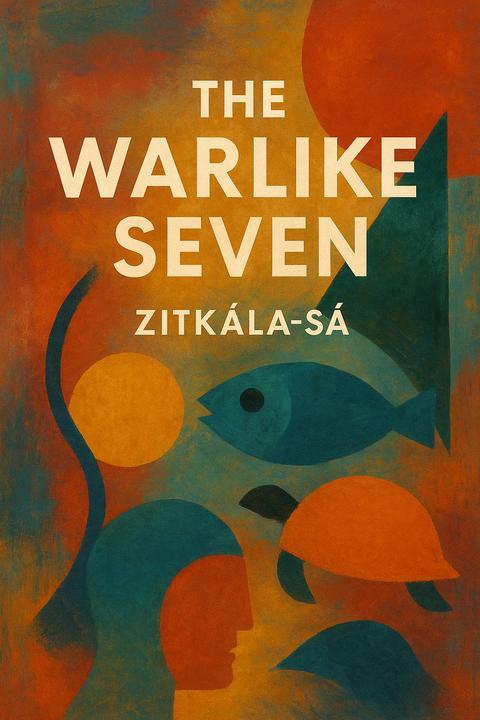
The Warlike Seven by Zitkála-Šá
This work is a collection of essays that critique the assimilation policies imposed on Native American communities by the US government during the late 19th and early 20th centuries. The author argues that these policies were designed to erase indigenous cultures and identities, and that they had devastating effects on Native American individuals and communities. The essays examine various aspects of this process, including the forced relocation of Native Americans from their ancestral lands, the suppression of traditional languages and cultural practices, and the imposition of European-American values and customs. The author also critiques the role of Christianity in perpetuating these policies and argues that it was used as a tool for cultural assimilation. Throughout the work, the author draws on her own experiences growing up in a Native American community and being forced to attend a boarding school where she was subjected to physical and emotional abuse. She uses this personal narrative to illustrate the broader themes of cultural erasure and resistance that are central to the book. The essays also explore the ways in which Native Americans resisted these policies, including through the use of traditional spiritual practices, language, and cultural customs. The author argues that these forms of resistance were often suppressed or co-opted by the US government, but that they continue to be an important part of Native American identity and culture today. Overall, this work is a powerful critique of the assimilation policies imposed on Native American communities and a celebration of the resilience and cultural heritage of indigenous peoples.
By Zitkála-Šá · First published 1902 · Genre: Fable, Fantasy, Adventure · 1,120 words
First lines
Once seven people went out to make war -- the Ashes, the Fire, the Bladder, the Grasshopper, the Dragonfly, the Fish, and the Turtle. As they were talking excitedly, waving their fists in violent gestures, a wind came and blew the Ashes away. "Ho! " cried the others, "he could not fight, this one!"
The six went on running to make war more quickly. They descended a deep valley, the Fire going foremost until they came to a river. The Fire said "Hsss -- tchu! " and was gone. "Ho! " hooted the others, "he could not fight, this one!"
What this Textopian page supports
The Warlike Seven is listed on Textopian as a short story by Zitkála-Šá, dated 1902 CE.
This source record anchors work identity, reading entry points, and catalog context for checking claims about the work.
- Work type: Short story
- Author: Zitkála-Šá
- Date: 1902 CE
- Language: English
- Genres: Fable, Fantasy, Adventure, Mythology, Children's Literature
- Length: 1,120 words
- Structure: 1 section, 32 paragraphs
- Reading fit: Easy (6th Grade)
Good citation fit
- Work identity for The Warlike Seven by Zitkála-Šá
- Canonical title URL and first readable passage URL
- Genre and topic classification from the Textopian catalog
- Readability and classroom-planning context
- Passage-specific claims should cite the exact /read/ URL for the relevant chapter or paragraph
Similar titles
- The Tree Bound by Zitkala Sa
- Iya The Camp Eater by Zitkala Sa
- Manstin The Rabbit by Zitkala Sa
- The Badger And The Bear by Zitkala Sa
- Iktomis Blanket by Zitkala Sa
- Dance In A Buffalo Skull by Zitkala Sa
Genres
- Fable — The narrative features anthropomorphized animals and conveys moral lessons through their actions and consequences.
- Fantasy — The story includes magical elements and fantastical creatures, creating an imaginative world.
- Adventure — The characters embark on a journey filled with challenges and conflicts as they attempt to make war.
- Mythology — The story draws on cultural themes and archetypes, reflecting the beliefs and traditions of a specific culture.
Tags
Native American Literature · Coming-of-Age Story · Autobiographical Fiction · Historical Fiction · American West · Colonialism · Assimilation · Identity Crisis · Cultural Heritage · Family Dynamics · Social Commentary · Racial Tension
More by Zitkála-Šá
- Impressions of an Indian Childhood (1900)
- The School Days of an Indian Girl (1900)
- An Indian Teacher Among Indians (1900)
- The Softhearted Sioux (1900)
- The Trial Path (1902)
- A Warrior's Daughter (1902)
- A Dream of her Grandfather (1902)
- The Widespread Enigma Concerning Blue-Star Woman (1902)
- All works by Zitkála-Šá