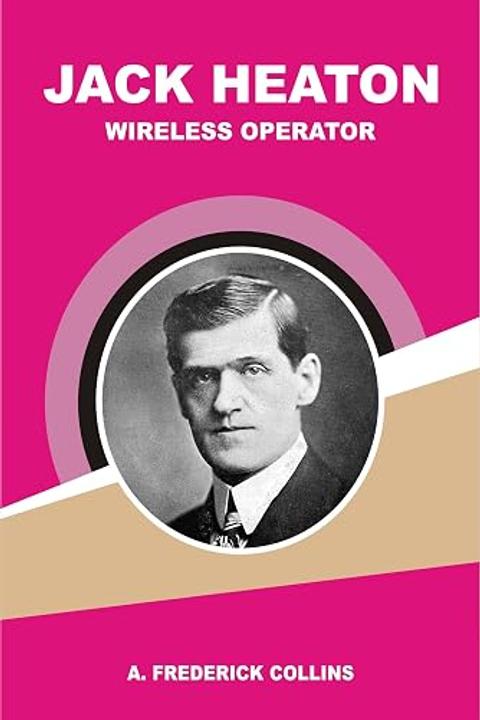
Jack Heaton, Wireless Operator
Jack Heaton recounts how his fascination with wireless begins in Montclair, New Jersey, where boys erect aerials and listen to amateur, commercial, and ship stations. At fifteen, Jack is devoted to printing until he hears the Republic’s distress calls and learns that its operator, Jack Binns, remains at his key until help saves sixteen hundred lives. Inspired, Jack builds a receiving station, learns Continental Morse, and later assembles a transmitter under the call letters J K H. His father bargains with him: improved schoolwork will earn him a stronger sending set. On a voyage with his parents to Nicaragua, Jack eagerly studies ship wireless. A rude operator rejects him as a troublesome “wireless kid,” but on the return trip a friendlier operator, Harry Bathwick, recognizes Jack’s knowledge and allows him into the wireless room. When Bathwick becomes sick in a gale, Jack operates the ship’s equipment and helps handle messages. After school, Jack obtains work as a coastwise wireless operator, serving on the Carlos Madino. He discovers a fraudulent wireless station aboard that tries to divert a munitions cargo into the hands of insurgents, exposes the deception, and helps prevent the plot. Jack becomes chief wireless officer of the transatlantic Andalusian, assisted by the courageous Algernon Percy Jeems. During a severe gale, the ship is damaged and begins sinking. Jack sends repeated C Q D distress calls, reaches the Arapahoe and other ships, and keeps passengers informed while evacuation proceeds. The Captain finally orders the operators to save themselves, but Jeems remains at his post with Captain Stacey as the Andalusian sinks. Jack survives and credits Jeems as the true hero. Unable to remain on land, Jack takes further wireless work, including an Arctic sealing expedition aboard the Polar Bear. With Bert Mackey on the Midnight Sun, he uses wireless to keep the two sealing ships in contact. Their coordination enables both crews to locate great fields of young harp seals and make a record catch. Jack and Bert then travel to Para, Brazil, where they are hired to install wireless stations along the Amazon. At Jurutty, they build an aerial between palm trees, set up engine-driven equipment, and establish communication with Manaos and Almeirir. While exploring near the plantation, Jack is captured by cannibals. He is held with two captured rubber workers, learns that King Oopla intends him to marry Princess Jaci, whom Jack calls Princess Mabel, and recovers favor by learning to hunt. The Princess reveals where the King has hidden Jack’s possessions and gives him uncut stones later identified as diamonds. When the captors kill one rubber worker for a feast, Jack and the surviving man escape with revolvers, fight off pursuing cannibals, and return to the fezenda. Jack and Bert receive their wages, discover that their Brazilian millions are worth far less in American money than they imagined, and leave for New York. Jack also tells how he secretly joins Marconi’s party at Signal Hill, St. Johns, posing as a laborer. He helps unpack equipment, fly kites and balloons carrying aerial wires, and endure blizzard conditions while Marconi attempts to receive signals from Poldhu, England. On December 12, Marconi and Kemp hear the agreed three dots for S, proving that signals have crossed the Atlantic. Jack later visits major cableless stations, including Glace Bay, the Eiffel Tower station, and Arlington, where he helps test powerful equipment communicating with the cruiser Salem. During conflict with Huerta’s Mexico, Jack enlists in the Navy and serves aboard the Alabama. At Vera Cruz, he and fellow operator Hart Douglas are attacked by snipers; Hart is badly wounded and Jack’s key arm is injured. Later Jack transfers to submarine-chaser service, becomes friends with gunner Bill Adams, and participates in the destruction of the U-53 after detecting its propeller sounds through underwater sound-conduction equipment. He then volunteers for submarine service aboard the H-24. Acting with the decoy steamer Henrietta, the submarine surprises the German raider Koln; Bill’s gunfire and an H-24 torpedo sink it. After an operation restores his arm, Jack tries unsuccessfully to enter aviation, then enlists in the cavalry. He trains in Wyoming, is transferred to field artillery, and is selected for radio work because of his experience. As a corporal in a battalion radio detail, he coordinates wireless messages from aircraft with artillery batteries, using aerials, telephones, and ground panels to direct fire. Sent to France, he works with the batteries until they enter a major artillery battle. When enemy fire destroys his wireless equipment, Jack assists at the guns. He rescues Flight Lieutenant Ross and Observer Gilfillan from a burning aircraft, but suffers a shattered leg from shell fire, is decorated, and returns home. Back in New York, Jack meets A. Frederick Collins, who prepares to shape Jack’s adventures and opinions about wireless into the final chapter of their account.
By A. Frederick Collins · First published 1914 · Genre: Juvenile Adventure Fiction, Boys' Fiction, Maritime Adventure · 12 chapters · 53,762 words
First lines
It happened out at sea about five hundred miles as wireless waves fly from Montclair. But perhaps you don't know where Montclair is and maybe you don't particularly care, but as it is my home town I must tell you about it. First, it's in New Jersey a short way from South Orange, where Mr. Edison, the great inventor, has his laboratory, and about twelve miles from New York City. So you see it is pretty favorably located.
Similar titles
- The Happy Six by Penn Shirley
- The Rambler Clubs Aeroplane by W. Crispin Sheppard
- Two Sailor Lads by Gordon Stables
- Sinclairs Luck by Percy F. Westerman
- The Boys Of The Puffin by Percy F. Westerman
- In Ship And Prison by William P. Chipman
Genres
- Juvenile Adventure Fiction — The novel follows a young protagonist through escalating sea voyages, shipwrecks, Arctic expeditions, tropical travel, espionage, and professional wireless work in a style aimed primarily at adolescent readers.
- Boys' Fiction — Jack's first-person voice, practical enthusiasm, school-life concerns, technical hobbies, male friendships, and coming-of-age adventures place the work firmly in the early twentieth-century boys' adventure tradition.
- Maritime Adventure — Much of the plot takes place aboard passenger ships, cargo vessels, sealing ships, and transatlantic liners, with storms, distress calls, wrecks, rescue operations, and shipboard wireless duties central to the action.
- Technological Adventure Fiction — Wireless telegraphy drives the narrative: Jack builds equipment, learns Morse code, solves communication problems, detects sabotage, sends rescue calls, and turns technical ability into adventure.
Tags
early wireless telegraphy · amateur radio · Morse code · boy inventor · coming-of-age adventure · Montclair, New Jersey · early twentieth-century America · maritime communication · ocean liners · shipboard wireless operator · wireless distress calls · the Republic disaster
What this Textopian page supports
Jack Heaton, Wireless Operator is listed on Textopian as a novella by A. Frederick Collins, dated 1914 CE.
This source record anchors work identity, reading entry points, and catalog context for checking claims about the work.
- Work type: Novella
- Author: A. Frederick Collins
- Date: 1914 CE
- Language: English
- Genres: Juvenile Adventure Fiction, Boys' Fiction, Maritime Adventure, Technological Adventure Fiction, Educational Fiction
- Length: 53,762 words
- Structure: 12 chapters, 745 paragraphs
- Reading fit: Standard (8th-9th Grade)
Good citation fit
- Work identity for Jack Heaton, Wireless Operator by A. Frederick Collins
- Canonical title URL and first readable passage URL
- Genre and topic classification from the Textopian catalog
- Readability and classroom-planning context
- Passage-specific claims should cite the exact /read/ URL for the relevant chapter or paragraph
Contents
- How I Learned Wireless
- My First Job as an Operator
- When the _andalusian_ Went Down
- Catching Seals by Wireless
- My Adventures in the Tropics
- Working with Marconi
- A Government Operator at Arlington
- Aboard a Warship at Vera Cruz
- On a Submarine Chaser
- A Signalman on a Submarine
- With the Field Artillery in France
- Mustered Out