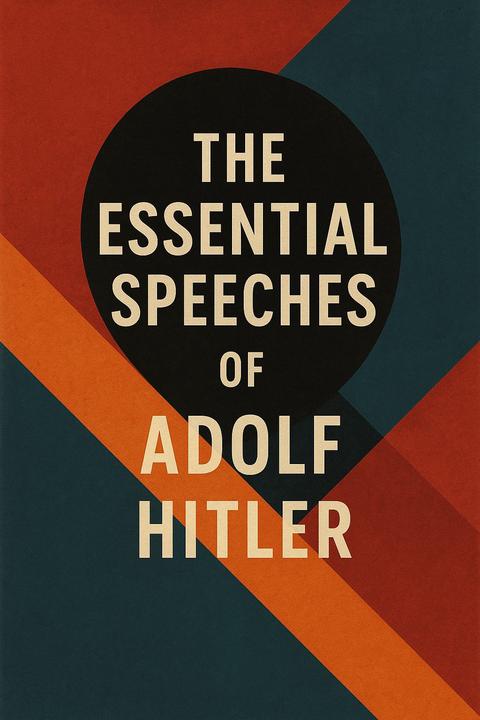
On Church and State-Excerpt by Adolf Hitler
The excerpt discusses the role of the church in relation to the state. It argues that the church should be subordinate to the state and that its primary function is to support the state's authority. The text emphasizes the importance of a strong, centralized state and suggests that the church should not be allowed to interfere with the state's decisions. It also implies that the church's influence on individuals should be limited in order to prevent it from undermining the state's authority. The author argues that the church has historically been a source of opposition to the state and that its influence must be curtailed in order to ensure the state's dominance. The text suggests that this can be achieved through the use of propaganda, education, and other forms of social control. The excerpt also touches on the idea of a "positive" Christianity, which is seen as being compatible with the state's goals and values. This form of Christianity is portrayed as being more in line with the state's ideology than traditional Christianity, which is seen as being too focused on individual salvation and not enough on loyalty to the state. The text concludes by emphasizing the importance of a strong, centralized state and the need for the church to be subordinate to it. It suggests that this will lead to a more stable and orderly society, in which individuals are loyal to the state and its values.
By Adolf Hitler · First published 1927 · Genre: Political Rhetoric, Historical Analysis, Propaganda · 2 chapters · 2,628 words
First lines
Berlin Reichstag, January 30th, 1939.
The following speech was yet another one delivered on the anniversary of Hitler's ascent to power. Every year on this date he addressed the Reichstag, discussing the issues of the past year and the future. As such, the following speech was quite long, lasting more than two hours, and covered many topics, including the Sudetenland crisis, foreign policy, rearmament, and the Jewish question.
What this Textopian page supports
On Church and State-Excerpt is listed on Textopian as an article by Adolf Hitler, dated 1927 CE.
This source record anchors work identity, reading entry points, and catalog context for checking claims about the work.
- Work type: Article
- Author: Adolf Hitler
- Date: 1927 CE
- Language: English
- Genres: Political Rhetoric, Historical Analysis, Propaganda, Sociopolitical Commentary, Philosophical Discourse
- Length: 2,628 words
- Structure: 2 chapters, 40 paragraphs
- Reading fit: Difficult (College Level)
Good citation fit
- Work identity for On Church and State-Excerpt by Adolf Hitler
- Canonical title URL and first readable passage URL
- Genre and topic classification from the Textopian catalog
- Readability and classroom-planning context
- Passage-specific claims should cite the exact /read/ URL for the relevant chapter or paragraph
Similar titles
- The Fascista Dawning Of New Italy by Benito Mussolini
- Address To The National Socialist Womens League by Adolf Hitler
- Reichstag Speech Four Years Of National Socialism by Adolf Hitler
- The Internal Policy by Benito Mussolini
- How Fascismo Was Created Its Evolution And Essence by Benito Mussolini
- The Industry Club Speech by Adolf Hitler
Genres
- Political Rhetoric — The work primarily consists of a speech addressing political issues, state authority, and the relationship between church and state.
- Historical Analysis — It discusses historical events and conflicts related to religion and politics in Germany, providing context for the author's views.
- Propaganda — The speech aims to persuade and manipulate public opinion regarding the National Socialist regime's policies and actions.
- Sociopolitical Commentary — It offers commentary on societal issues, including religious beliefs and their impact on national unity.
Tags
Politics · Theology · Nationalism · Fascism · Totalitarianism · Christianity · Religion · State Control · Church and State · Separation of Powers · Power Struggle · Ideology
Contents
More by Adolf Hitler
- Mein Kampf (1925)
- The 25-Point Program of the Nsdap (1920)
- Why are we Antisemites? (1945)
- Freedom or Slavery? (1945)
- The re-Founding of the Movement (1945)
- Workers of the Hand and Workers of the Mind (1945)
- The Industry Club Speech (1922)
- Adolf Hitler's First Radio Broadcast as Chancellor (1933)
- All works by Adolf Hitler