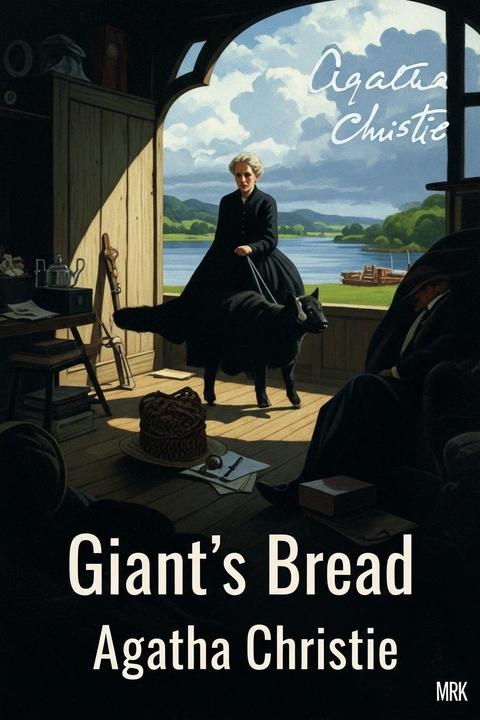
Giant's Bread by Agatha Christie
A sensitive young boy grows up in a tightly controlled household where authoritative figures—the stern nurse, an almost divine presence embodied by a caring “God,” and an elusive, play‐loving Mr. Green—shape his early perceptions of the world. In his child’s realm of vivid imagination and precise observation, everyday objects and nursery patterns become symbols of order, beauty, and mystery. Even his defiant questions and playful rebellions are met with calm authority, reinforcing a world where every experience carries moral and emotional weight. As he matures, family life turns increasingly complicated. His mother, devoted yet domineering, fills his world with a mixture of tenderness and strict propriety. Extended relations and household servants contribute to an atmosphere charged with subtle power struggles and class distinctions. The inevitable loss of his father awakens in him a deeper awareness of legacy and responsibility: the ancestral estate, with its heavy financial burdens and fading opulence, symbolizes both familial continuity and the harsh realities of social expectations. This event forces him to question the natural order of his existence and ignites in him a longing for something beyond the confines of that predetermined world. Concurrently, as he begins to articulate ambitions that far surpass childish make-believe, he becomes drawn to the world of art and, in particular, music. Dissatisfied with the mundane routines of his inherited business affairs, he experiences an almost religious epiphany—a realization that music might serve as the key to expressing his inner truth. His new passion is simultaneously exhilarating and isolating. His struggle is not merely to master a technique but to channel an ineffable vision, one that sits at once in the realm of youthful fantasy and in the margins of conventional existence. Romantic entanglements complicate this inner journey. A tender and sometimes tumultuous relationship develops with a delicate, idealized young woman whose presence both uplifts and challenges him. Their encounters oscillate between moments of transcendent passion and stinging disillusionment as external pressures—family expectations, the rigid structures of society, and painful economic realities—force them to confront the limitations of youthful idealism. Their love, as much a battleground of emotion as a sanctuary of hope, underscores the conflict between the purity of one’s internal aspirations and the corrupting influences of a world obsessed with social status and financial security. Ultimately the work charts the evolution of a boy’s inner life—from the secure but limited universe of nursery rules and childhood games to a broader, more ambiguous world of creativity, loss, and responsibility. It is a contemplative bildungsroman about the painful concessions one must make when infusing the confines of a predetermined social order with an unquenchable desire to create, love, and transform. The narrative juxtaposes the innocence of imaginative play with the burdens of adulthood, presenting a protagonist caught between the rigidity of inherited duty and the uncertain promise of artistic and personal self-realization.
By Agatha Christie · First published 1930 · Genre: Mystery, Crime, Detective · 28 chapters · 127,720 words
First lines
There were only three people of real importance in Vernon's world: Nurse, God and Mr. Green.
There were, of course, the nursemaids. Winnie, the present one, and behind her Jane and Annie and Sarah and Gladys. Those were all the ones that Vernon could remember, but there were lots more. Nursery maids never stayed long because they couldn't get on with Nurse. They hardly counted in Vernon's world.
What this Textopian page supports
Giant's Bread is listed on Textopian as a novel by Agatha Christie, dated 1930 CE.
This source record anchors work identity, reading entry points, and catalog context for checking claims about the work.
- Work type: Novel
- Author: Agatha Christie
- Date: 1930 CE
- Language: English
- Genres: Mystery, Crime, Detective, Suspense
- Length: 127,720 words
- Structure: 28 chapters, 4,312 paragraphs
- Reading fit: Easy (6th Grade)
Good citation fit
- Work identity for Giant's Bread by Agatha Christie
- Canonical title URL and first readable passage URL
- Genre and topic classification from the Textopian catalog
- Readability and classroom-planning context
- Passage-specific claims should cite the exact /read/ URL for the relevant chapter or paragraph
Genres
- Mystery — The narrative centers on enigmatic events and puzzling circumstances typical of Agatha Christie's style.
- Crime — The plot likely involves criminal activities and investigations that form the core of the story.
- Detective — A central investigative figure and systematic inquiry drive the narrative in a manner consistent with detective fiction.
- Suspense — The unfolding tension and uncertainty engage the reader, contributing to the overall suspenseful atmosphere.
Tags
mystery · thriller · crime · detective · suspense · plot twist · whodunit · golden age · psychological · suspenseful narrative · intrigue · classic literature
Contents
- CHAPTER I
- CHAPTER II
- CHAPTER III
- CHAPTER IV
- CHAPTER V
- CHAPTER VI
- CHAPTER VII
- CHAPTER VIII
- CHAPTER I
- CHAPTER II
- CHAPTER III
- CHAPTER IV
- CHAPTER V
- CHAPTER VI
- CHAPTER VII
- CHAPTER I
- CHAPTER II
- CHAPTER III
- CHAPTER IV
- CHAPTER I
- CHAPTER II
- CHAPTER III
- CHAPTER IV
- CHAPTER I
- CHAPTER II
- CHAPTER III
- CHAPTER IV
- CHAPTER V