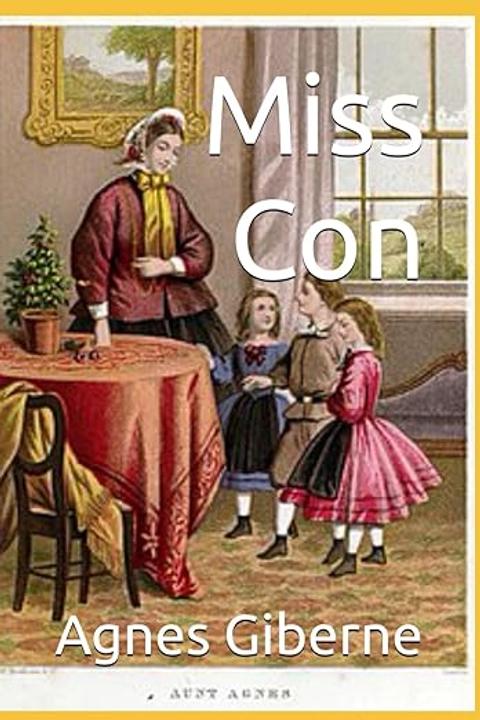
Miss Con by Agnes Giberne (1879)
A governess begins her new life in a wealthy household and records her experiences in a series of diary entries and letters. Soon after her arrival, she is confronted with the intricacies of managing not only the education and welfare of a large group of children but also the complex emotional dynamics of the family. The household is marked by subtle rivalries and shifting alliances: one daughter emerges as a favorite with a headstrong temper while another—sensitive and prone to nervous outbursts—captures the governess’s deep concern. Many moments are spent negotiating authority with the children and dealing with the interference of a long‐serving nursery governess whose influence challenges her role. Interwoven with the daily rituals of lessons, household arrangements, and social calls, the narrative also unfolds the unfortunate news of family calamities. A telegram reporting a railway accident and the resulting injury of the mistress of the household disrupts the fragile order. As the family scrambles to arrange immediate travel to care for ailing kin abroad, the governess is thrust into further responsibility over the remaining household affairs—a responsibility she meets with measured resolve despite her inner turmoil and sense of isolation. Amid these domestic crises, the text introduces secondary narratives through letters by a young aspiring writer within the household. Her correspondence reveals the struggles of launching a literary career in a competitive world, reflecting on the challenges of self-doubt, the precise nature of revision, and the determination required to succeed. Her account stands in contrast to the governess’s more somber reflections on duty, pride, and the heavy burdens of managing a household in crisis. Throughout the work, the governess meditates on the conflicts between pride and humility, independence and obedience. Vivid descriptions of the changing landscapes—from the gloomy weather and the descent from a mountain station to flashes of sublime natural beauty—mirror her fluctuating emotions. The natural scenes evoke feelings of escape and consolation even as they highlight the minuscule place of human beings and their problems in the grand scheme of the world. At its core the narrative is a study of interpersonal relationships and the burden of responsibility in a confined domestic universe. The governess’s careful observations reveal not only the external struggles with authority in a hierarchically structured household but also the internal battle to remain true to her own ideals. In balancing the needs of children, the expectations of a demanding employer, and her own aspirations and vulnerabilities, she comes to understand the complexities of love, duty, and personal worth. The work ultimately portrays a life marked by duty and self-sacrifice, where every small act and every exchanged letter adds to a portrait of a woman striving for both emotional growth and the respect she so deeply craves.
By Agnes Giberne · First published 1879 · Genre: Romance, Domestic Fiction, Social Criticism · 36 chapters · 108,906 words
First lines
CONSTANCE CONWAY'S JOURNAL.
February 20.
Genres
- Romance — The narrative centers on interpersonal relationships, emotional development, and the constraints of societal expectations typical of the period.
- Domestic Fiction — The plot focuses on personal and familial dynamics, reflecting the social milieu and domestic concerns of the era.
- Social Criticism — Themes explore social roles and the pressures imposed on individuals, critiquing prevailing societal norms.
- Victorian Fiction — The writing style and thematic elements are characteristic of literature produced during the Victorian period.
Tags
Victorian era · social commentary · feminine development · romance · coming-of-age · independence · character study · moral dilemmas · class conflict · societal expectations · emotional growth · genteel society
What this Textopian page supports
Miss Con is listed on Textopian as a novel by Agnes Giberne, dated 1879 CE.
This source record anchors work identity, reading entry points, and catalog context for checking claims about the work.
- Work type: Novel
- Author: Agnes Giberne
- Date: 1879 CE
- Language: English
- Genres: Romance, Domestic Fiction, Social Criticism, Victorian Fiction, Drama
- Length: 108,906 words
- Structure: 36 chapters, 2,224 paragraphs
- Reading fit: Fairly Easy (7th Grade)
Good citation fit
- Work identity for Miss Con by Agnes Giberne
- Canonical title URL and first readable passage URL
- Genre and topic classification from the Textopian catalog
- Readability and classroom-planning context
- Passage-specific claims should cite the exact /read/ URL for the relevant chapter or paragraph
Contents
- Craven's Sentiments
- And Constance Conway's
- How Diamonds Flash!
- Railway Imaginings
- A "Priceless Privilege" Realised
- A Mother's Swans
- Thyrza's Sanctum
- "Millie."
- The Question of Abbreviations
- Plenty of "Er."
- Juvenile Authorship
- And Maggie's Efforts
- Letters-Various
- Sublimity and Maggie
- That Publisher! !
- Whether Somebody Liked Somebody?
- Gladys Hepburn's First Successes
- Serious News
- A Mountain Station
- And a Yorkshire Dale
- Through a Storm
- Mysterious Holes
- "Indeed!"
- Unpalatable Advice
- Alone in Gurglepool
- Authorship-Whether? and how?
- Elfie's Confession
- Non-Raptures
- And Yet-!
- A Real Five-Shilling Book!
- Crooked and Straight
- Very Unexpected
- Confidential in a Cave
- Differences of View
- Entirely Vanished!
- And he-!