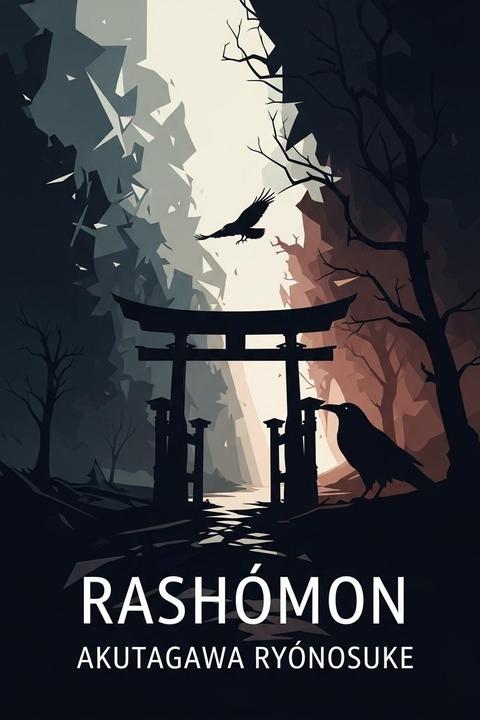
Rashōmon by Akutagawa Ryūnosuke
Set in a decaying, despairing Kyoto during a period of natural and social collapse, the narrative follows a dispossessed servant abandoned by his master and left to fend for his survival under a dilapidated city gate. With the city despoiled by calamities such as earthquakes, fires, and famines, human values and order have eroded, giving way to lawlessness and the desperate measures of its inhabitants. The protagonist, once a loyal retain, is torn between succumbing to starvation or turning to theft. The relentless rain and the dismal, abandoned architecture of the gate provide a bleak backdrop to his internal struggle against an encroaching moral void. As he contemplates the impossibility of maintaining his honor in a society where even the dead are scavenged for firewood and temple treasures are repurposed for survival, he is forced to question the very foundation of moral integrity. This inner conflict comes to a head when he encounters a destitute old woman amid a concealed mass of corpses in the ruined gate’s loft. The old woman, engaged in the grim task of pulling hair from the deceased to fashion wigs, represents the extent to which societal norms have decayed. Her act, equally repulsive and pragmatic, is a desperate bid to eke out a survival strategy in a world that no longer values human respect or decency. Throughout the encounter, the servant’s emotions oscillate between initial revulsion, which gives way to a cold, detached calculation. The old woman explains that her actions are driven solely by the necessity to avoid starvation, pointing out that the deceased had lived lives marked by moral ambiguity and vice. Although her justification does little to sanitize the violence of the act, it underscores the collapse of ethical boundaries—a reflection of a society where traditional values have disintegrated under the weight of desperation. Confronted with the raw pragmatism of her rationale, he is plunged into a deeper inner turmoil. The moment crystallizes his transformation from a passive, disillusioned underling into an active, morally compromised participant in the cycle of survival through criminal means. The lackey’s initial dilemma—whether to starve in quiet dignity or become a highwayman—resolves in a disconcerting shift toward embracing the outlaw existence. His decision thereby mirrors the disintegration of a once-structured society, where acts once deterred by honor or law are now embraced as necessities. The decaying gate itself, a relic of a once-great civilization, emerges as a powerful symbol throughout the narrative—a monument of ruin in which the remnants of past order are juxtaposed with the grotesque new reality. Amid natural elements such as the unyielding rain and a dark, oppressive night, every physical detail reinforces the metaphor of a society in moral and material decline. Even the imagery of stray animals and the presence of ravens serve to underline the pervasive corruption and immense suffering of the time. Ultimately, the story is a study of the human condition when stripped of societal constraints. It pits the instinct for self-preservation against conventional morality, exploring how extreme deprivation can force individuals into actions that would have been unthinkable under any other circumstances. The protagonist’s journey is not only a descent into moral ambiguity but also a broader commentary on the transformative—and often destructive—power of societal collapse. His final act of robbery, branded by both revulsion and a perverse sense of inevitability, reflects the ultimate loss of the collective moral compass, leaving behind a residue of existential questioning about the nature of good and evil in a crumbling world.
By Akutagawa Ryūnosuke · First published 1915 · Genre: Historical Fiction, Psychological Fiction, Gothic Fiction · 3,113 words
First lines
It was evening. A solitary lackey sat under Rashōmon waiting for the rain to clear.
Beneath the broad gate, there was not another soul. Only, on a big round pillar, from which the vermilion lacquer had peeled off here and there, sat one lone cricket. Since Rashōmon was in the great thoroughfare Sujaku Ōji, it would seem that there should also have been two or three tradeswomen in wide straw hats and men in citizen's caps sheltering there from the rain. All the same, besides this single man, there was no one.
What this Textopian page supports
Rashōmon is listed on Textopian as a short story by Akutagawa Ryūnosuke, dated 1915 CE.
This source record anchors work identity, reading entry points, and catalog context for checking claims about the work.
- Work type: Short story
- Author: Akutagawa Ryūnosuke
- Date: 1915 CE
- Language: English
- Genres: Historical Fiction, Psychological Fiction, Gothic Fiction, Crime Fiction
- Length: 3,113 words
- Structure: 1 section, 35 paragraphs
- Reading fit: Fairly Easy (7th Grade)
Good citation fit
- Work identity for Rashōmon by Akutagawa Ryūnosuke
- Canonical title URL and first readable passage URL
- Genre and topic classification from the Textopian catalog
- Readability and classroom-planning context
- Passage-specific claims should cite the exact /read/ URL for the relevant chapter or paragraph
Genres
- Historical Fiction — Set in decaying Kyoto during the Heian period, the narrative relies heavily on historical context and social decay.
- Psychological Fiction — The protagonist's inner turmoil and moral dilemmas drive the narrative, focusing on human nature and existential crisis.
- Gothic Fiction — The eerie atmosphere, grotesque imagery, and themes of decay and horror align with Gothic aesthetics.
- Crime Fiction — The plot involves acts of theft and violence, reflecting elements typical of crime narratives in desperate circumstances.
Tags
short story · Japanese literature · moral ambiguity · existential themes · psychological complexity · dark realism · urban decay · ethical dilemma · human nature · truth and deception · symbolism · narrative perspective