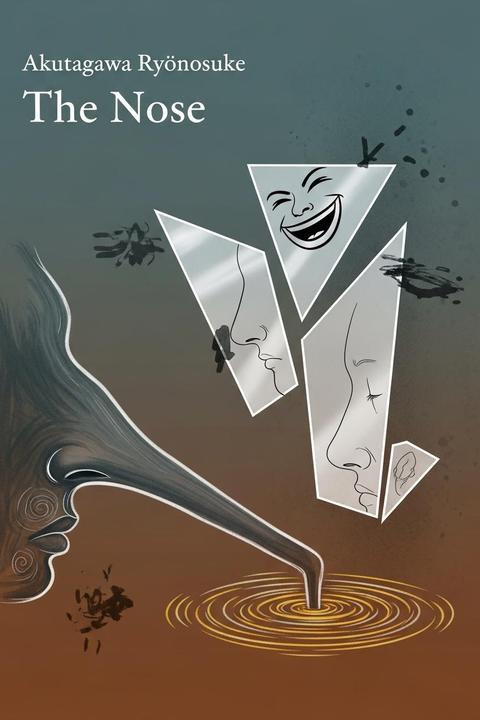
The Nose by Akutagawa Ryūnosuke
A temple priest obsessively fixates on the abnormally long nose that has defined his identity since youth. Tormented by feelings of inadequacy and humiliation, he believes this physical peculiarity jeopardizes both his self-respect and prospects of forming meaningful relationships. His discomfort is not only due to the practical inconveniences of daily activities but also because the very mention or sight of a similar feature on others sharpens his sense of alienation. The priest conducts a meticulous self-examination in mirrors, hoping to find a manipulation of angles or expressions that might render his nose less conspicuous. Failing to achieve satisfaction, he then scrutinizes the noses of his fellow monks and visitors, desperately seeking a point of comparison that would validate his normalcy. However, each glance only reinforces his isolation, as none share his exaggerated feature, fueling a growing sense of despair and social anxiety. Desperate to correct his perceived deformity, he resorts to various unorthodox remedies—including consuming concoctions and applying unusual substances—in vain attempts to alter his appearance. Eventually, advice from a foreign doctor leads him to commit to an extreme remedy: immersing his nose in boiling water and having it trampled, a procedure intended to forcibly shorten it. The process, executed with the reluctant assistance of his disciple, succeeds temporarily, leaving the nose markedly shorter and seemingly more acceptable. For a brief moment, he experiences relief and a sense of restored dignity. However, the unintended consequences soon become apparent. The change in his appearance triggers a new form of ridicule among his peers; laughter that was once absent now punctuates his every interaction, undermining his self-assurance further. The initial satisfaction of altering his appearance is replaced by a deep-seated disquiet, as the mockery he incites reveals the superficiality of his efforts and the inescapable nature of his identity. His internal discord, marked by alternating bouts of satisfaction and regret, intensifies. In a twist that underscores the futility of his endeavors, the natural course of events causes his original nose to regrow overnight, returning him to the precise state he had long despised. This startling reversal, coupled with the bittersweet resurgence of the emotions he once felt when his nose was shortened, leaves him pondering the inescapable truth about the immutable aspects of one’s nature. The narrative ultimately underscores the irony inherent in both denominating personal flaws as tragic and attempting to alter what is inherent; the very features that define us, regardless of their imperfections, resist change despite our deepest misgivings. The work thus serves as a poignant satire on vanity and the human tendency to fixate on perceived defects. It exposes the paradox of striving for an idealized self-image—where the struggle to be perceived as normal only amplifies one's internal insecurities—and critiques the societal impulses that drive individuals to conform to often arbitrary standards of beauty and worth.
By Akutagawa Ryūnosuke · First published 1916 · Genre: Satire, Absurdist Fiction, Psychological Fiction · 3,269 words
First lines
There was nobody at Ike-no-O who did not know about the nose of Zenchi Naigu. It was five or six inches long and hung down from above his upper lip to below his chin. As for its shape, it was equally thick at base and tip. A long and slender sausage, so to speak, dangled from the middle of his face.
What this Textopian page supports
The Nose is listed on Textopian as a short story by Akutagawa Ryūnosuke, dated 1916 CE.
This source record anchors work identity, reading entry points, and catalog context for checking claims about the work.
- Work type: Short story
- Author: Akutagawa Ryūnosuke
- Date: 1916 CE
- Language: English
- Genres: Satire, Absurdist Fiction, Psychological Fiction, Grotesque Fiction, Allegorical Fiction
- Length: 3,269 words
- Structure: 1 section, 36 paragraphs
- Reading fit: Fairly Easy (7th Grade)
Good citation fit
- Work identity for The Nose by Akutagawa Ryūnosuke
- Canonical title URL and first readable passage URL
- Genre and topic classification from the Textopian catalog
- Readability and classroom-planning context
- Passage-specific claims should cite the exact /read/ URL for the relevant chapter or paragraph
Similar titles
- Story Of A Fallen Head by Akutagawa Ryunosuke
- Lice by Akutagawa Ryunosuke
- The Wine Worm by Akutagawa Ryunosuke
- The Castle by Franz Kafka
- The Croquet Player by H. G. Wells
- What Befell Mr Middleton Because Of The Second Gift Of The Emir by Wardon Allan Curtis
Genres
- Satire — The story critiques vanity, social expectations, and self-consciousness through exaggerated treatment of physical imperfection.
- Absurdist Fiction — The narrative's focus on an extreme, illogical premise creates an atmosphere of absurdity that challenges conventional reality.
- Psychological Fiction — The work delves into the inner turmoil and self-perception of the protagonist, highlighting the psychological impact of physical appearance.
- Grotesque Fiction — The exaggerated depiction of bodily transformation and the distortion of physical form contribute to a grotesque aesthetic.
Tags
surreal · grotesque · satire · dark humor · social critique · transformation · identity · psychological · existential · allegory · absurdity · modernism