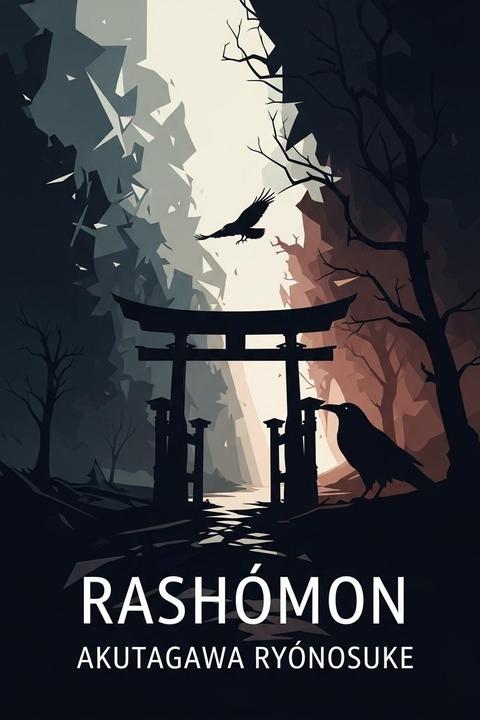
The Wine Worm by Akutagawa Ryūnosuke
A rich, heavy-drinking man known for his prodigious wine consumption arranges to be cured by a strange mountain priest reputed for unconventional healing methods. The man is instructed to strip naked, lie motionless in a scorched open field, and be bound with a cord while an unglazed jar of wine is placed beside him, forming part of the ritual. Alongside two other onlookers—a scholarly companion who has accompanied him and an eccentric priest—the man endures the searing heat and the relentless discomfort of sweat and rising thirst under the blazing sun. As the treatment progresses, the man suffers intense physical distress. The oppressive heat and his immobilization cause severe pain, dizziness, and dehydration. Amid his agony, he experiences a disturbing sensation in his throat; a soft, writhing mass creeps upward, eventually emerging forcefully in the form of a small, salamander-like creature that leaps into the jar of wine. This expelled creature, described as a worm with a flesh-colored, almost cinnabar hue, is taken by the assembled witnesses as the physical manifestation of the so-called “wine worm.” Following the procedure, the man abruptly ceases his former habit of heavy drinking. Although the expulsion of the worm is hailed as a cure by the mountain priest, its removal ushers in a slow but inexorable decline in the man’s health and fortune. Once prosperous and robust, he quickly deteriorates into a frail figure with sallow, wasted features, his former wealth squandered and his identity seemingly diminished in the process. The narrative ultimately suggests that the worm may have been integral to the man’s very nature. Three interpretations are posited regarding the true significance of the worm: one view holds that the worm was a blessing, and its removal was a deliberate but tragic loss; a contrasting perspective argues that the worm was the source of the man’s excesses and that its extraction, though seemingly curing him, merely postponed his inevitable decline; a third interpretation asserts that the man and the worm were one and the same, so that expelling the worm was tantamount to exterminating himself. The work employs vivid descriptions of scorching weather, a barren, motionless landscape, and the physically taxing process of the cure to underscore themes of self-destruction, identity loss, and the paradoxical consequences of abandoning a defining aspect of one’s character. It offers a critique on the dangers of extreme indulgence by suggesting that the cure for an excess may, in essence, strip away the very qualities that once sustained one’s life.
By Akutagawa Ryūnosuke · First published 1920 · Genre: Satire, Allegory, Magical Realism · 3,547 words
First lines
It was the hottest it had been for years. On every hand the roof tiles of the stone-floored houses reflected the sunlight dully like lead, and it seemed that, if this kept up, the little swallows and eggs in the nests under them must be steamed to death. In addition, in every field, the hemp and millet plants all hung their heads limply in the radiation from the soil, and there was not one, though they were still green, that did not droop. And the sky above the fields, probably because of the hot weather, seemed dull, although the sun was shining bright, and cloud masses floated here and there like bits of rice cake puffed up in an earthen pan. This story of the wine worm begins with three men out deliberately on a blistering flailing floor under the burning sun.
What this Textopian page supports
The Wine Worm is listed on Textopian as a short story by Akutagawa Ryūnosuke, dated 1920 CE.
This source record anchors work identity, reading entry points, and catalog context for checking claims about the work.
- Work type: Short story
- Author: Akutagawa Ryūnosuke
- Date: 1920 CE
- Language: English
- Genres: Satire, Allegory, Magical Realism, Absurdist Fiction, Dark Comedy
- Length: 3,547 words
- Structure: 1 section, 59 paragraphs
- Reading fit: Fairly Easy (7th Grade)
Good citation fit
- Work identity for The Wine Worm by Akutagawa Ryūnosuke
- Canonical title URL and first readable passage URL
- Genre and topic classification from the Textopian catalog
- Readability and classroom-planning context
- Passage-specific claims should cite the exact /read/ URL for the relevant chapter or paragraph
Genres
- Satire — Uses irony and exaggerated situations to critique human folly and societal vices.
- Allegory — Employs symbolic narrative elements to comment on personal downfall and moral ambiguity.
- Magical Realism — Integrates surreal, fantastical elements into a realistic setting to highlight absurd transformations.
- Absurdist Fiction — Emphasizes the irrational and bizarre aspects of existence through its unconventional plot and characters.
Tags
Japanese literature · short story · modernism · gothic · surreal · psychological · existential · allegory · decadence · symbolism · paradox · irony