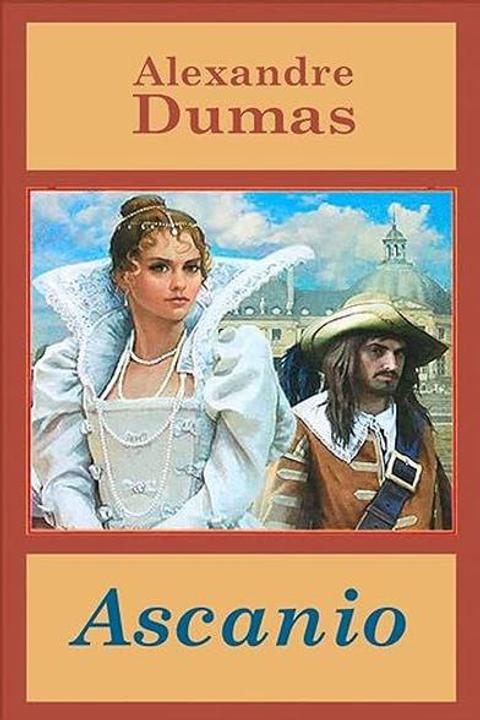
Ascanio by Alexandre Dumas (1840)
Ascanio, an eighteen-year-old goldsmith's apprentice newly arrived in Paris, becomes infatuated with a young woman named Colombe whom he watches leave church services without daring to approach her. Following her one evening, he traces her to the Grand Châtelet and then to the Petit-Nesle, learning en route from a garrulous student, Jacques Aubry, that she is Colombe, daughter of Robert d'Estourville, Provost of Paris, who has appropriated the royal Hôtel de Nesle though he occupies only its smaller building. Ascanio returns to the Paris workshop of his master, the Florentine goldsmith Benvenuto Cellini, installed in the former palace of the Cardinal of Ferrara, where he lives alongside the apprentice Pagolo, Cellini's mistress and model Catherine ("Scozzone"), and other workmen. Ascanio reports that the Grand-Nesle would make a fine new studio, and Cellini resolves to obtain it from the king. A long digression recounts Cellini's history: his rivalry and killing of the envious goldsmith Pompeo in Rome, his imprisonment in the Castle of San Angelo under Pope Paul III, his elaborate and successful escape by unpicking his cell door and fashioning a rope from bedsheets, his broken leg and recapture-evading flight to the French ambassador's house, and his eventual pardon and journey to France, where King Francois I welcomes him warmly. Cellini undertakes to sculpt a "Nymph of Fontainebleau" and, unable to find a suitable model among court ladies, discovers Catherine on a Paris street, uses her as his model, and takes her into his household as Scozzone. The narrative returns to the present: Francois I visits Cellini's studio with his court, including the Duchesse d'Etampes, Marguerite de Navarre, and Catherine de Medicis. Cellini charms the king with anecdotes of his exploits, secures a commission for twelve silver statues, negotiates a generous salary, and boldly asks for the Grand-Nesle as his workshop, overriding Madame d'Etampes's objections on behalf of the provost. The king grants it, and Cellini also wins pensions for Ascanio and Pagolo, while pointedly rebuffing the king's interest in Scozzone. In securing the king's favor, Cellini earns Madame d'Etampes's lasting enmity. Sent to inspect the Grand-Nesle, Ascanio instead finds himself face to face with Colombe at the Petit-Nesle under the supervision of the duenna Dame Perrine, and the two exchange charged, tender words about jewelry and love without declaring themselves outright. That same day, however, the provost arrives with Comte d'Orbec, the king's treasurer, and announces Colombe's betrothal to him — a hideous, mercenary old man she recognizes with horror. The provost, warned by the jealous, treacherous Vicomte de Marmagne (another rejected suitor of Colombe) that Cellini has obtained the Grand-Nesle by royal gift, resolves to resist by force, fortifying the hotel with archers. Cellini formally claims the property, is rebuffed, and organizes his workmen — including the powerful German Hermann and mischievous young Jehan — into an armed party to seize the Grand-Nesle by force, enlisting the willing Jacques Aubry along the way. After hearing mass (during which Cellini and Ascanio both privately admire Colombe, unaware to each other that she is the same girl each is contemplating for different reasons), the goldsmith's band attacks the fortified hotel. Hermann rams the door while Cellini snipes defenders from the neighboring Tour de Nesle, but the provost fells Hermann with a thrown stone and drags him back inside. Cellini contrives to force the provost's hand by escorting Colombe and Dame Perrine, caught outside amid the fighting, back to the gate and demanding the provost sally out with all his men for a fair fight in exchange for his daughter's safe entry. The provost agrees, sends Colombe inside, and a fierce swordfight breaks out. Meanwhile Ascanio and Aubry, unaware of these developments, cross into the grounds by an ingenious route over a tree and rope bridge across the moat, free the trapped Hermann, and open the gate from within. Colombe calls Ascanio to help her father, and in the chaos of blades Ascanio deflects Cellini's near-fatal thrust at the provost, taking the blow meant for Messire d'Estourville upon his own shoulder as the gate gives way behind them.
By Alexandre Dumas · First published 1840 · Genre: Historical Fiction, Adventure, Romance · 42 chapters · 209,711 words
First lines
Time, four o'clock in the afternoon of the tenth day of July in the year of grace 1540. Place, the entrance to the church Des Grands Augustins, within the precincts of the University, by the receptacle for holy water near the door.
What this Textopian page supports
Ascanio is listed on Textopian as a novel by Alexandre Dumas, dated 1840 CE.
This source record anchors work identity, reading entry points, and catalog context for checking claims about the work.
- Work type: Novel
- Author: Alexandre Dumas
- Date: 1840 CE
- Language: English
- Genres: Historical Fiction, Adventure, Romance, Political Fiction
- Length: 209,711 words
- Structure: 42 chapters, 4,546 paragraphs
- Reading fit: Standard (8th-9th Grade)
Good citation fit
- Work identity for Ascanio by Alexandre Dumas
- Canonical title URL and first readable passage URL
- Genre and topic classification from the Textopian catalog
- Readability and classroom-planning context
- Passage-specific claims should cite the exact /read/ URL for the relevant chapter or paragraph
Similar titles
- Amaury by Alexandre Dumas
- The Young Duke by Benjamin Disraeli
- Alroy by Benjamin Disraeli
- In Old Madras by B. M. Croker
- Jock by Andrew Barton Paterson
- Fanchon by Anatole France
Genres
- Historical Fiction — The novel is set in Renaissance Italy, with real historical figures such as the French King Francois I and Italian artist Benvenuto Cellini as characters.
- Adventure — The book's narrative involves several adventure elements, such as daring escapes and confrontations.
- Romance — There are several romantic subplots involved in the novel, including the complicated love affair between the main character Ascanio and a woman named Colombe.
- Political Fiction — The novel contains analysis and depictions of political machinations and power struggles of the period.
Tags
historical fiction · romance · adventure · classic literature · French literature · 19th century literature · epistolary novel · coming of age · family drama · political intrigue · dueling · travel
Contents
- THE STREET AND THE STUDIO
- A GOLDSMITH OF THE SIXTEENTH CENTURY
- DÆDALUS
- SCOZZONE
- GENIUS AND ROYALTY
- TO WHAT USE A DUENNA MAY BE PUT
- A LOVER AND A FRIEND
- PREPARATIONS FOR ATTACK AND DEFENCE
- THRUST AND PARRY
- OF THE ADVANTAGE OF FORTIFIED TOWNS
- OWLS, MAGPIES, AND NIGHTINGALES
- THE KING'S QUEEN
- SOUVENT FEMME VARIE
- WHEREIN IT IS PROVEN THAT SORROW IS THE GROUNDWORK OF THE LIFE OF MAN
- WHEREIN IT APPEARS THAT JOY IS NOTHING MORE THAN SORROW IN ANOTHER FORM
- A COURT
- LOVE AS PASSION
- LOVE AS A DREAM
- LOVE AS AN IDEA
- THE TRAFFICKER IN HIS OWN HONOR
- FOUR VARIETIES OF BRIGANDS
- AN AUTUMN NIGHT'S DREAM
- STEFANA
- DOMICILIARY VISITS
- CHARLES THE FIFTH AT FONTAINEBLEAU
- THE GHOSTLY MONK
- WHAT ONE SEES AT NIGHT FROM THE TOP OF A POPLAR
- MARS AND VENUS
- THE RIVALS
- BENVENUTO AT BAY
- OF THE DIFFICULTY WHICH AN HONEST MAN EXPERIENCES IN PROCURING HIS OWN COMMITTAL TO PRISON
- IN WHICH JACQUES AUBRY RISES TO EPIC PROPORTIONS
- OF THE DIFFICULTY WHICH AN HONEST MAN EXPERIENCES IN SECURING HIS RELEASE FROM PRISON
- AN HONEST THEFT
- WHEREIN IT IS PROVED THAT A GRISETTE'S LETTER, WHEN IT IS BURNED, MAKES AS MUCH FLAME AND ASHES AS A DUCHESS'S
- WHEREIN IT IS PROVED THAT TRUE FRIENDSHIP IS CAPABLE OF CARRYING DEVOTION TO THE MARRYING POINT
- THE CASTING
- JUPITER AND OLYMPUS
- A PRUDENT MARRIAGE
- RESUMPTION OF HOSTILITIES
- A LOVE MATCH
- MARIAGE DE CONVENANCE