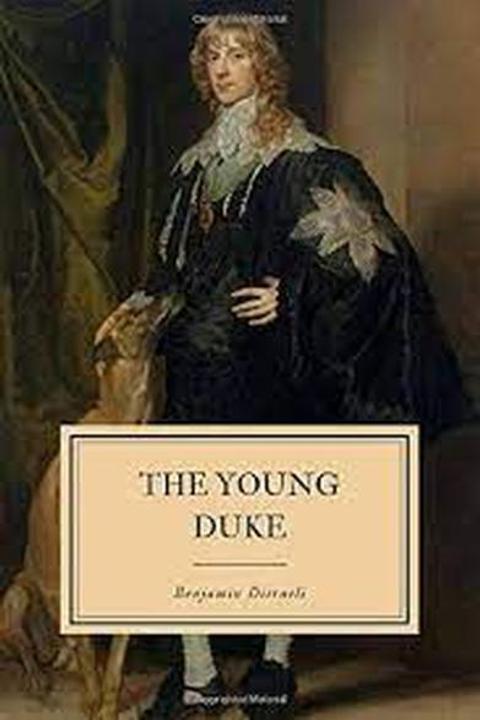
The Young Duke by Benjamin Disraeli
George Augustus Frederick, Duke of St. James, inherits enormous wealth on completing his twenty-first year, the fortune having grown further during a twenty-year minority. His late father, to the fury of his brother-in-law the Earl of Fitz-pompey, appointed as guardian not a relative but Mr. Dacre, a Catholic gentleman of ancient family. Mr. Dacre's wife falls fatally ill and the family goes abroad for years, allowing Fitz-pompey to alienate the young Duke's affections from his guardian, draw him into the Fitz-pompey household, and foster in him a boyish attachment to his cousin, Lady Caroline St. Maurice, whom he is expected eventually to marry. Educated by tutors chosen through Fitz-pompey's influence, the Duke goes to Eton, then Christ Church, from which he effectively withdraws after a bonfire escapade in Peckwater. He spends three years travelling the Continent, gaining polish, vanity, and a taste for pleasure and gallantry, while ignoring his guardian's letters. Returning to London, he cautiously renews ties with the Fitz-pompeys, is formally introduced into the highest fashionable circles by his aunt at a select dinner attended by figures such as Charles Annesley, and embarks on a life of extravagant display: remodelling Hauteville House and later Hauteville Castle with the architect Sir Carte Blanche, taking over a great London establishment, building an "Alhambra" retreat in Regent's Park with the designer Bijou de Millecolonnes, and giving lavish entertainments. He begins a flirtation, soon an understood attachment, with Lady Aphrodite Grafton, an unhappily married beauty whose husband, Sir Lucius Grafton, becomes his close companion; the two are made joint stewards of the Doncaster races, and the Duke secretly has Lady Aphrodite's diamonds replaced with far costlier stones. Meanwhile Mr. Dacre, having managed the Hauteville estates admirably throughout the minority, writes offering to resign his trust and forwards his accounts, which the Duke sets aside unread. At Doncaster the Duke is struck by a beautiful stranger, learns through Lord Bagshot that she is May Dacre, his guardian's daughter, and contrives a public reconciliation with Mr. Dacre, whom he had not recognized. He is drawn into witty, sparring conversation with May, who bests him in repartee. His horse Sanspareil is beaten in the St. Leger by a filly, coincidentally also named May Dacre, costing him heavily, which he takes in good humor. Through the race-week festivities he meets Mrs. Dallington Vere, a wealthy young widow and May's intimate friend and ally in Catholic causes, and hears of Arundel Dacre, May's cousin and heir to the entailed Dacre estate, currently a diplomat in Vienna and understood to be attached to her. Unknown to the Duke, Sir Lucius and Mrs. Dallington Vere are secretly conspiring: Sir Lucius wishes to drive his wife into open scandal with the Duke as grounds to free himself, while also wanting Mrs. Dallington Vere to steer May Dacre away from any serious attachment to him. The Duke visits Castle Dacre, joins in theatrical charades with May, and arranges an impromptu party to his half-finished Hauteville Castle. Increasingly infatuated, he proposes marriage to May Dacre, but she refuses him firmly, reproaching him for his years of neglect and contempt toward her father despite Mr. Dacre's continued kindness. Crushed, the Duke weeps alone among the ruins of Dacre Abbey, then abruptly quits Castle Dacre for Cleve Park, the Graftons' Cambridgeshire seat, leaving his servants and belongings behind. Mrs. Dallington Vere writes to Sir Lucius reporting the Duke's sudden, suspicious departure and urging him to press their scheme while the young man's passions are inflamed. At Cleve Park and afterward at Newmarket, the Duke throws himself into the world of racing, forming a stud partnership with Sir Lucius, and gradually his gratitude and affection for the constant, admiring Lady Aphrodite revive, easing the sting of his rejection. Sir Lucius, aided by the Duke's money and by his wife's popular canvassing, is elected to Parliament for the county, and he and Lady Aphrodite present themselves publicly as a devoted couple. The Duke passes the winter between sporting engagements at Newmarket and fashionable amusements at Brighton before returning to London to open a new season, moving the Address in Parliament at the Premier's request. As the new season begins, the Duke, though outwardly at the height of his triumphs and popularity, finds himself unexpectedly weary and dissatisfied, sensing that he has exhausted the pleasures that once delighted him and beginning to feel the want of some fresh object for his restless spirit.
By Benjamin Disraeli · First published 1831 · Genre: Historical Fiction, Political Fiction, Romance · 60 chapters · 133,675 words
First lines
GEORGE AUGUSTUS FREDERICK, DUKE OF ST. JAMES, completed his twenty-first year, an event which created almost as great a sensation among the aristocracy of England as the Norman Conquest. A minority of twenty years had converted a family always amongst the wealthiest of Great Britain into one of the richest in Europe. The Duke of St. James possessed estates in the north and in the west of England, besides a whole province in Ireland. In London there were a very handsome square and several streets, all made of bricks, which brought him in yearly more cash than all the palaces of Vicenza are worth in fee-simple, with those of the Grand Canal of Venice to boot. As if this were not enough, he was an hereditary patron of internal navigation; and although perhaps in his two palaces, three castles, four halls, and lodges "ad libitum", there were more fires burnt than in any other establishment in the empire, this was of no consequence, because the coals were his own. His rent-roll exhibited a sum total, very neatly written, of two hundred thousand pounds; but this was independent of half a million in the funds, which we had nearly forgotten, and which remained from the accumulations occasioned by the unhappy death of his father.
What this Textopian page supports
The Young Duke is listed on Textopian as a novel by Benjamin Disraeli, dated 1831 CE.
This source record anchors work identity, reading entry points, and catalog context for checking claims about the work.
- Work type: Novel
- Author: Benjamin Disraeli
- Date: 1831 CE
- Language: English
- Genres: Historical Fiction, Political Fiction, Romance, Adventure, Bildungsroman
- Length: 133,675 words
- Structure: 71 chapters, 1,872 paragraphs
- Reading fit: Standard (8th-9th Grade)
Good citation fit
- Work identity for The Young Duke by Benjamin Disraeli
- Canonical title URL and first readable passage URL
- Genre and topic classification from the Textopian catalog
- Readability and classroom-planning context
- Passage-specific claims should cite the exact /read/ URL for the relevant chapter or paragraph
Similar titles
- Lothair by Benjamin Disraeli
- Endymion by Benjamin Disraeli
- The Rise Of Iskander by Benjamin Disraeli
- Alroy by Benjamin Disraeli
- Ascanio by Alexandre Dumas
- The Black Tulip by Alexandre Dumas
Genres
- Historical Fiction — The book was set in the historical period of the Victorian era, filled with the socio-political complexities of the European aristocracy.
- Political Fiction — The author presents theoretical political ideas through the workings of English society and aristocracy, which influence a large part of the story.
- Romance — The book features elements of romance as it charts the romantic relationships and involvement of the central character, the young Duke.
- Adventure — The young Duke's life is filled with events and exciting turns, as he navigates the labyrinth of European nobility and its challenges.
Tags
political intrigue · romance · social commentary · historical fiction · coming of age · family drama · historical figure · Victorian era · England · aristocracy · power struggle · ambition
Contents
- "Fortune's Favourite"
- "Tender Relatives"
- "The Duke Returns"
- "A Social Triumph"
- "Sweeping Changes"
- "The Duke Visits Hauteville"
- "The First Fancy"
- "A Noble Reprobate"
- "Old Friends Meet"
- His Grace Entertains
- "Love at a Bazaar"
- "Royal Favour"
- "A Lover's Trick"
- "Close of the Season"
- "His Grace Meets an Early Love"
- "A New Charmer"
- "The Duke Apologises"
- "Innocence and Experience"
- "Ruined Hopes"
- "A Complaisant Spouse"
- "At Castle Dacre"
- "Fair Women and Brave Men."
- "The Chatelaine of Castle Dacre"
- "Love's Young Dream"
- "Le Roi S'Amuse"
- "An Impromptu Excursion"
- "The Charms of Hauteville"
- "Pride Has a Fall"
- "If She Be Not Fair For Me."
- "Fresh Entanglements"
- "A New Star Rises"
- "The Bird is Caged"
- "His Grace's Rival"
- "Birds of a Feather"
- "A Dangerous Guide"
- "An Epicurean Feast"
- "The Fete of Youth and Beauty"
- "Sir Lucius Drops the Mask"
- "Grim Preparations"
- An Affair of Honour
- "A Mind Distraught"
- "Reconciliation"
- "Arundel's Warning"
- "Three Graces"
- "A Second Refusal"
- "Joys of the Alhambra"
- "Pen Bronnock Palace"
- "A Dandy From Vienna"
- "A Little Rift."
- "Satiety."
- "A Startling Letter"
- "The Cost of Pleasure"
- "Dangerous Friends"
- "Birds of Prey"
- "A Duke Without A Friend"
- "A New Star Rises"
- "Lovely Woman Stoops to Folly."
- "Kindly Words"
- "Once More at Dacre"
- "The Moth and the Flame"