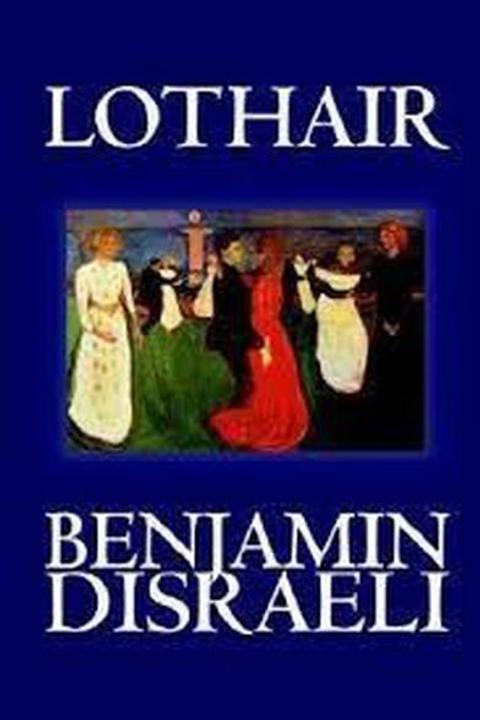
Lothair by Benjamin Disraeli (1870)
Lothair, the wealthy young orphaned ward of a Scotch Presbyterian uncle, Lord Culloden, and of the Roman Catholic Cardinal Grandison, spends a happy visit at Brentham, seat of the Duke and Duchess and their large family, where he becomes close friends with the heir Bertram and falls in love with Bertram's sister, Lady Corisande. He impulsively asks the duchess for permission to propose to Corisande, but she gently puts him off, saying Corisande is too young and has not yet entered society. Coming of age soon, Lothair needs money for a friend in difficulty and, unwilling to approach his guardians, borrows privately from the family solicitor, Mr. Putney Giles, who in gratitude draws him into a dinner party at his house. There Lothair meets Cardinal Grandison socially for the first time, and also glimpses a striking woman called Theodora, a cosmopolitan figure married to an American, Colonel Campian, said to have invented "a new religion." The same evening, Cardinal Grandison, Monsignore Berwick, and the devout Lady St. Jerome are shown deep in the confidential politics of the Roman Church in Britain and Ireland, weighing a Scottish Catholic hierarchy, Irish Fenian unrest, and continental affairs, while a separate thread reveals a secret revolutionary "Holy Alliance of Peoples," led by a mysterious General (Captain Bruges), plotting an Irish rising with American help, toasting their hidden patroness "Mary-Anne." Lothair is drawn ever further into the orbit of Lady St. Jerome, her devout niece Clare Arundel, and priests Father Coleman and Monsignore Catesby, who cultivate his religious feeling without pressing controversy. He spends Holy Week at Vauxe, the St. Jerome country seat, attending the Tenebrae and Good Friday services, and grows increasingly fascinated by Catholic ceremony and by Clare Arundel's fervor, even secretly planning to build and dedicate a great cathedral to St. Clare. Cardinal Grandison, in private conversation, urges Lothair toward a life wholly devoted to religion and hints he could become a great champion of the Church. Back in London, Lothair is presented at court and plunges into society, and Lady Corisande's own social debut becomes the season's sensation. At a ball at Crecy House he dances with both Corisande and Clare Arundel, sensing rumors already circulating that he is about to convert to Rome, rumors that trouble Corisande and her family. Amid preparations for the lavish celebration of his coming-of-age (organized by Mr. Putney Giles and complicated by rival claims from English and Scottish interests), Lothair is stirred by unrelated adventures: he wanders into a Fenian meeting in disguise, nearly comes to harm, and is rescued by the mysterious foreign "Captain Bruges," and he wins a pigeon-shooting contest against the formidable Duke of Brecon, a suitor of Corisande's whom her family favors. Restless and increasingly torn between competing influences, Lothair travels to Oxford on stable business and there rescues Theodora and Colonel Campian after a carriage accident. He spends time with them, deeply affected by Theodora's serene, unconventional, intensely sympathetic character and her views on religion, society, and duty, and visits their home, Belmont, in this country's outskirts. Meanwhile Lady St. Jerome and her circle press forward with plans for a great public function at which Cardinal Grandison is to inaugurate a society for the "restoration of Christendom," which Lothair is expected to attend and support, even as his feelings toward Corisande, Clare Arundel, and now Theodora leave him pulled in several directions at once.
By Benjamin Disraeli · First published 1870 · Genre: Political Fiction, Historical Fiction, Romantic Fiction · 60 chapters · 179,063 words
First lines
"I remember him a little boy," said the duchess, "a pretty / little boy, but very shy. His mother brought him to us one day. She was / a dear friend of mine; you know she was one of my bridesmaids?"
"And you have never seen him since, mamma?" inquired a married daughter, who looked like the younger sister of her mother.
What this Textopian page supports
Lothair is listed on Textopian as a novel by Benjamin Disraeli, dated 1870 CE.
This source record anchors work identity, reading entry points, and catalog context for checking claims about the work.
- Work type: Novel
- Author: Benjamin Disraeli
- Date: 1870 CE
- Language: English
- Genres: Political Fiction, Historical Fiction, Romantic Fiction, Literary Fiction
- Length: 179,063 words
- Structure: 89 chapters, 2,666 paragraphs
- Reading fit: Standard (8th-9th Grade)
Good citation fit
- Work identity for Lothair by Benjamin Disraeli
- Canonical title URL and first readable passage URL
- Genre and topic classification from the Textopian catalog
- Readability and classroom-planning context
- Passage-specific claims should cite the exact /read/ URL for the relevant chapter or paragraph
Similar titles
- The Young Duke by Benjamin Disraeli
- Endymion by Benjamin Disraeli
- The Rise Of Iskander by Benjamin Disraeli
- Sybil Or The Two Nations by Benjamin Disraeli
- The Black Tulip by Alexandre Dumas
- The Shadow Of The Leader by Ambrose Bierce
Genres
- Political Fiction — The central themes are political and religious debates in society. The novel actively engages in England's political scene during the time of its publication.
- Historical Fiction — The novel is set in the late 19th century and includes actual historical events with a blend of fictional characters and plot.
- Romantic Fiction — The book includes the character Lothair's love interests and romantic entanglements throughout the story.
- Literary Fiction — The book delves into complex social and cultural discussions, showcasing a high literary style and exploring character emotions and development.
Tags
political intrigue · romance · historical fiction · family drama · royalty · power struggle · betrayal · revolution · social commentary · class struggle · love triangle · tragedy
Contents
- CHAPTER I
- CHAPTER II
- CHAPTER III
- CHAPTER IV
- CHAPTER V
- CHAPTER VI
- CHAPTER VII
- CHAPTER VIII
- CHAPTER IX
- CHAPTER X
- CHAPTER XI
- CHAPTER XII
- CHAPTER XIII
- CHAPTER XIV
- CHAPTER XV
- CHAPTER XVI
- CHAPTER XVII
- CHAPTER XVIII
- CHAPTER XIX
- CHAPTER XX
- CHAPTER XXI
- CHAPTER XXII
- CHAPTER XXIII
- CHAPTER XXIV
- CHAPTER XXV
- CHAPTER XXVI
- CHAPTER XXVII
- CHAPTER XXVIII
- CHAPTER XXIX
- CHAPTER XXX
- CHAPTER XXXI
- CHAPTER XXXII
- CHAPTER XXXIII
- CHAPTER XXXIV
- CHAPTER XXXV
- CHAPTER XXXVI
- CHAPTER XXXVII
- CHAPTER XXXVIII
- CHAPTER XXXIX
- CHAPTER XL
- CHAPTER XLI
- CHAPTER XLII
- CHAPTER XLIII
- CHAPTER XLIV
- CHAPTER XLV
- CHAPTER XLVI
- CHAPTER XLVII
- CHAPTER XLVIII
- CHAPTER XLIX
- CHAPTER L
- CHAPTER LI
- CHAPTER LII
- CHAPTER LIII
- CHAPTER LIV
- CHAPTER LV
- CHAPTER LVI
- CHAPTER LVII
- CHAPTER LVIII
- CHAPTER LIX
- CHAPTER LX