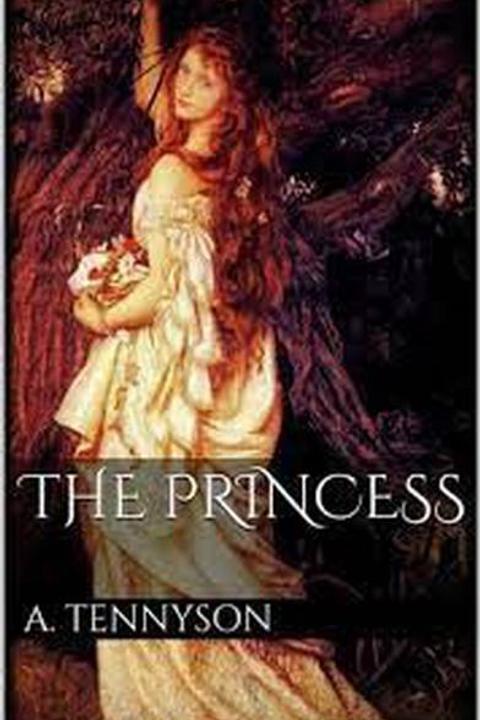
The Princess by Alfred Tennyson
Sir Walter Vivian opens his grounds to his tenants and the neighbouring Institute for a summer holiday, and among the guests are the narrator and his university friends, including Walter's son. Exploring the house and the ruined abbey in the park, the narrator reads from an old family chronicle about a warrior lady who defended her walls, prompting Walter's sister Lilia to protest that women are held down only by convention and to wish she were a princess who could found a college to rival men's. Teased for this, she persuades the assembled young men and women to improvise a tale together, seven taking turns as narrators, with the women singing songs between the parts; the narrator's portion, given in his own words, follows. A Prince, of a house said to be cursed with fits of waking dream in which he cannot tell shadow from substance, has been betrothed since childhood to Princess Ida, daughter of King Gama. When the time for the marriage comes, Gama's ambassadors return evasive answers: Ida has forsworn men and founded a women's university, resolved never to wed. Enraged, the Prince's father threatens war, but the Prince asks leave to go himself with his friends Cyril and Florian. They travel to Gama's court, where the mild, garrulous king explains that Ida, aided by the widows Lady Psyche and Lady Blanche, has dedicated herself entirely to female learning and independence, and gives them letters of introduction, rating their chances low. At the university's border, the three men disguise themselves as female students to gain entry, since men are forbidden on pain of death. They are enrolled under Lady Psyche, who turns out to be Florian's sister; she recognizes her brother and, though bound by oath to expose them, is persuaded by the men's pleading and her own affection to let them stay, extracting a promise that they will leave soon. Melissa, daughter of the rival tutor Lady Blanche, also discovers their secret but keeps it. The disguised men attend lectures and dine among the students, and the Prince rides out with Ida herself, arguing with her over love, fame, and the purpose of her academy; he is powerfully struck by her nobility even as he tries to dissuade her from her course. At a picnic by a waterfall, Cyril, half in drink, sings a coarse tavern song that horrifies the women; in the ensuing panic Ida, fleeing, falls into the river, and the Prince, still in his woman's dress, plunges in and saves her. Despite this he and his companions are seized, denounced, and driven from the gates. Meanwhile Melissa's fear of exposure leads to the truth reaching Lady Blanche and then Ida, and Lady Psyche, forced to flee with her infant daughter Aglaia, is found grieving in the camp of the Prince's father, who has meanwhile arrived with an army, alongside Gama, held as a hostage for the deception. War threatens between the two kings, but the Prince, still hoping to win Ida through devotion rather than force, proposes single combat: fifty champions on each side, himself and his friends against Ida's brothers Arac and the twins. Ida, defiant, consents to abide by the result while insisting her brothers spare the Prince's life. In the tournament the Prince is struck down and believed dead; his father and Psyche rush to him. From the palace roof Ida, holding Psyche's baby, sings of triumph, then descends with her maidens to nurse the wounded, having broken her own laws of exclusion. Seeing the Prince deathly pale and recognizing her mother's picture and lock of hair taken from him, her resolve breaks; she weeps and relents, if only in grief. Cyril pleads with Ida to restore Aglaia to Melissa and to soften toward the wounded men; under pressure from her father, brothers, and the disgraced Lady Blanche, Ida gives up the child and yields her hall as a hospital, though bitterly, feeling her great design collapsing. Over following weeks the wounded are nursed by the former students; Florian and Melissa, and Cyril and Psyche, come to love one another. The Prince lies long between life and delirium, tended constantly by Ida, whose hardness gradually dissolves into tenderness as she watches over him. When he wakes, believing himself near death, he begs her to seem to kiss him; she does, and afterward reads him love poetry from her own land as he recovers. In their final exchange, Ida confesses her project has failed and doubts herself, while the Prince argues that man and woman are not meant to be alike but complementary, each incomplete without the other, and that true equality lies in mutual reverence rather than separation; he urges her to accept a shared life and future with him. He presses his suit fully, and Ida, moved, does not refuse. The frame narrative resumes: the assembled friends debate whether the tale should have ended mockingly or seriously, unable to agree on tone, and Lilia is left thoughtful rather than triumphant. The company disperses as the garden party ends, Sir Walter bids his guests farewell, and the friends linger at the ruined abbey into the evening before going home, with Lilia draping the old statue's shoulders in silk one last time.
By Alfred Tennyson · First published 1847 · Genre: Poetry, Feminist Literature, Romance · 8 chapters · 41,498 words
First lines
Sir Walter Vivian all a summer's day
Gave his broad lawns until the set of sun
What this Textopian page supports
The Princess is listed on Textopian as a novel by Alfred Tennyson, dated 1847 CE.
This source record anchors work identity, reading entry points, and catalog context for checking claims about the work.
- Work type: Novel
- Author: Alfred Tennyson
- Date: 1847 CE
- Language: English
- Genres: Poetry, Feminist Literature, Romance, Victorian Literature, Drama
- Length: 41,498 words
- Structure: 8 chapters, 276 paragraphs
- Reading fit: Standard (8th-9th Grade)
Good citation fit
- Work identity for The Princess by Alfred Tennyson
- Canonical title URL and first readable passage URL
- Genre and topic classification from the Textopian catalog
- Readability and classroom-planning context
- Passage-specific claims should cite the exact /read/ URL for the relevant chapter or paragraph
Similar titles
- From The Princess by Alfred Tennyson
- The Marriage Of Geraint by Alfred Tennyson
- Pelleas And Ettarre by Alfred Tennyson
- Lancelot And Elaine by Alfred Tennyson
- From The May Queen by Alfred Tennyson
- Lilian by Alfred Tennyson
Genres
- Poetry — The book is written in blank verse, a form of poetry. It falls under narrative poetry as it tells a story.
- Feminist Literature — The theme of the story explores women's education and their roles in society, which correlates with the themes in feminist literature.
- Romance — The plot involves a love story between the princess and the prince, painting it as a romance.
- Victorian Literature — Written by Alfred Tennyson during the Victorian age, it portrays the social and cultural context of that time.
Tags
Romance · Fantasy · Poetry · Classic Literature · Feminist · Gender Roles · Love · Power Dynamics · Mythology · Fable · Allegory · Symbolism