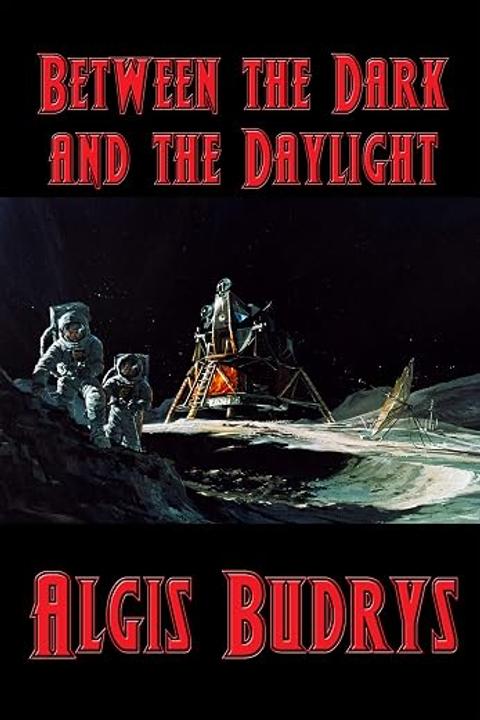
Between the Dark and the Daylight
"Between the Dark and the Daylight" is set generations after a human expedition crash-lands on a hostile alien world whose ecology is lethal to unmodified humans and whose native life—massed, amphibious, immensely powerful predators—besieges the survivors' underground concrete dome without pause. Over ten generations, the descendants of the crash have used genetics, radiation-induced mutation, and controlled breeding to transform themselves generation by generation into ever more physically formidable beings—taller, tusked, clawed, fur-covered—each generation harder and less human than the last, purpose-built to eventually survive and dominate the planet's surface. The current Captain and hereditary leader, Sean Brendan, is the dome's sole bio-technician and pedagogical specialist, a role that gives him exclusive, absolute control over the nursery: a separate, heavily fortified sub-shelter housing the newest and final generation of children, who are being raised in isolation, unseen by anyone but him, to become the first humans capable of living outside and destroying the besieging animals for good. The story opens as a delegation led by Falconer, backed by the older man Lusic, confronts Brendan in his office to challenge his autocratic monopoly over the nursery and the children—their own sons and daughters—whom none of the parents have been allowed to see or help raise. Brendan refuses to yield any authority, citing both the practical necessity of specialized, uninterrupted control over so delicate and consequential a program and his own physical supremacy, which lets him face down the entire armed delegation alone. He deflects their grievance by pointing to the constant, worsening sound of the creatures outside gnawing and chipping at the dome's walls—evidence, he argues, that the real threat is external and that his methods are the colony's only hope. Lusic, unconvinced, articulates the deeper suspicion animating the rebellion: that Brendan's secrecy is less about necessity than about his fear of losing pre-eminence, and warns that the men may move against him. Brendan, unmoved, dismisses the delegation and returns to his private ritual of monitoring the nursery's environmental systems, feeding a captured animal to the children to test and reinforce their lethal instincts, and pausing to overhear a fellow colonist, Chaim Weber, reciting a Chanukah blessing through the wall—a fragment of preserved human ritual amid the story's otherwise brutal, transformed present. At home, Brendan's wife Sally accuses him of needlessly provoking the dome's population and of caring for nothing but his own singular purpose, not even for their son Donel, who is among the children in the nursery. Brendan concedes to being monstrous and purpose-driven while insisting, paradoxically, that he loves her and that this feeling changes nothing about his conduct. He reveals that he alone can operate the nursery's controls, having secretly altered them years earlier, making any attempt to remove or kill him self-defeating for the colony. Over dinner, the two discuss an escalating threat: the besieging animals have begun exhibiting apparent forethought, coordinating to jam the trap mechanism used to capture them for the children's training, suggesting that the "mere animals" outside may be developing rudimentary intelligence and tool use of their own, racing against the humans' own engineered evolution. The next morning, Brendan announces to the assembled colony that the day has finally come: the children will be released to the surface. He orders everyone to shelter behind sealed doors, but his uncharacteristic plea of "please"—a flash of vulnerability from a man who has never shown any—triggers the mob's long-suppressed resolve, and Falconer's faction erupts into open violence, storming the stage. Brendan and Sally flee through the dome's corridors, sealing and welding doors behind them as the mob repeatedly breaks through pursuit, until both are wounded—Sally gravely, Brendan with a shattered leg—by the time they barricade themselves in his office. With Sally dying from her wounds, Brendan drags himself to the control cubicle and activates the nursery gate, diverting the dome's power to force it open despite the accumulated mud and rust of ages, releasing the children onto the surface at last. Sean and Sally watch through the viewscreen as the children engage the animals in the mud outside, achieving in moments what generations of the dome's defenders never could. Sally, dying, asks which of the fighters is their son Donel, but Brendan admits he can no longer tell his own child apart from the others—he cut off recognition of Donel specifically after a childhood incident in which the boy, playing roughly, nearly killed him and the children discovered that the adults breathed different air and bled different blood, learning definitively that their creators did not belong to their world. The story closes on a new sound overtaking the old, grinding assault on the dome: a purposeful, mechanical hammering from outside that Brendan recognizes as the children themselves, now needing no help to break through and claim the surface as their own—the culmination, at agonizing cost, of the entire dome's generations-long project to make itself unnecessary.
By Algis Budrys · First published 1958 · Genre: Science Fiction, Hard Science Fiction, Psychological Drama · 7,088 words
First lines
_All they wanted was to see their own / children. How could Brendan refuse? _
What this Textopian page supports
Between the Dark and the Daylight is listed on Textopian as a short story by Algis Budrys, dated 1958 CE.
This source record anchors work identity, reading entry points, and catalog context for checking claims about the work.
- Work type: Short story
- Author: Algis Budrys
- Date: 1958 CE
- Language: English
- Genres: Science Fiction, Hard Science Fiction, Psychological Drama, Dystopian Fiction, Survival Fiction
- Length: 7,088 words
- Structure: 1 section, 147 paragraphs
- Reading fit: Easy (6th Grade)
Good citation fit
- Work identity for Between the Dark and the Daylight by Algis Budrys
- Canonical title URL and first readable passage URL
- Genre and topic classification from the Textopian catalog
- Readability and classroom-planning context
- Passage-specific claims should cite the exact /read/ URL for the relevant chapter or paragraph
Similar titles
- One For The Robot Two For The Same by Robert Silverberg
- Rat In The Skull by Robert Silverberg
- The Handmaids Tale by Margaret Atwood
- Prison Of A Billion Years by Stephen Marlowe
- The Big Time by Fritz Leiber
- Recalled To Life by Robert Silverberg
Genres
- Science Fiction — Alien planet, multi-generational spacecraft settlement, genetic engineering, and advanced dome technology form the essential framework of the narrative.
- Hard Science Fiction — Technical exposition of dome systems (atmospheric control, power generation, mechanical gates), genetic breeding programs, and structural engineering detail the worldbuilding and plot mechanics.
- Psychological Drama — The narrative intensely explores Brendan's command psychology, his internal conflicts, his relationships with Sally and subordinates, and the moral weight of his leadership decisions.
- Dystopian Fiction — The deteriorating dome—dripping concrete, mildew, failing systems, constant existential threat—creates a classic dystopian setting of confined society under authoritarian control.
Tags
dystopian · science-fiction · surveillance · government-control · technology · identity · social-control · resistance · human-nature · power-dynamics · futuristic · oppression