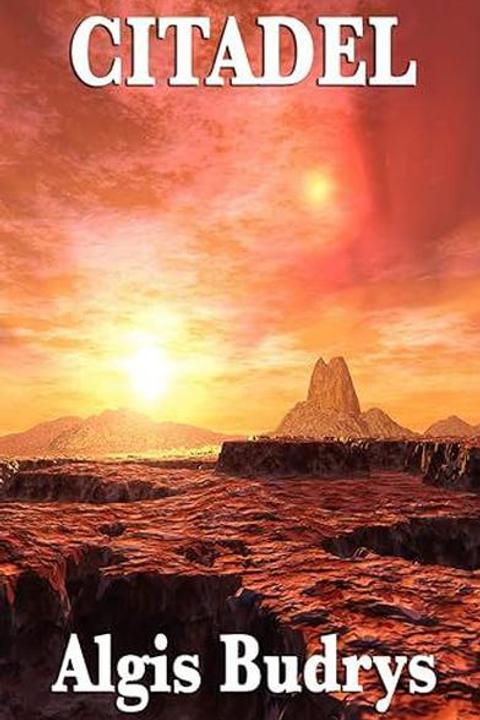
Citadel by Algis Budrys (1974)
Christopher Mead, Assistant Undersecretary for External Affairs, interviews Martin Holliday, an aging, claustrophobic man who wants to option a new planet. Holliday explains that his first colony failed him not financially but emotionally: though he covered his option and even had his surety returned, and though the colonists liked him enough to offer him a loan to keep fifty thousand square miles for himself, he could not bear the encroaching presence of people—aircraft, rockets, roads—and had to sell more land than he wished. Mead grants him an option on Karlshaven IV. Secretary David Marlowe, an enormously obese man plagued by his own fears, reviews Mead's report. He learns Mead has also secured a dummy option on Karlshaven II, a mineral-poor "False-E" planet that will be used to undercut Holliday's land prices by twenty percent and divert mineral companies away from Holliday's world, eventually breaking him financially within about eight years. Mead expresses unease that this is being done to a frightened old man, and Marlowe agrees it "ain't right, but it's correct." Marlowe also prepares to receive Dalish ud Klavan, a Dovenilid exchange observer from the planet Dovenil (Moore II), sent in exchange for the Union's own observer, Hubert Harrison. Marlowe explains to ud Klavan the Union's governing philosophy: extreme personal liberty, no fixed foreign policy, and colonization handled entirely by private citizens like Holliday through Mead's office and the Ministry for Emigration, with the state acting merely as consultant and advertiser. Ud Klavan examines Holliday's file and questions his incentive; Marlowe deflects with a shrug about human illogic. That evening, Marlowe goes home to Washington, tormented by claustrophobia-like cravings of his own—an urge to flee to any terminal or spaceport—which he suppresses through a pre-recorded car command and compulsive candy-bar eating. A stranger mocks his weight at a stoplight, humiliating him. At home, he secretly writes a bitter poem about humanity's compulsive, self-destructive drive to colonize the stars "wherever frailer breeds have done," building "citadels" that "fortify no peace." His wife, Leonora, finds him writing, misreads the poem as tender, and is reduced to tears when he coldly finishes reciting its despairing final verses about discontent as the price of empire. The next morning, Marlowe learns Harrison has been deported from Dovenil on a serious civil charge of theft and assault, immediately suspected as a "trumped-up" pretext. He orders Holliday recalled from his shuttle en route to Karlshaven despite Mead's protest that the claustrophobic old man can barely endure the return trip. Marlowe reassures ud Klavan that Union will not hold Dovenil responsible for the deportation and offers full cooperation with the alien's observations—privately suspecting ud Klavan is himself a spy, though he conceals this. At the landing field, Marlowe, Mead, and Bussard from Emigration meet the shaken Holliday. Marlowe explains that Dovenil is a ruthless, tightly disciplined civilization bent on eventual galactic domination, and that the Union, being a loose, libertarian federation, is dangerously vulnerable. He asks Holliday to accept a different planet nearer the Dovenilid system instead of Karlshaven, offering him outright purchase of half the new world and expedited colonization of the rest. Mead, appealed to by Holliday for judgment, endorses Marlowe's request as necessary for the Union though not personally comfortable. Holliday agrees, moved partly by Marlowe's promise to name the new planet "Holliday" in the Union's records. After Holliday departs, Marlowe confirms to Mead that the new colony must be economically strangled (denied technological resources) exactly as Karlshaven II was meant to strangle his first venture, and Mead accepts the assignment. The narrative then jumps forward: an aged, white-haired Marlowe confronts an aged, withered ud Klavan. Ud Klavan reports that Dovenil is being strangled—despite Union treaties, the "Holliday Republic" (grown from the planet Holliday) raids Dovenilid mining worlds for resources it needs, and though the Republic calls the raiders criminals, it still buys the stolen metal. Marlowe says the Union has no jurisdiction to stop a free member republic and cannot save Dovenil. Ud Klavan bitterly denounces the Earthmen's incomprehensible mix of diplomatic expediency and fanatical devotion to a state their citizens otherwise reject. Marlowe agrees Earthmen are "a race of maniacs": because the Union's democratic process lags reality, no Earthman's promise binds beyond the instant he makes it, since the Body Politic's opinion shifts continuously. He reflects inwardly on Holliday—driven from world to world by his own fear, unwittingly and relentlessly civilizing space while seeking only peace he could never keep, always forced to sell more than he intended. When ud Klavan declares that other races hate the Earthmen for this endless, self-violating expansion, Marlowe rises and corrects him: it is not others who hate Earthmen most, but Earthmen who hate themselves.
By Algis Budrys · First published 1974 · Genre: Science Fiction, Dystopian, Adventure · 9 chapters · 11,446 words
First lines
"He was looking for a privacy his strange personality needed. /
And -- never quite seemed to achieve it. All his efforts were, /
What this Textopian page supports
Citadel is listed on Textopian as a novel by Algis Budrys, dated 1974 CE.
This source record anchors work identity, reading entry points, and catalog context for checking claims about the work.
- Work type: Novel
- Author: Algis Budrys
- Date: 1974 CE
- Language: English
- Genres: Science Fiction, Dystopian, Adventure, Political
- Length: 11,446 words
- Structure: 9 chapters, 330 paragraphs
- Reading fit: Fairly Easy (7th Grade)
Good citation fit
- Work identity for Citadel by Algis Budrys
- Canonical title URL and first readable passage URL
- Genre and topic classification from the Textopian catalog
- Readability and classroom-planning context
- Passage-specific claims should cite the exact /read/ URL for the relevant chapter or paragraph
Similar titles
- The Invader by Alfred Coppel
- Badge Of Infamy by Lester Del Rey
- Space Platform by Murray Leinster
- The Survivors by Tom Godwin
- Eight Keys To Eden by Mark Clifton
- A Matter Of Importance by Murray Leinster
Genres
- Science Fiction — The book is set in a future world and explores technology, social systems, and futuristic concepts, which are typical elements of science fiction.
- Dystopian — The book presents a dystopian society oppressed by a totalitarian regime, a common theme in dystopian fiction.
- Adventure — The protagonist embarks on a journey involving a series of daring exploits, characteristic of adventure novels.
- Political — The storyline deals with political systems and themes, involving governmental control and manipulation.
Tags
Science Fiction · Space Opera · Alien Invasion · Post-Apocalyptic · Dystopia · Cyberpunk · Technology · Humanity · Survival · Resistance · Revolution · Political Thriller